GUIDES · WEIGHT
Rider weight or bike weight: which matters more.
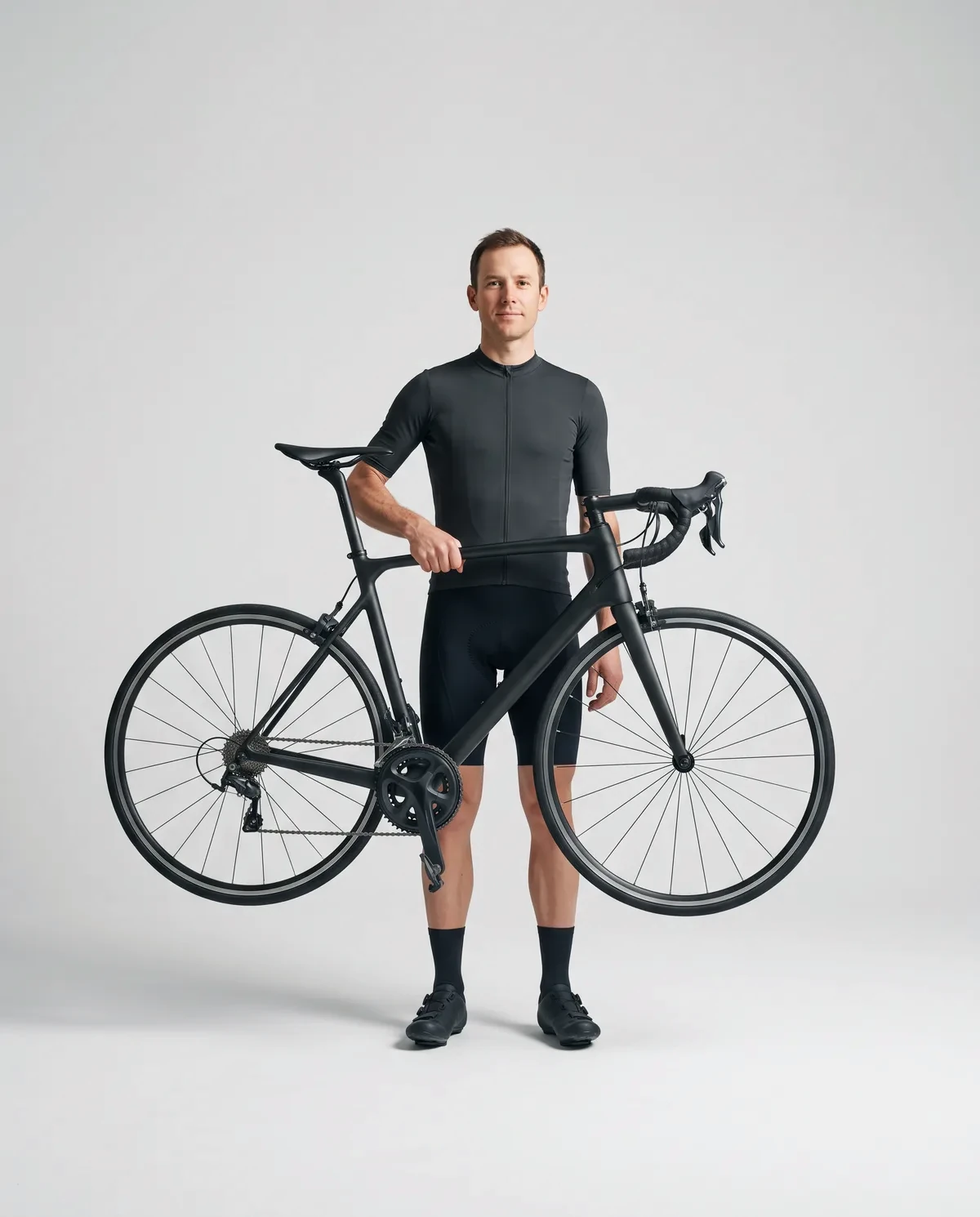
As far as physics is concerned, a kilo on the rider costs the same watts and the same seconds as a kilo on the bike. On the example road ride it’s worth about 35 seconds, nearly all of them on the uphill stretches, even the gentle ones. The real difference is that the rider makes up almost 90% of the total weight, and taking a kilo off the bike costs a lot of money. There’s no diet or weight-loss advice here, only the physics and the seconds.
−0'35"
What 1 kg (2.2 lb) less is worth, whether it comes off the rider or the bike, on the example road ride: 80 km (50 mi) with 900 m (2,950 ft) of climbing at 28 km/h (17 mph).
88%
The rider’s share of the total weight on the example ride: 74 kg out of 84.1 (163 out of 185 lb), counting the bike, helmet, shoes and clothing.
2.7 W
The extra watts 1 kg more costs you on a 6% climb at 15 km/h (9 mph). On the flat at 35 km/h (22 mph), it’s 0.5 W.
4%
How much the total weight dropped in a real-world trial with a bike that was 30% lighter. The time didn’t change in any measurable way.
A kilo is a kilo
On a bike you’re working against gravity on climbs, the rolling resistance of the tires, and the air. The formulas for gravity and rolling resistance use the combined weight of rider and bike as a single number1. Rider and bike go up the hill together, so it makes no difference where the kilo is.
Air resistance is a different story. It depends on CdA and speed, not on weight1. So 1 kg on your body or on the frame costs the same watts, except for the air part, which we’ll get to below. The calculator works the same way. It adds your weight, the bike’s weight and 1.5 kg (3.3 lb) for helmet, shoes and clothing.
Rotating weight. The other exception is a small one. Weight at the rim counts a little more when your speed changes, because the wheel also has to be spun up. The wheels guide covers it. The calculator only counts it if you add your own rim part or tire and upload a ride with timestamps, because it needs to know where you accelerate.
Where weight counts
On the flat, most of your power goes into the air, about 70% at 25 km/h (16 mph) and over 80% at 35 (22 mph). On climbs, almost all of it goes into lifting you and the bike. The steeper the road, the slower you go, so the air matters less and weight matters more1. We have a guide on how many watts it takes to climb.
HOW MANY WATTS 1 KG MORE COSTS
| WHERE | WATTS | +1 KG | SHARE |
|---|---|---|---|
| Flat at 25 km/h (16 mph) | 111 W | 0.38 W | 29% |
| Flat at 35 km/h (22 mph) | 260 W | 0.54 W | 17% |
| 3% climb at 22 km/h (14 mph) | 237 W | 2.2 W | 77% |
| 6% climb at 15 km/h (9 mph) | 247 W | 2.7 W | 93% |
| 9% climb at 11 km/h (7 mph) | 253 W | 2.9 W | 97% |
On a climb, 1 kg more costs about 1% of your power, the same share as 1 kg out of 85. On the flat at 35 km/h, it’s 0.2%. TOUR, a German magazine, calculates that over 10 km (6.2 mi) at 7% and 250 W, 1 kg less saves about 25 seconds, the same as 2.5 W more. On the flat, it says, the effect is barely measurable2. Our model gives 28 seconds on the same climb.
For what real road bikes weigh, from €1,000 bikes to pro bikes, there’s a guide on how much a road bike weighs.
Rider vs bike
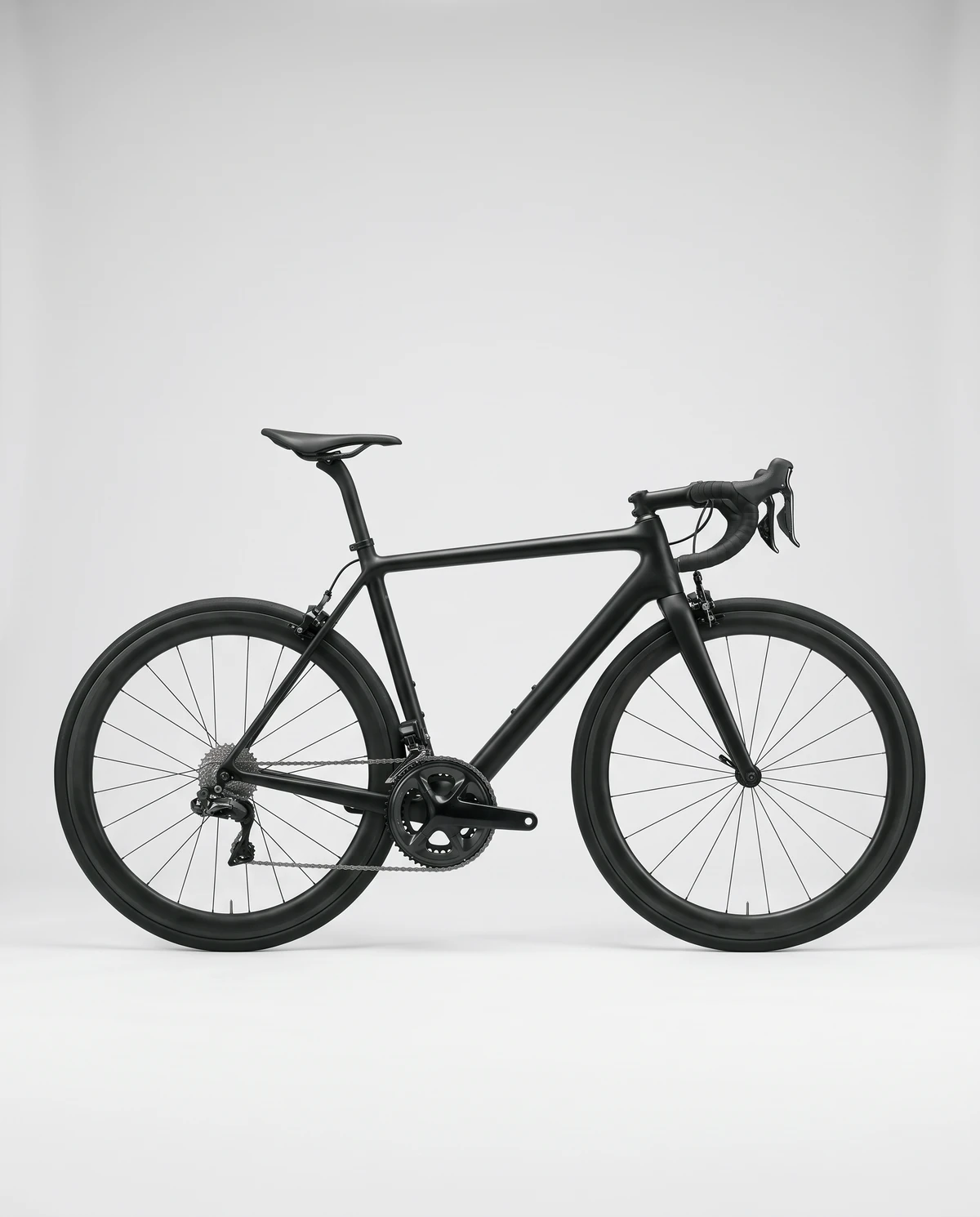
On the example ride the rider weighs 74 kg (163 lb), the bike 8.6 kg (19 lb), and helmet, shoes and clothing 1.5 kg (3.3 lb). The rider makes up 88% of the total and the bike 10%. A kilo is 1.4% of the rider but 12% of the bike, which is a lot.
There’s also a real-world trial from 2010. Jeremy Groves, an anesthesiologist at a hospital in England, timed his commute 56 times, 43.5 km (27 mi) round trip. Each day he picked at random between a 13.5 kg (30 lb) steel bike and a 9.5 kg (21 lb) carbon one. The carbon bike was 30% lighter, but with him on board at 76 kg (168 lb), the total weight dropped by only 4%. The average time differed by about half a minute over 1 h 48', in favor of the steel bike, but the difference wasn’t significant. The real gap could have been anywhere from about three and a half minutes one way to two and a half the other3.
The trial measured time, not power, and on a city commute traffic, stoplights and wind all play a part3. With one rider and that much variation, a difference of a minute or two wouldn’t have shown up. His times changed by almost 7 minutes between winter and summer3. What it does show clearly is that 4 kg off the bike was only 4% of the total weight.
Weight and the air
A kilo on your body and a kilo on the bike do differ, but in the air, not on the climb. A bigger body puts more area into the wind. In a study of 21 competitive cyclists on standard road bars, frontal area grew with weight, though less than proportionally. With the bike included, it grew roughly as weight to the power of 0.59, so 10% more weight meant about 6% more area. The body alone grew roughly as weight to the power of 0.72. The bike added about 0.12 m², almost the same in all four positions tested4.
Earlier, the same author had measured from photos that in a low time trial position on aero bars, body area grows roughly as weight to the power of 0.764,5. Using wind tunnel data from other studies, he then estimated that CdA grows roughly as weight to the power of 0.315. That means 10% more weight gives about 3% more CdA.
Two caveats. These studies compare different riders, so they don’t tell you how much CdA changes when one rider gains or loses weight. Area also isn’t everything. Across different athletes and positions, it explains only about half of the differences in air resistance6. The calculator doesn’t change CdA with weight. If you know yours from a test, enter it under “My numbers”.
What it’s worth on your ride
The calculator simulates your ride twice at the same power, once at your current weight and once with 1 kg less. The difference is at the bottom of the plan, under “How we calculated it”, and it’s the same for body and bike. On the example road ride it’s 35 seconds. On the example gravel ride, 62 km (39 mi) with 780 m (2,560 ft) of climbing, it’s 45 seconds.
To run the numbers for weight alone on your own ride, use the weight savings calculator. It also breaks the result down into climbs, descents and flat.
WHAT 1 KG LESS IS WORTH, BY YOUR WEIGHT
| YOUR WEIGHT | ROAD | GRAVEL |
|---|---|---|
| 60 kg (132 lb) | 36 s | 49 s |
| 74 kg (163 lb) | 35 s | 45 s |
| 90 kg (198 lb) | 33 s | 41 s |
The more you weigh, the less each kilo is worth, because it’s a smaller share of the total. The differences are small, though. How much you climb and how slowly you go matter much more. In the calculator, enter your real weight without the bike, because every number on the ladder depends on it too.
What pays off
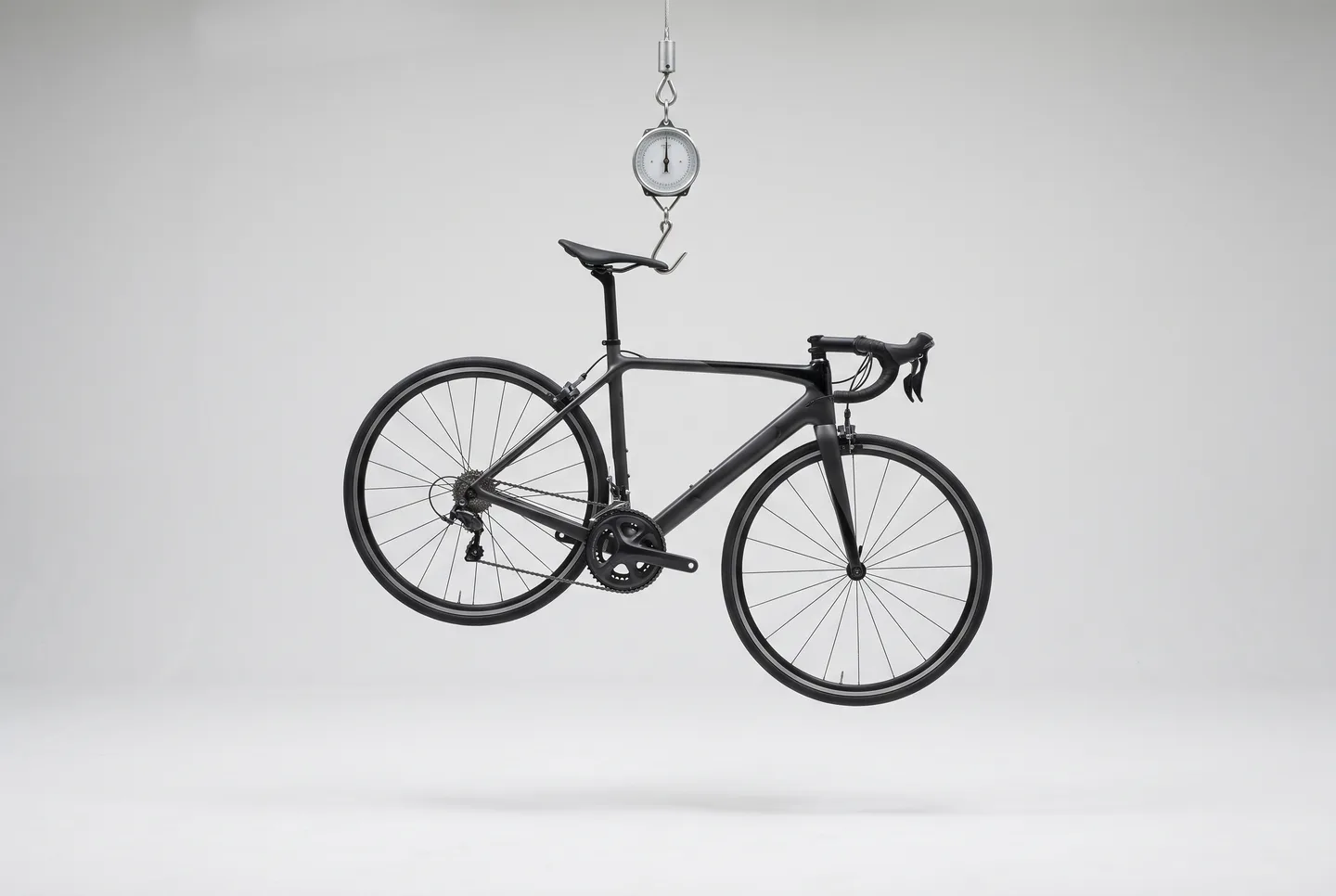
Taking a kilo off the bike costs a lot. In the guide on how to lighten your bike, all twelve gravel weight upgrades together save about 1.10 kg (2.4 lb) for €7,350, and they’re worth 0'49" on the example gravel ride.
Aero is often worth more. On the example road ride, 0.01 m² less CdA is worth about 1'10", nearly the same as 2 kg (4.4 lb). Changing your riding position can be free too, but you have to test it. TOUR says an aero position that cramps you can cost 5 to 10% of your performance2.
Body weight isn’t an upgrade. It depends on health, nutrition and training, and a calculator shouldn’t be deciding it. That’s why this guide gives no advice on how to change it.
Sources
We read every source ourselves. They’re all public pages you can read for free. For the two studies on frontal area, we read the abstracts.
- Steve Gribble. The formulas for cycling power from gravity, rolling resistance and air. The first two use the combined weight of rider and bike. Page
- TOUR, 2026. German magazine. What 1 kg less is worth on a 10 km climb at 7% at 250 W and on the flat, and what an aero position you can’t hold can cost you. Article
- Groves, BMJ, 2010. Randomized trial over 56 commutes with a 13.5 kg steel bike and a 9.5 kg carbon bike. Study (PDF)
- Heil, 2002. European Journal of Applied Physiology. How the area 21 competitive cyclists present to the air grows with weight, on standard road handlebars, with and without the bike. Abstract
- Heil, 2001. European Journal of Applied Physiology. 21 competitive cyclists on a cycle ergometer, with the torso low in a time trial position: how area grows with weight, and an estimate of how CdA grows. Abstract
- Crouch, Burton, LaBry and Blair, 2017. Scientific review of cycling aerodynamics, in Sports Engineering: how much frontal area explains the differences in air resistance between athletes and positions. Study (PDF)