GUIDES · AERODYNAMICS
Riding position: what a low torso is worth.
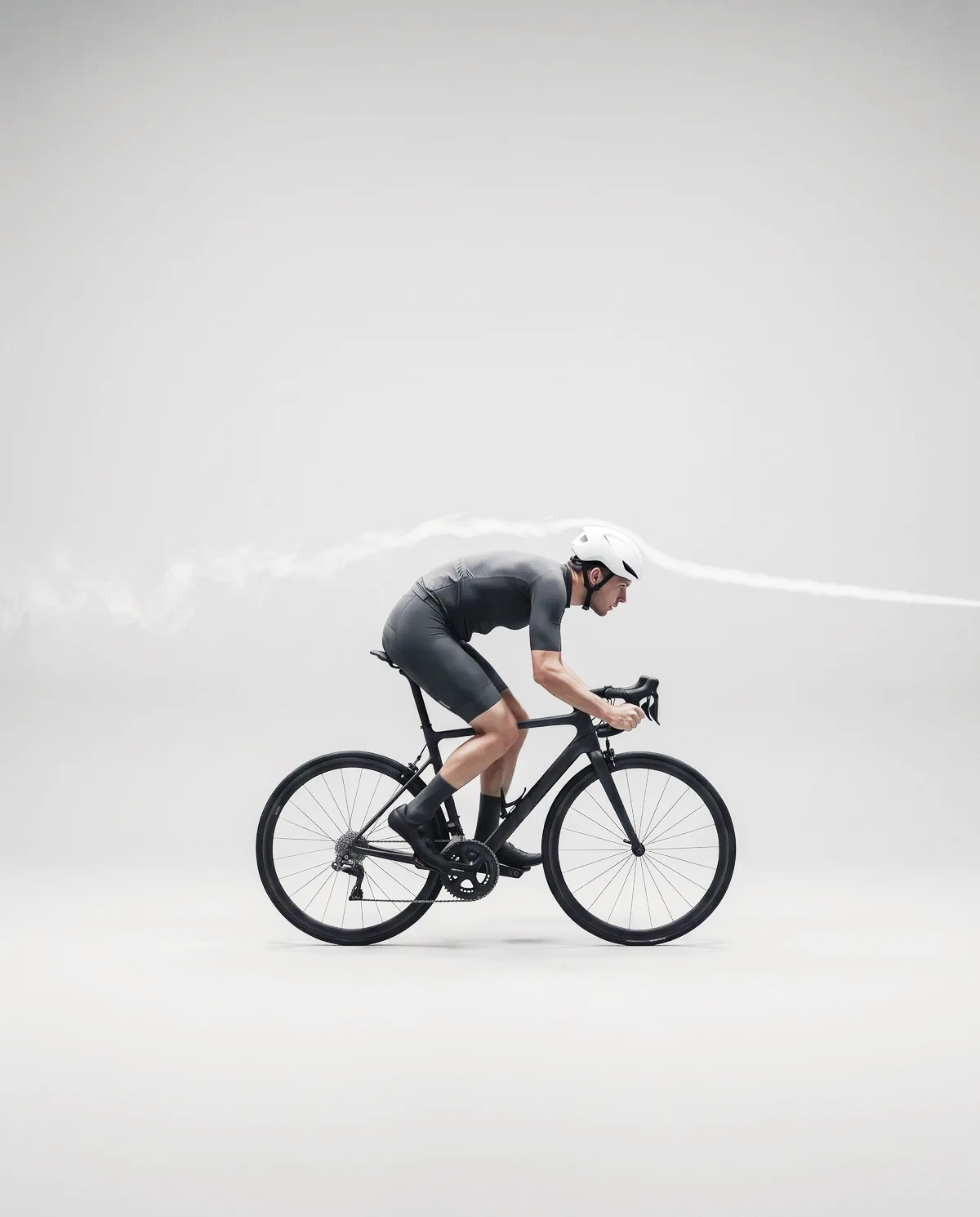
On the flat, your position matters more than almost any part on the bike. The rider accounts for about 80% of the air resistance and the bike for the rest. In the wind tunnel, going from sitting upright with straight arms to the drops cuts air resistance by as much as 15–20%. On the example road ride, riding low instead of in the medium position is worth about 3'20" at the same power, and it’s free. That only holds if you can push the same watts, though, and the right position is one you can hold comfortably for the whole ride.
−3'20"
What the calculator says the low position is worth over the medium one at the same power, on the example road ride of 80 km (50 mi) with 900 m (2,950 ft) of climbing at 28 km/h (17 mph). It’s free.
80%
The rider’s share of the air resistance on today’s aero bikes. The bike accounts for the rest.
15–20%
How much air resistance can drop when you go from upright with straight arms to the drops, according to a review of wind tunnel tests.
5.7 kg
How much weight you’d have to lose to gain the same time on the same ride as the low position.
Air or weight?
On the flat at race speeds, air accounts for more than 90% of the resistance. Once you add climbs, its share ranges from 56% to 96% of your power, depending on the gradient1. With the calculator’s road bike values, about three quarters of your power goes into pushing air at 30 km/h (19 mph).
Your body is the biggest part of that air resistance, about 80% on today’s aero bikes, with the bike making up about 20%1. That’s why changing position is worth more than almost any upgrade. On the example road ride, riding low instead of in the medium position is worth as much as taking about 5.7 kg (12.6 lb) off the bike.
How much position changes things
A rider’s air resistance is measured as CdA, in m², and the lower it is, the less air you push. A review of wind tunnel studies found that going from upright with straight arms to the drops can cut air resistance by as much as 15–20%, and a time trial position by as much as 30–35%1.
CDA IN THREE POSITIONS, IN M²
| STUDY | UPRIGHT | DROPS | TIME TRIAL |
|---|---|---|---|
| Kyle and Burke | 0.32 | 0.26 | – |
| Barry and colleagues | 0.343 | 0.295–0.332 | – |
| Gibertini and Grassi | 0.282–0.318 | 0.275–0.289 | 0.223–0.235 |
| Blocken and colleagues | 0.270 | 0.243 | 0.211 |
In the test by Blocken and colleagues, on the same rider, going from upright to the drops with straight arms cut air resistance by 10%, and the time trial position cut it by 22%2. Barry and colleagues found that dropping the head and torso and keeping the arms inside hip width reduces air resistance1.
The numbers vary a lot. In a time trial position, CdA differs by up to 40% from one study to another. Your frontal area explains only about half of the differences between riders and between positions, and pedaling adds about 6% to air resistance compared with keeping your legs still1. The only way to know your real gain is to have it measured.
What it’s worth on your ride
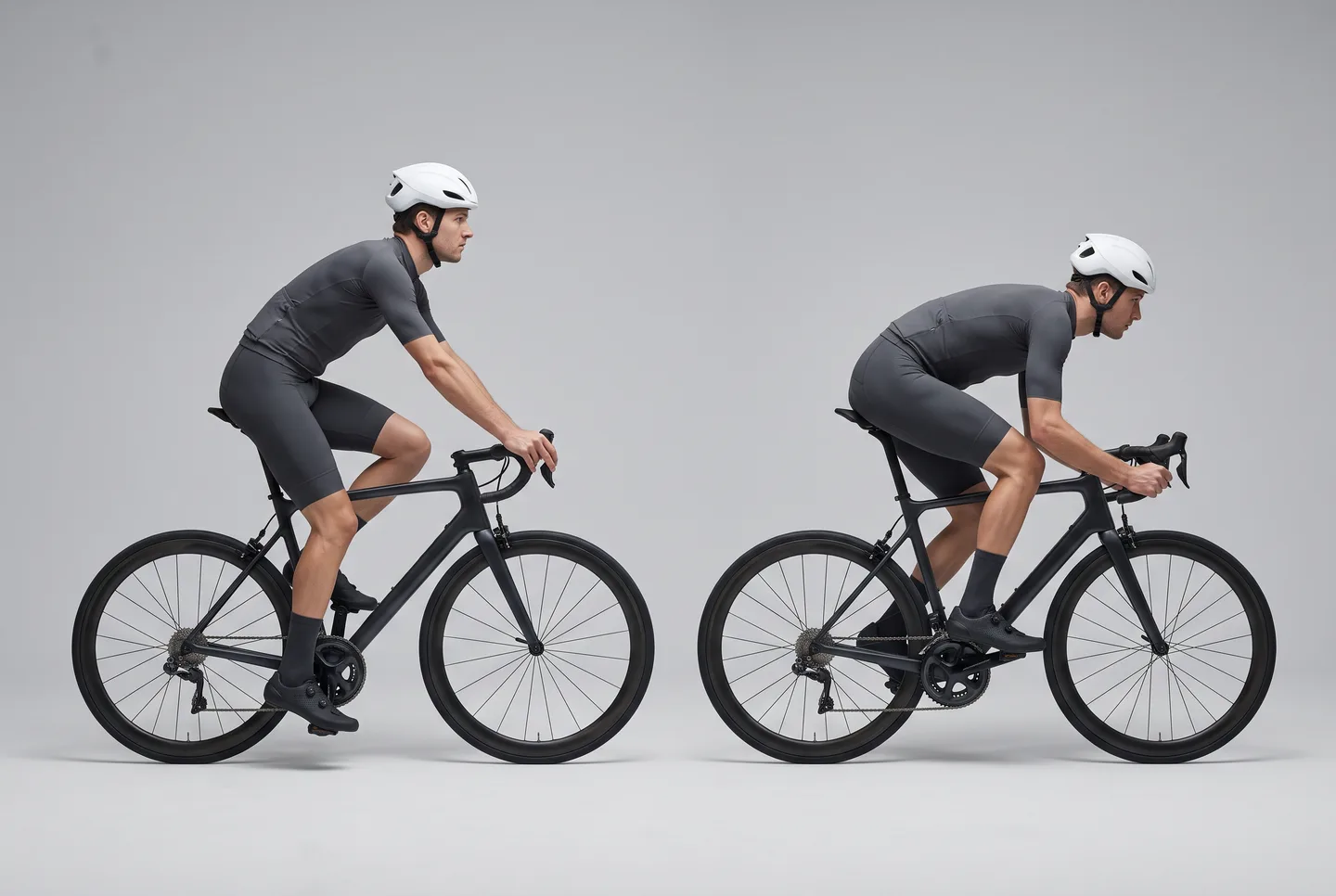
In the calculator you pick upright, medium or low. On a road bike we start from a CdA of 0.42, 0.38 and 0.35 m², and on gravel from 0.44, 0.40 and 0.36. These are estimates for a rider in a regular jersey, bib shorts and a road helmet. That’s why they’re higher than almost every wind tunnel number, which often come from riders in race gear who aren’t pedaling. We explain where they come from in the calculator’s starting values.
WATTS NEEDED ON THE FLAT
| SPEED | UPRIGHT | MEDIUM | LOW |
|---|---|---|---|
| 25 km/h (16 mph) | 119 W | 111 W | 104 W |
| 30 km/h (19 mph) | 188 W | 174 W | 163 W |
| 35 km/h (22 mph) | 283 W | 260 W | 243 W |
Time saved. On the example road ride, 80 km (50 mi) with 900 m (2,950 ft) of climbing at 28 km/h (17 mph) and the same power, going from upright to medium saves about 4'10" and from medium to low about 3'20". On the example gravel ride, 62 km (39 mi) with 780 m (2,560 ft) of climbing at 23.5 km/h (15 mph), upright to medium saves about 2'50" and medium to low about 3'00". On a mountain bike you’re slower and position matters little, with medium to low worth about 0'40". That last one is our own estimate, since nobody has measured different positions on the same mountain biker.
On the upgrade pages, the low position sits “off the ladder” because you can’t buy it, and what it’s worth depends on your body. In the calculator, changing your position also shifts the seconds the other upgrades save, a little.
Why some riders lose watts
The calculator assumes you push the same watts in the low position. That isn’t always true. The lower you go, the more your hip angle closes, and some riders put out less power or tire sooner. The review by Crouch and colleagues also warns that aero gains have to be weighed against power and fatigue1.
A University of Birmingham study used data from 19 time trialists to work out the best time trial position for each speed. Below 30 km/h (19 mph) it pays to sit higher, while above 46 km/h (29 mph) the air you save outweighs the power you lose. Even at those speeds, a fully flat torso wasn’t the best choice3.
Lower doesn’t always mean less drag, either. In two studies on time trial position, dropping the torso generally reduced air resistance, but the lowest torso position wasn’t always the one with the least drag1.
How to get lower
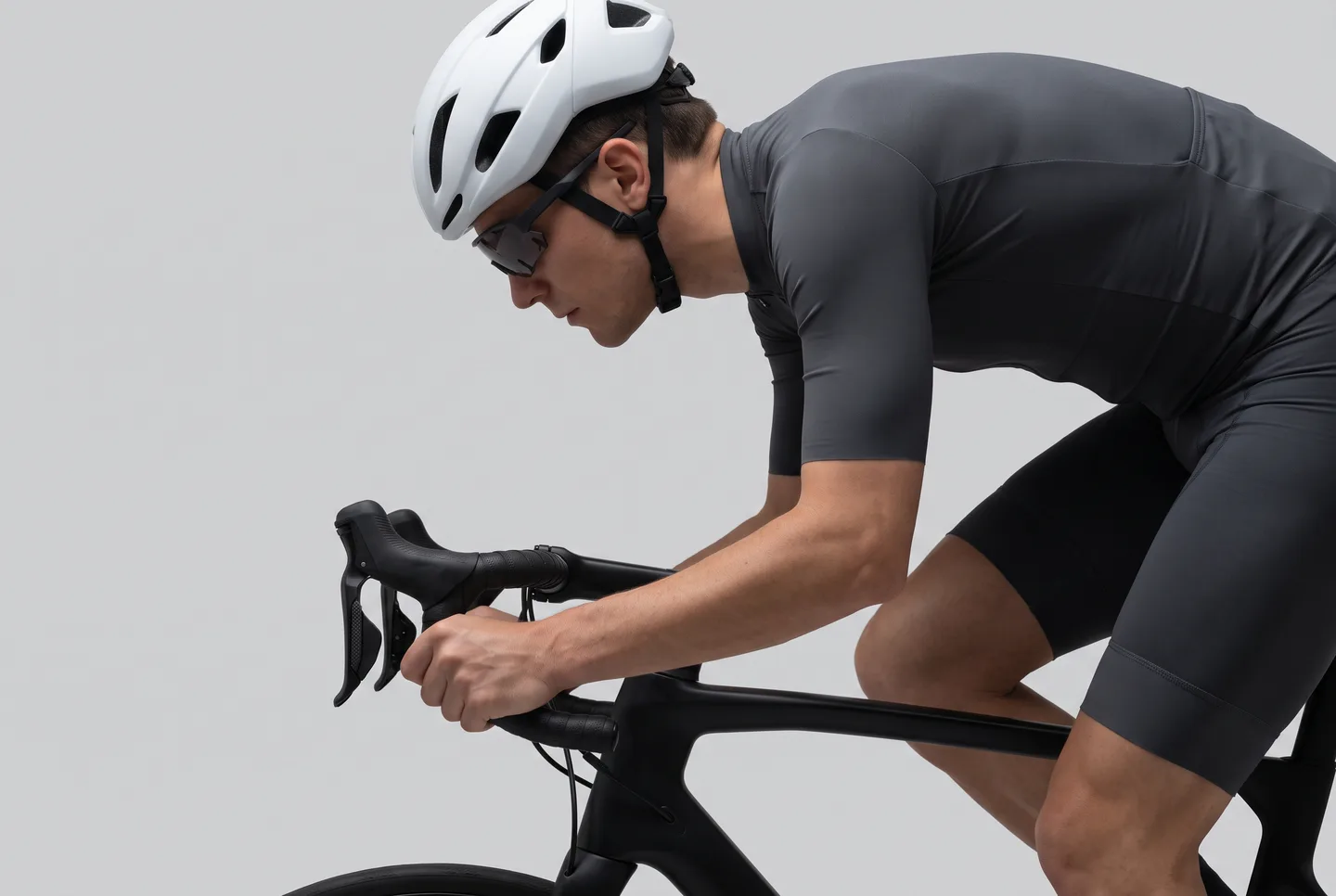
- Ride in the drops more. It’s the simplest change, and you don’t have to touch the bike. Flatten your back and drop your head1. Bend your elbows and keep your eyes on the road.
- Tuck your arms in. Keep them inside hip width1 without taking your hands off the bar, so the brakes stay under your fingers.
- Take it a bit at a time. You need to be able to hold a new position for the whole ride, so ease into it.
- Get help if you change your setup. Slamming the stem or fitting a longer one changes your whole position, so it’s best done with a bike fitter.
- Watch the road. A low position is no good if you can’t see ahead, especially in a group.
If you’re thinking about a new bike, there’s a guide on aero vs endurance bikes, with the numbers on the bike versus your position.
When it doesn’t matter much
On climbs. You’re slower, so the air matters less1.
If you lose watts or it’s uncomfortable. A position you can’t hold won’t help you. If it hurts, talk to a doctor or a bike fitter.
If you spend most of the ride in the draft. You’re already pushing little air, so position matters less. Drafting has its own guide.
Sources
We read every source ourselves. They’re all public pages you can read for free.
- Crouch, Burton, LaBry and Blair, 2017. Scientific review of cycling aerodynamics, in Sports Engineering: how much the air contributes to total resistance, how much comes from the rider and how much from the bike, and CdA in different positions in wind tunnel studies. Study (PDF)
- Blocken and colleagues, 2013. Computers & Fluids. One rider in the wind tunnel in three positions, upright, in the drops with straight arms and in a time trial position: air resistance of rider and bike. Authors’ version. Study (PDF)
- Fintelman and colleagues, 2014. University of Birmingham, Journal of Biomechanics. The best time trial position for each speed, using data from 19 time trialists at different torso angles: air versus power. Abstract