GUIDES · AERODYNAMICS
Aero or endurance bike: the real difference in minutes.
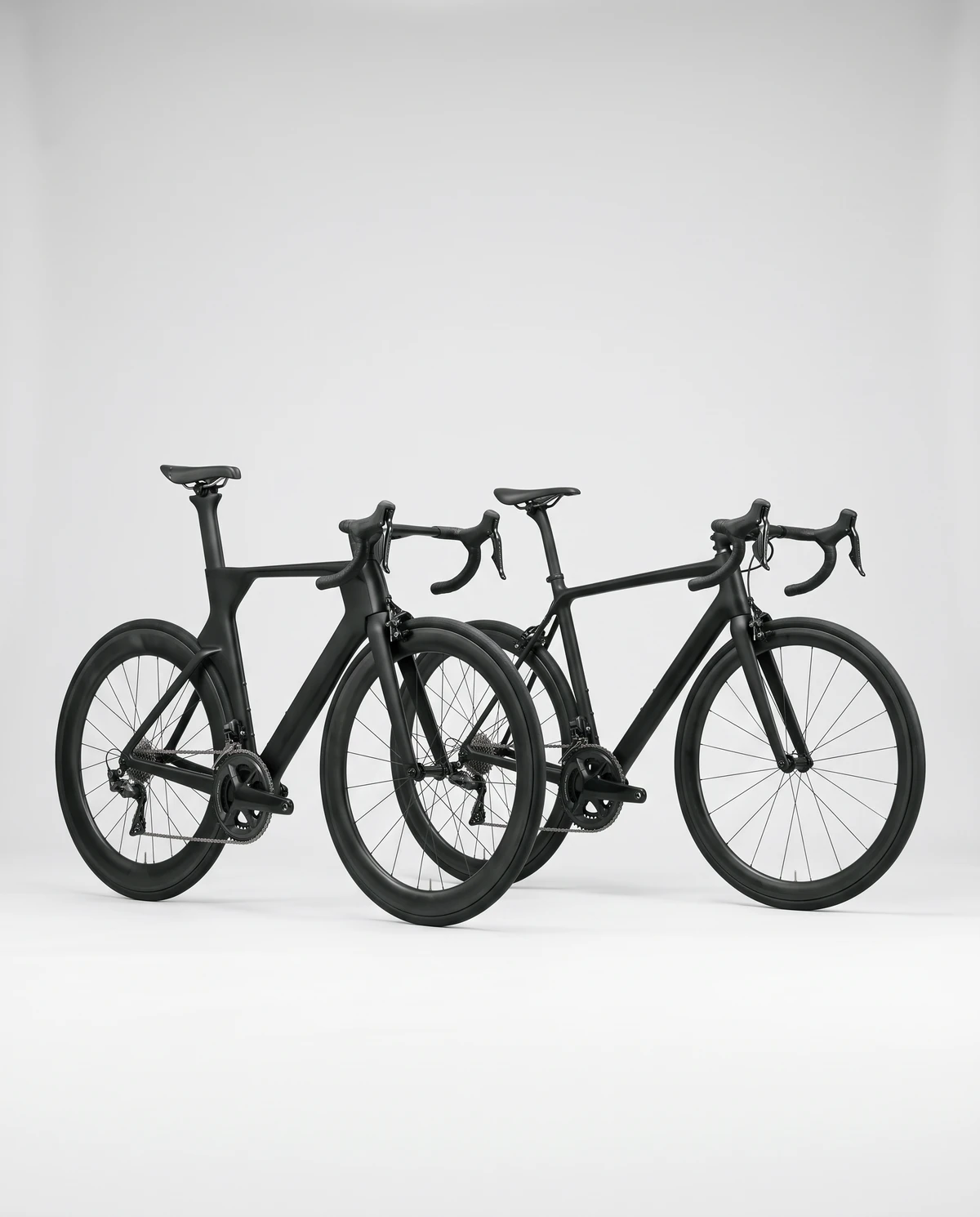
An aero bike cuts through the air better. An endurance bike lets you sit higher and more comfortably. By our numbers, on the example road ride, a complete aero bike in place of a 2015 round-tube race bike saves you 2 to 4 minutes. But if you ride with your torso more upright, position matters even more than the bike.
−3'45"
Our own calculation on the example road ride, 80 km (50 mi) with 900 m (2,950 ft) of climbing: an aero bike with its deep wheels saves you up to this much over a 2015 round-tube bike, in the same position. At least 2'04".
15–28 W
How much 12 aero bikes, with their deep wheels, saved over a 2015 round-tube bike at 40 km/h (25 mph), in the wind tunnel with a rider on board.
+4'10"
Our own calculation on the same ride: what it costs to ride with your torso upright instead of in the medium position. More than the bike.
6 s
On an 18 km (11 mi) lap at 260 W, there was no measurable difference between a new aero bike and an old bike with a lower position.
What’s different between the two bikes
An endurance bike is made for riding comfortably on long, rough roads. The handlebar is a few centimeters higher than on a race bike, and the tires are wider. The endurance bikes TOUR tested in 2022 all weighed more than 8 kg (17.6 lb), and TOUR treats 30–32 mm tires as standard2.
An aero bike has aero-shaped tubes and a clean front end, designed to cut drag. TOUR says a race bike is the better choice for fast races2.
So there are three differences: the bike with its wheels, the position and the weight. We’ll go through them one by one.
The bike and the wheels
With a rider. In 2025 Cyclingnews tested 12 aero bikes in the wind tunnel, each with its own wheels, against a 2015 round-tube bike with rim brakes, shallow wheels and external cables. At 40 km/h (25 mph), with the rider on the bike in the same position, the aero bikes saved 15.5 to 27.6 W. In CdA terms, that’s 0.019 to 0.034 less. The margin of error was 1.7 W1.
Without a rider. TOUR tests bikes in the wind tunnel at 45 km/h (28 mph) with a mannequin that only has legs. The gap between a very good bike and a very poor one is about 35 W. At amateur speeds, TOUR says the bike alone, in the same position, can be worth about 1 km/h (0.6 mph)3.
Keep in mind that the Cyclingnews round-tube bike is a 2015 race bike, with shallow wheels, external cables and rim brakes, not a modern endurance bike. It’s the worst case. Many new endurance bikes have internal cables and partly aero-shaped tubes. For the sportiest version of one of these, with deep wheels, the maker claims just one watt more than its aero bike. For a more comfortable version it claims 209 W, also at 45 km/h, but without saying which wheels. So the comparison with the aero bike’s 204 W is only a rough guide4,7.
Position matters more
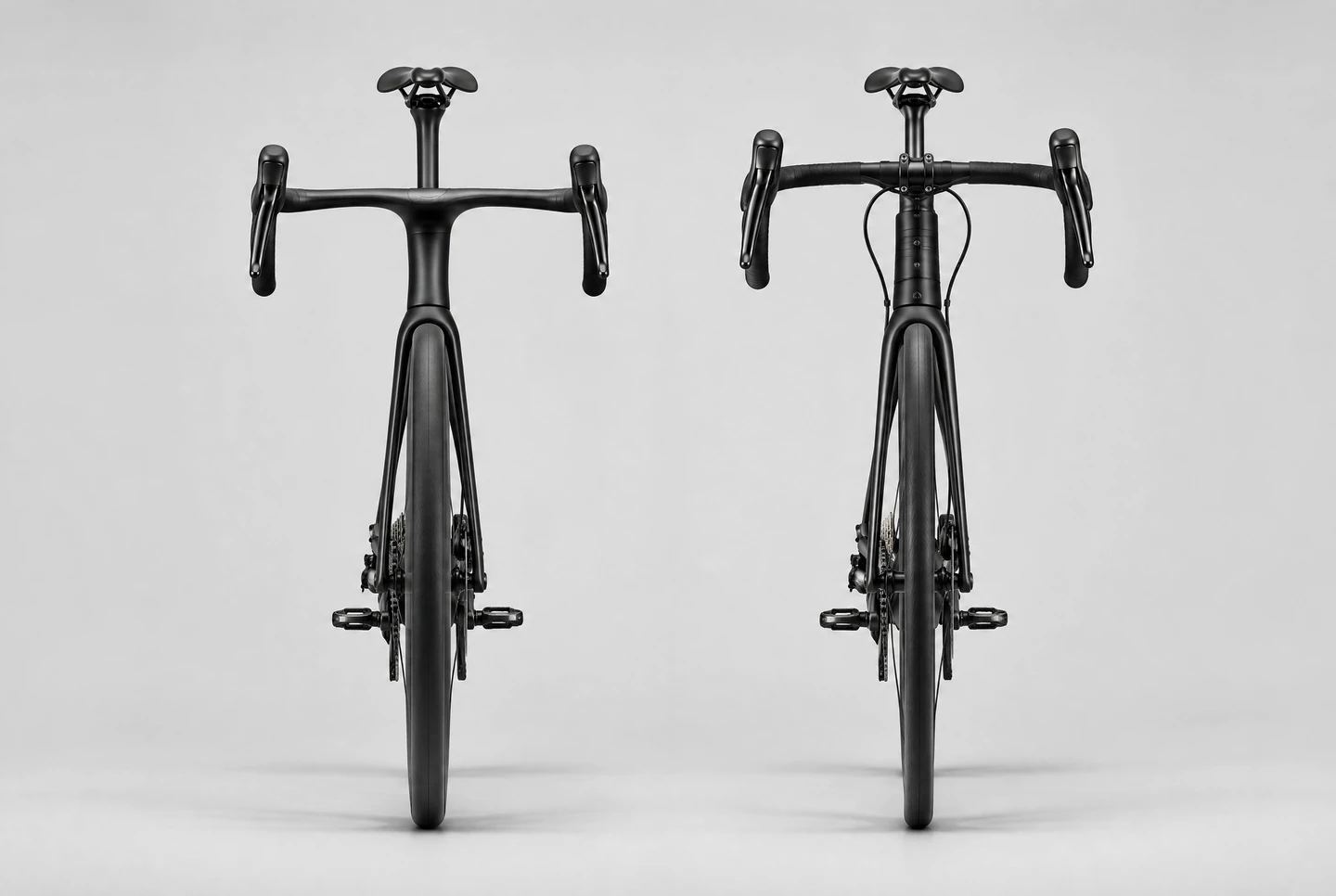
About 80% of air resistance comes from the rider, not the bike5. In the calculator, on a road bike, we use a CdA of 0.42 with your torso upright and 0.38 in the medium position. That’s a difference of 0.04, more than Cyclingnews measured between the aero bikes and the 2015 bike, which was 0.034 at most. Position doesn’t depend only on the bike: you can also raise or lower the handlebar with spacers and the stem. There’s a guide on riding position.
In 2025 road.cc compared a new aero bike, with a wide handlebar, against a race bike from ten years earlier, with round tubes but deep wheels, a low stem and a narrower handlebar. Same rider, in the drops, at 260 W on an 18 km (11 mi) lap, two laps per bike. On average the old bike was 6 seconds faster. On the same bike, lap times varied by up to 10 seconds, so the test can’t pick up differences that small. The expected gain from the aero bike was 5–15 W at 35 km/h (22 mph), or 15–25 seconds per lap5.
The author thinks position and handlebar width matter more than the frame. It’s only one test5.
The numbers over a full ride
We ran the numbers again with the calculator’s model, on the example road ride. For the aero bike we use the Cyclingnews numbers with a rider, a CdA 0.019 to 0.034 lower1. They were measured at 40 km/h (25 mph): CdA changes little with speed, but watts do. Our own calculation: at 28 km/h (17 mph) on the flat, the same difference is worth about 5–10 W.
ON THE EXAMPLE ROAD RIDE
| WHAT CHANGES | TIME |
|---|---|
| Aero bike with its deep wheels, same position CdA 0.019 to 0.034 lower | −2'04" to −3'45" |
| Upright torso instead of medium position CdA 0.42 instead of 0.38 | +4'10" |
| Bike 0.5 kg (1.1 lb) heavier | +0'18" |
| Bike 1 kg (2.2 lb) heavier | +0'35" |
| 3 W less reaching the road efficiency rig, a single pair of bikes | +1'22" |
| Worst case: 2015 round-tube bike, upright torso and 0.5 to 1 kg more, against an aero bike in the medium position our own assumption | +6'31" to +8'29" |
The aero bike saves you 2 to 4 minutes. Riding upright costs more than 4. In the worst case, a 2015 round-tube bike ridden upright against an aero bike in the medium position, the two add up: between six and a half and eight and a half minutes over the ride. With a modern endurance bike the difference is smaller. Weight matters little: even 1 kg is worth about half a minute.
The power that reaches the road. road.cc put an aero bike and a light climbing bike from the same maker on a rig, with the same wheels, tires and drivetrain. The rig measures how much of the rider’s power actually moves the bike forward. At 30 and 40 km/h (19 and 25 mph), on smooth asphalt and on rough surfaces, the light bike lost about 3 W less. It’s a single pair of bikes, and the test was paid for by the maker6. With our model, 3 W over the ride is worth about one minute and 20 seconds. An endurance bike, being more comfortable, might win some of that back, but no test has measured this on an endurance bike.
Run the numbers on your ride, with your bike and your position
Which one to choose
If you ride fast on your own or race at speed, by our numbers the aero bike saves you real minutes, as long as you can hold a fairly low position. In a group, when you’re drafting, the advantage shrinks.
If you do long rides, on rough roads, or riding low hurts, the endurance bike makes sense. The higher position costs a few minutes, but if you hold it for the whole ride it can be worth more than a low position you can’t sustain.
If you already have a bike and want to go faster, work on your position first: it costs little and, according to road.cc, it matters more than the frame5.
What the numbers don’t tell you
The numbers assume constant power, no wind and riding alone. In a group, when you’re drafting, drag matters less and the aero bike’s advantage shrinks. There’s a guide on drafting. The round-tube bike in the tests is a 2015 race bike, not a modern endurance bike, and the aero bikes had their own deep wheels: the 2–4 minutes are for the whole bike, not just the frame. The Cyclingnews CdA is an average over several wind angles, and we use it unchanged over the whole ride. With steeper, more concentrated climbs, for the same distance and climbing, the aero bike’s gain drops and weight matters a little more, in our model. TOUR’s watts are measured without a torso: with a real rider the total drag is about 50% higher, but the differences between one bike and another usually shrink, because the rider partly shields the bike3.
Run the numbers on your ride, with your bike and your position
Sources
We read every source ourselves. They’re all public pages you can read for free.
- Cyclingnews, 2025. 12 aero bikes in the wind tunnel at Silverstone, at 40 km/h (25 mph), with and without a rider, against a 2015 round-tube bike: CdA, watts saved and margin of error. The bikes were lent by the makers; the magazine paid for the wind tunnel. Contains paid product placement from a clothing brand. Article
- TOUR, 2022. Six endurance bikes compared: a handlebar a few centimeters higher, 30–32 mm tires, weights above 8 kg (17.6 lb), and when a race bike is the better choice. Article
- TOUR, 2021. How the magazine tests bikes in the wind tunnel: 45 km/h (28 mph), a mannequin with legs only, wind angles, about 35 W between a very good bike and a very poor one, about 1 km/h (0.6 mph) at amateur speeds. Article
- TOUR, 2026. Launch of an endurance bike with shaped tubes: in the wind tunnel TOUR also uses, at 45 km/h (28 mph), the maker claims 205 W against 204 W for its aero bike, with 65 mm wheels. It’s the maker’s own figure. Article
- road.cc, 2025. A new aero bike against a race bike from ten years earlier, with round tubes but deep wheels and a lower position: 260 W on an 18 km (11 mi) lap, two laps per bike, lap-by-lap times. Article
- road.cc, 2024. An aero bike and a light bike from the same maker on a rig that measures how much power reaches the road, at 30 and 40 km/h (19 and 25 mph), on smooth asphalt and on rough surfaces. The article was paid for by the bike maker. Article
- TOUR, 2026. Launch of the more comfortable versions of the same endurance bike, with a higher handlebar: the maker claims 209 W at 45 km/h (28 mph), under TOUR’s test conditions, without saying which wheels. It’s the maker’s own figure. Article