GUIDES · AERODYNAMICS
How many watts you need at 30, 35 and 40 km/h.
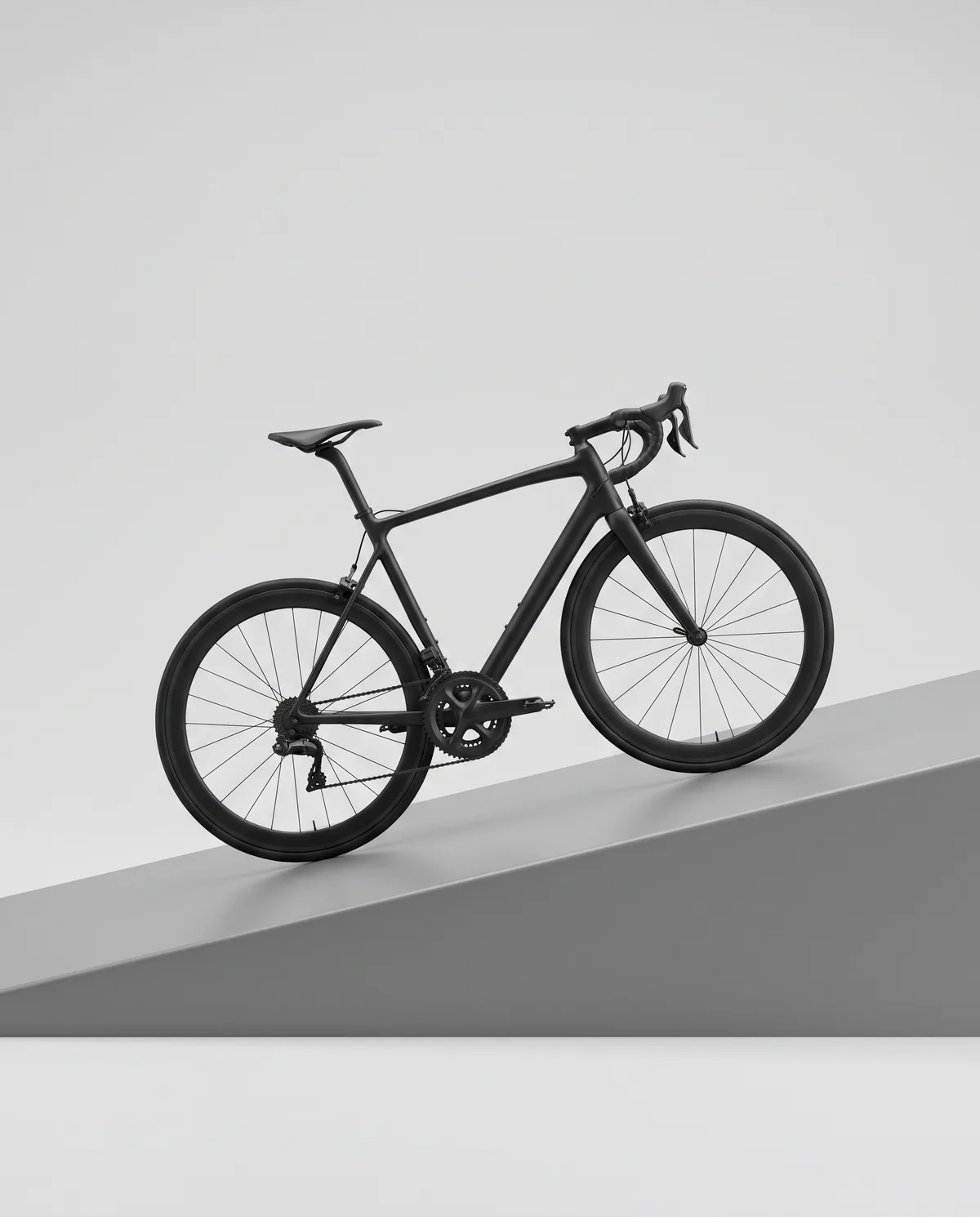
On a road bike on the flat, a 74 kg (163 lb) rider in the medium position needs about 174 W to hold 30 km/h (19 mph), 260 W for 35 km/h (22 mph) and 372 W for 40 km/h (25 mph). Going 10 km/h (6 mph) faster more than doubles the watts, because the power needed to push through the air rises with the cube of speed. These numbers come from the calculator’s model. Below are the tables for road and gravel, on the flat and uphill, and what changes them.
260 W
The watts you need for 35 km/h (22 mph) on the flat with no wind, on a road bike in the medium position, for a 74 kg (163 lb) rider.
174 W
The watts you need for 30 km/h (19 mph) in the same conditions.
372 W
The watts you need for 40 km/h (25 mph), more than twice as many as at 30.
84%
The share of that power that goes into beating the air at 40 km/h (25 mph). At 25 km/h (16 mph) it’s 69%.
How we calculate them
The power you put into the pedals goes into beating the air, the tires’ rolling resistance, the climb and any accelerations, and a small part is lost in the drivetrain. This is the model by Martin and colleagues, as described in the review by Crouch and colleagues1. Martin and colleagues tested it on the road with a power meter, using parameters measured for those rides. The model’s watts and the measured watts matched almost exactly, with a typical gap of 2.7 W2. The calculator uses a simplified version, with constant speed, no bearing friction and no separate term for the drag of the spinning wheels.
The tables use the calculator’s starting values: a 74 kg (163 lb) rider plus 1.5 kg (3.3 lb) for helmet, shoes and clothing, an 8.6 kg (19 lb) road bike, CdA 0.38 m² in the medium position, Crr 0.0055 with standard tires, air density 1.2 kg/m³ and 2.5% lost in the drivetrain. There’s no wind and the speed is constant. Headwinds have their own guide.
On the flat
WATTS ON THE FLAT, NO WIND
| SPEED | ROAD | UPRIGHT | LOW | GRAVEL |
|---|---|---|---|---|
| 25 km/h (16 mph) | 111 W | 119 W | 104 W | 134 W |
| 30 km/h (19 mph) | 174 W | 188 W | 163 W | 205 W |
| 35 km/h (22 mph) | 260 W | 283 W | 243 W | 299 W |
| 40 km/h (25 mph) | 372 W | 406 W | 347 W | 421 W |
Why it climbs so fast. Air resistance grows with the square of speed, and the power to overcome it grows with the cube1. The power that goes into rolling resistance only grows in step with speed. So going from 30 to 40 km/h (19 to 25 mph) is a third more speed, but the watts go from 174 to 372.
It’s almost all air. With these values, the air takes 69% of the power at 25 km/h (16 mph), 76% at 30 km/h (19 mph) and 84% at 40 km/h (25 mph). At race speeds, above 50 km/h (31 mph), it’s about 90%3,4. That’s why position and aero upgrades matter so much on the flat.
Gravel. On dirt the tires roll worse, the bike is heavier and the rider and bike catch a bit more air. At 30 km/h (19 mph) you need about 205 W, 18% more than on the road.
Uphill
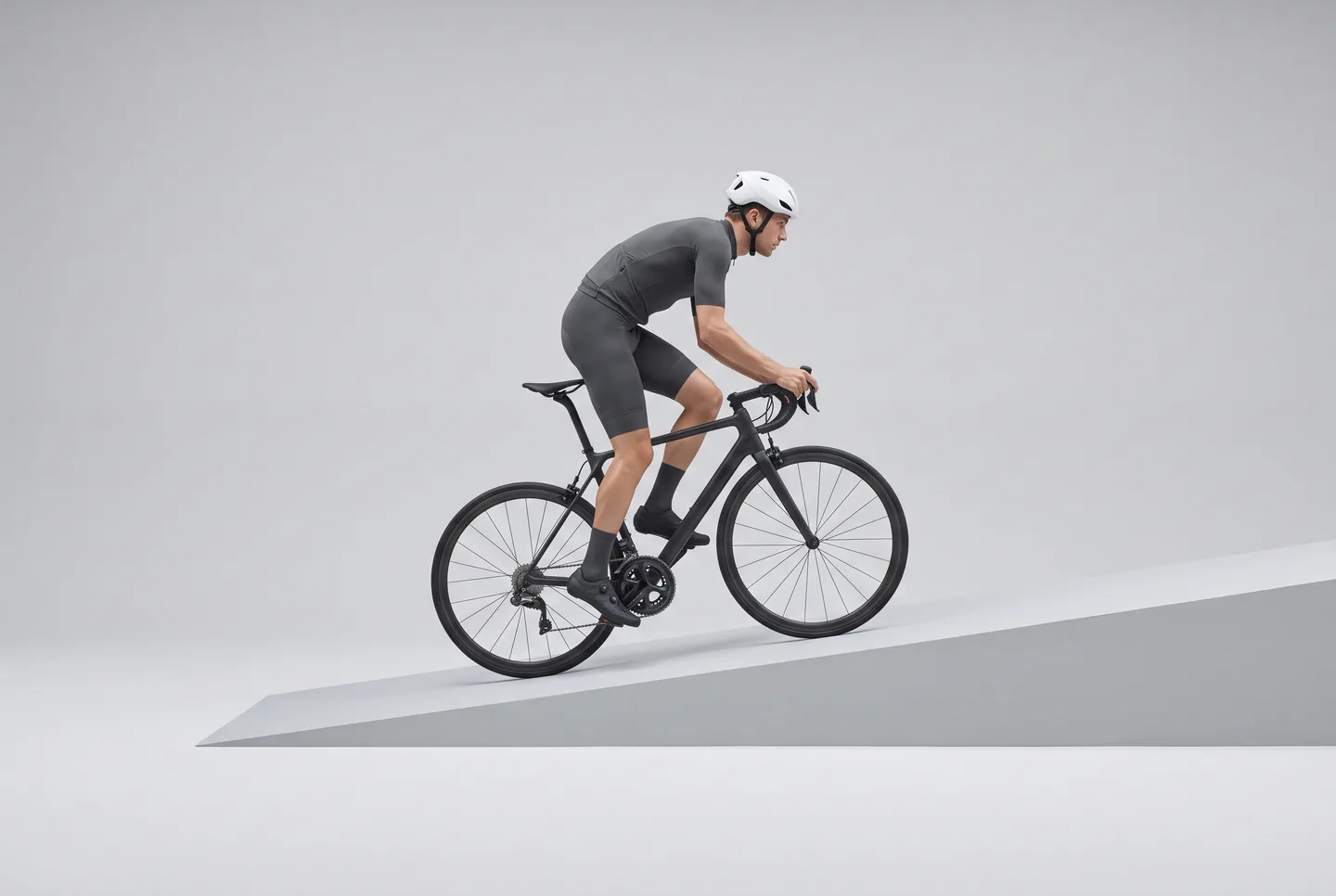
WATTS UPHILL, ON THE ROAD
| GRADE | 10 km/h (6 mph) | 15 km/h (9 mph) | 20 km/h (12 mph) | 25 km/h (16 mph) |
|---|---|---|---|---|
| 3% | 88 W | 142 W | 207 W | 287 W |
| 6% | 159 W | 247 W | 347 W | 463 W |
| 9% | 229 W | 352 W | 487 W | 637 W |
Uphill, it’s mostly about weight. With these values, at 6% and 15 km/h (9 mph) the air accounts for only about 7% of the power. At 3% and the same 15 km/h (9 mph), it’s about 12%. We have a guide on how many watts you need to climb, with more gradients and W/kg.
Weight. An extra 5 kg (11 lb) costs about 14 W at 6% and 15 km/h (9 mph), but only about 3 W on the flat at 35 km/h (22 mph).
Wind
Wind matters, because what counts is the speed of the air hitting you1. Into a 10 km/h (6 mph) headwind, riding at 30 km/h (19 mph) takes about 279 W instead of 174. The air holds you back as if you were doing 40 km/h (25 mph), but you’re only going 30. With a 10 km/h (6 mph) tailwind, about 99 W is enough, so you save less than you lose into the headwind. That’s why an out-and-back ride in the wind ends up slower.
Drafting also cuts the air, since you push much less of it behind another rider. It has its own guide.
Your watts
These numbers are for the calculator’s example rider, and yours can be very different. What changes them:
- Position and body. CdA varies a lot between riders and between positions1. We have a guide on riding position.
- Tires and road. Rolling resistance changes with faster tires or on rough pavement.
- Air. At altitude and in the heat the air is thinner, so you need fewer watts for the same speed1. At 54 km/h (34 mph), air resistance in Mexico City is about 24% lower than in Bordeaux, at sea level4. If you upload a ride, the calculator works this out from the elevation.
- Weight. It barely matters on the flat and matters a lot uphill.
If you have a power meter, you’ll see different numbers on a real ride, because wind, corners, accelerations and time spent drafting all play a part. The watts in the tables are at the pedals, at constant speed. We also have a guide on average road bike speed.
For a quick check with your own watts or speed, try the watts to speed calculator. It uses the same model. You can only pick one surface there, while the gravel ride in the table above is 70% off-road.
Multiply your watts by the time and you get the kJ for your ride, and from there the calories. We have a guide on calories burned cycling.
In the full calculator you can enter your ride, your weight, your position and, if you know them, your CdA and Crr. Enter your average power and it also gives you your time.
Sources
We read every source ourselves. They’re all public pages you can read for free. For the study by Martin and colleagues we read the abstract.
- Crouch, Burton, LaBry and Blair, 2017. Scientific review of cycling aerodynamics, in Sports Engineering: the power model by Martin and colleagues, air resistance with the square of speed and power with the cube, how much the air counts on the flat and uphill, air density, CdA in different positions. Study (PDF)
- Martin, Milliken, Cobb, McFadden and Coggan, 1998. Journal of Applied Biomechanics. The power model tested on the road with a power meter: R² 0.97 between calculated and measured watts, standard error 2.7 W. Abstract
- Blocken and colleagues, 2013. Computers & Fluids. Computer simulation of riders at 54 km/h (34 mph); in the introduction: at race speeds air resistance is about 90% of total resistance. Authors’ version. Study (PDF)
- Debraux, Grappe, Manolova and Bertucci, 2011. Sports Biomechanics. Review of the methods for measuring air resistance: above 14 m/s, about 50 km/h (31 mph), it’s about 90% of the resistance; the effect of altitude. Study (PDF)