GUIDES · AERODYNAMICS
Drafting: how much air you save.
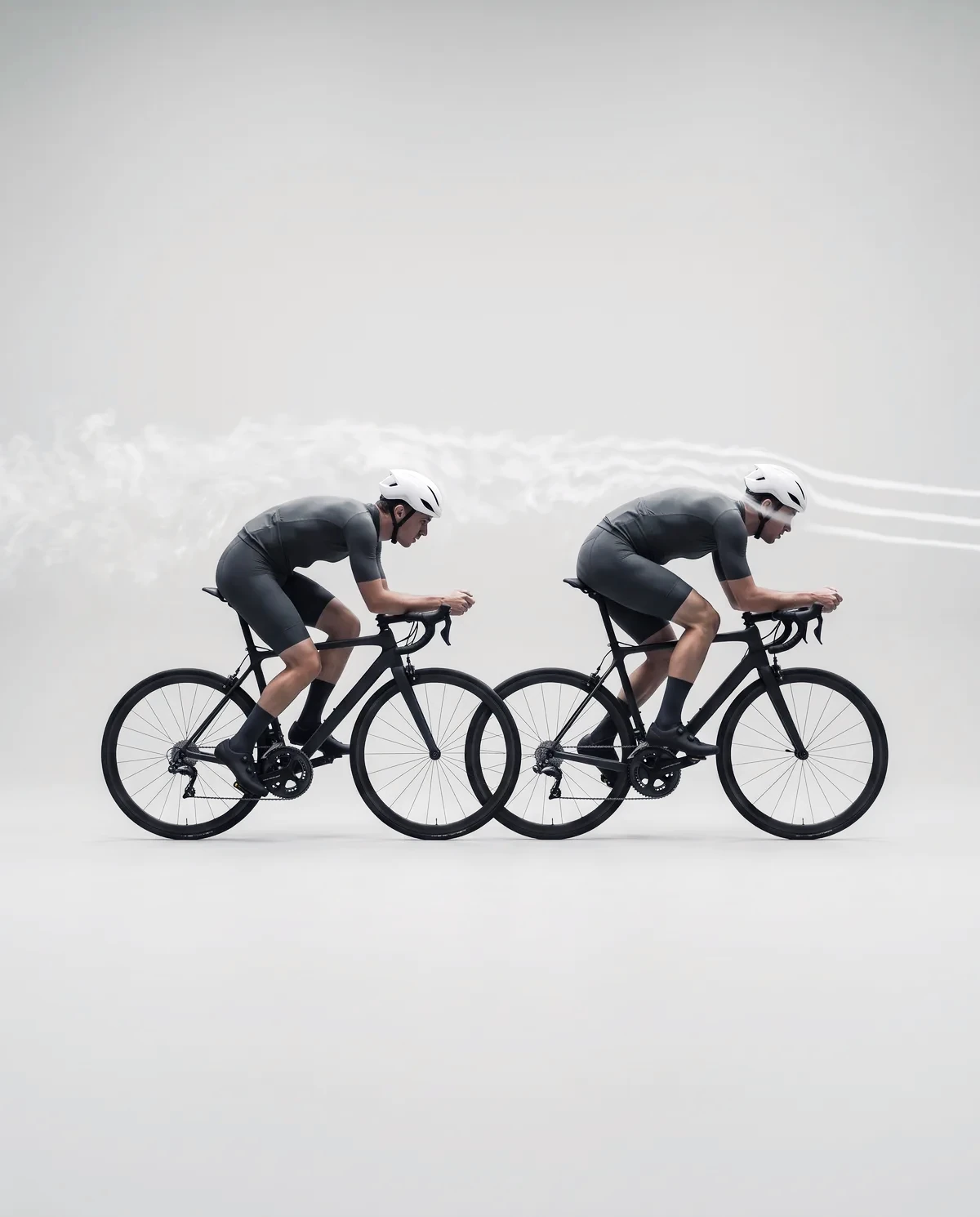
Sit behind another rider and you push less air. In a wind tunnel at 50 km/h (31 mph), a rider 20 cm (8 in) off the wheel had 41% less air resistance, and 38% less at about 1 m (3 ft). In a simulation of a 121-rider bunch, riders in the middle had 5–10% of the air resistance they’d have on their own. No new part comes close. On the example road ride, drafting for half the ride is worth more than any upgrade in the calculator.
−7'30"
Time saved at the same average power by sitting on a wheel for half of the example road ride, 80 km (50 mi) with 900 m (2,950 ft) of climbing at 28 km/h (17 mph). Estimated with the calculator’s model.
38–41%
Less air resistance for the rider behind, at gaps from 20 cm (8 in) to about 1 m (3 ft), in a wind tunnel at 50 km/h (31 mph).
5–10%
The air resistance left in the middle and back of a big group, compared with riding alone. From a simulation of 121 riders at 54 km/h (34 mph).
30%
Less air resistance for the rider behind at 20 cm (8 in) with a light crosswind. With no crosswind it was 41%.
Why it matters so much
On the flat, most of your effort goes into pushing air. Using the calculator’s values for a road bike, a 74 kg (163 lb) rider at 30 km/h (19 mph) spends about three quarters of their power on air resistance, and over 80% at 40 km/h (25 mph). At race speeds of around 54 km/h (34 mph), it’s about 90%2.
When you draft, the rider in front has already moved the air out of the way. That’s why it saves more than any part on the bike. With the calculator’s values, an aero helmet or a skinsuit cuts air resistance by a few percent. Drafting can cut it by double-digit percentages.
Behind another rider
Politecnico di Milano. Two real riders, hands on the hoods, pedaled on rollers in a large wind tunnel at 50 km/h (31 mph). The rider behind had 41% less air resistance 20 cm (8 in) off the wheel in front, and still 38% less at about 1 m (3 ft). The closer you sit, the more you save1.
AIR RESISTANCE LEFT, OUT OF 100 RIDING ALONE
Alone
Behind one rider, about 1 m
Behind one rider, 20 cm
Behind one rider, 20 cm, with a crosswind
Big group, rider on the front
Big group, sides of the front rows
Big group, middle and back
Crosswind. In the same test, wind coming 5° from the side, about 4 km/h (2.5 mph) of crosswind at 50 km/h (31 mph), cut the saving at 20 cm (8 in) from 41% to 30%. It doesn’t take much wind to push the draft off to one side1.
Off to one side. In an older wind tunnel test, the saving was up to 49% right behind the wheel and 37% when the rider sat 10 cm (4 in) off to the side2.
Other measurements. In a computer simulation of riders without bikes, the one 1 cm (0.4 in) behind saved 23% in the drops, 27% sitting upright and 14% in a time trial position2. In older tests outside the wind tunnel, the drafting rider needed 33% less power at 40 km/h (25 mph). Oxygen uptake dropped by 18% at 32 km/h (20 mph) and by more than 27% at 37 and 40 km/h (23 and 25 mph)2. Results vary a lot between tests. Behind a single rider, the saving ranges from 14% to 49%.
The rider in front
The rider in front saves a little too. The rider behind partly fills the wake behind them, so it drags on them a bit less. It isn’t much. In the two-rider simulation with a 1 cm (0.4 in) gap, it ranged from 0.8% sitting upright to 2.6% in a time trial position, and at 1 m (3 ft) it was under 1%2. In the Politecnico wind tunnel it was a few percent1.
Whoever is pulling a big group does almost all the work. In the 121-rider simulation, the front rider still had 84% to 96% of the air resistance they’d have alone3.
In a group
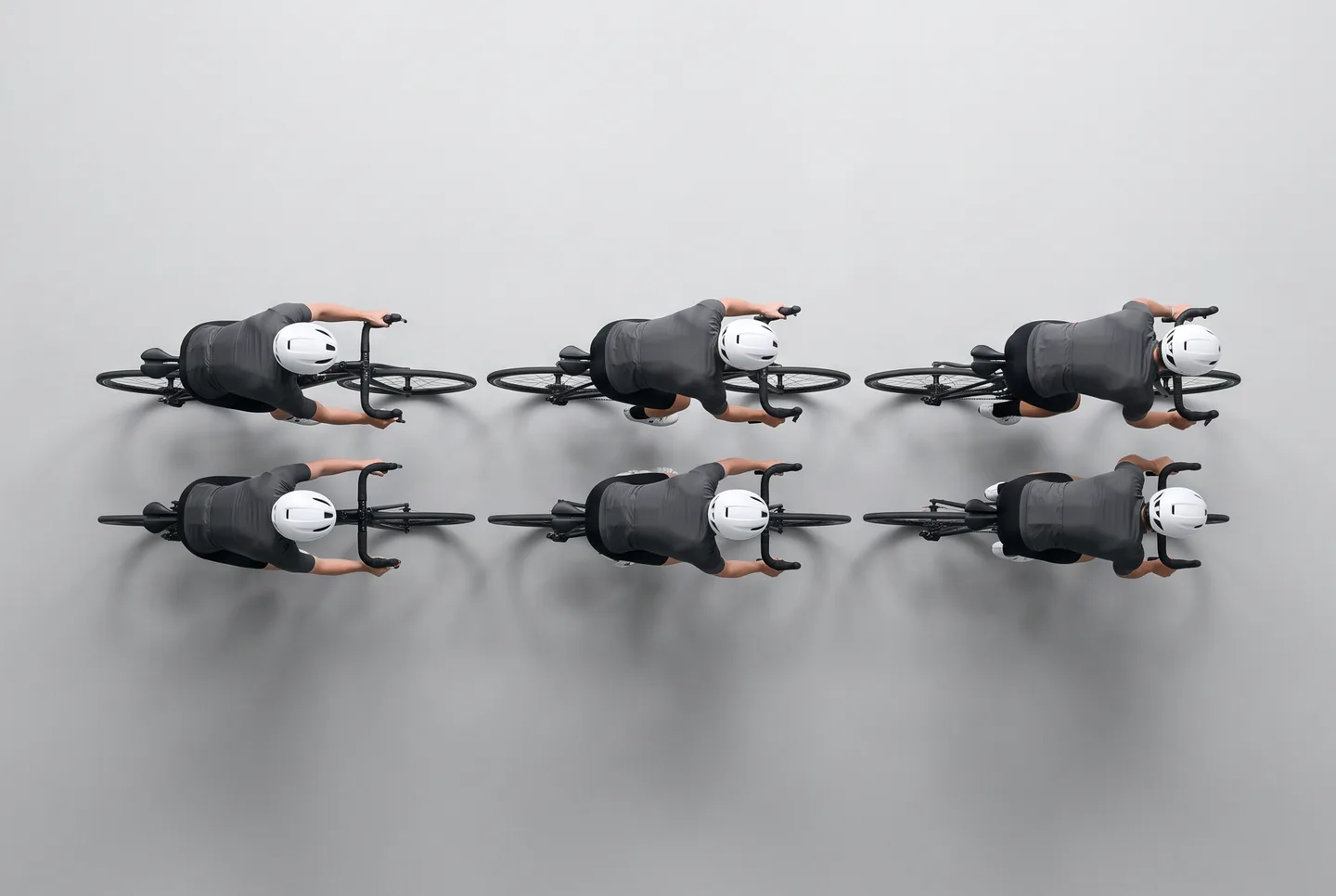
Small pacelines. Earlier studies found that in a small single-file group, the riders behind have 50% to 70% of the air resistance they’d have alone3. In a team pursuit setup, four athletes in a time trial position rode 12 cm (5 in) apart in a wind tunnel at 65 km/h (40 mph). The first rider saved 5% of air resistance, the second 45%, the third 55% and the fourth 57%4.
Big group. With 121 riders in the drops at 54 km/h (34 mph) and no wind, the riders on the sides of the front rows had 59–67% of the air resistance they’d have alone. It dropped fast further back, to 5–10% in the middle and at the back. As far as the air is concerned, that’s like riding alone at 12–17 km/h (7–11 mph) while the group is doing 54 km/h (34 mph)3.
The authors point out the limitations themselves. The simulated riders weren’t pedaling, didn’t move around in the group, and there was no wind3.
What it’s worth on your ride
In watts. This uses the calculator’s model on the flat with no wind, for a 74 kg (163 lb) rider on a road bike in the medium position, on standard tires. As in the calculator, we count 35% less air behind one rider and 90% less in the middle of a group.
WATTS NEEDED ON THE FLAT
| SPEED | ALONE | BEHIND ONE RIDER | MIDDLE OF THE GROUP |
|---|---|---|---|
| 30 km/h (19 mph) | 174 W | 127 W | 52 W |
| 35 km/h (22 mph) | 260 W | 185 W | 67 W |
| 40 km/h (25 mph) | 372 W | 260 W | 84 W |
In time. The example road ride, 80 km (50 mi) with 900 m (2,950 ft) of climbing at 28 km/h (17 mph), takes about 200 W on average. At that same average power, drafting for half the ride saves about 7'30" in the calculator’s model, anywhere from 5'20" to 9'50" depending on how much air you actually save. The best part on the same ride, fast-rolling tires, is worth about 4'20". This is an estimate. The calculator spreads the saving over the whole ride, climbs included, where air matters less. If you mostly draft on the flat you save more, and if you draft on the climbs you save less. In a group you also ride at the group’s pace, so the gain shows up more as less effort than as time saved.
In the calculator. You can tell it how much of the ride you spend drafting and in what kind of group. We count about 30% less air in a small group taking turns, 35% if you’re always on a wheel, and 90% in the middle of a big group. We use this to work out your power. If you enter your average speed or upload a ride, drafting means you need fewer watts for the same time. But in a group you go at the group’s speed, so there an upgrade saves you effort but won’t get you home any sooner. That’s why we only count upgrade seconds on the part of the ride you do alone. If you draft for half the ride, they’re worth roughly half.
Safety and rules
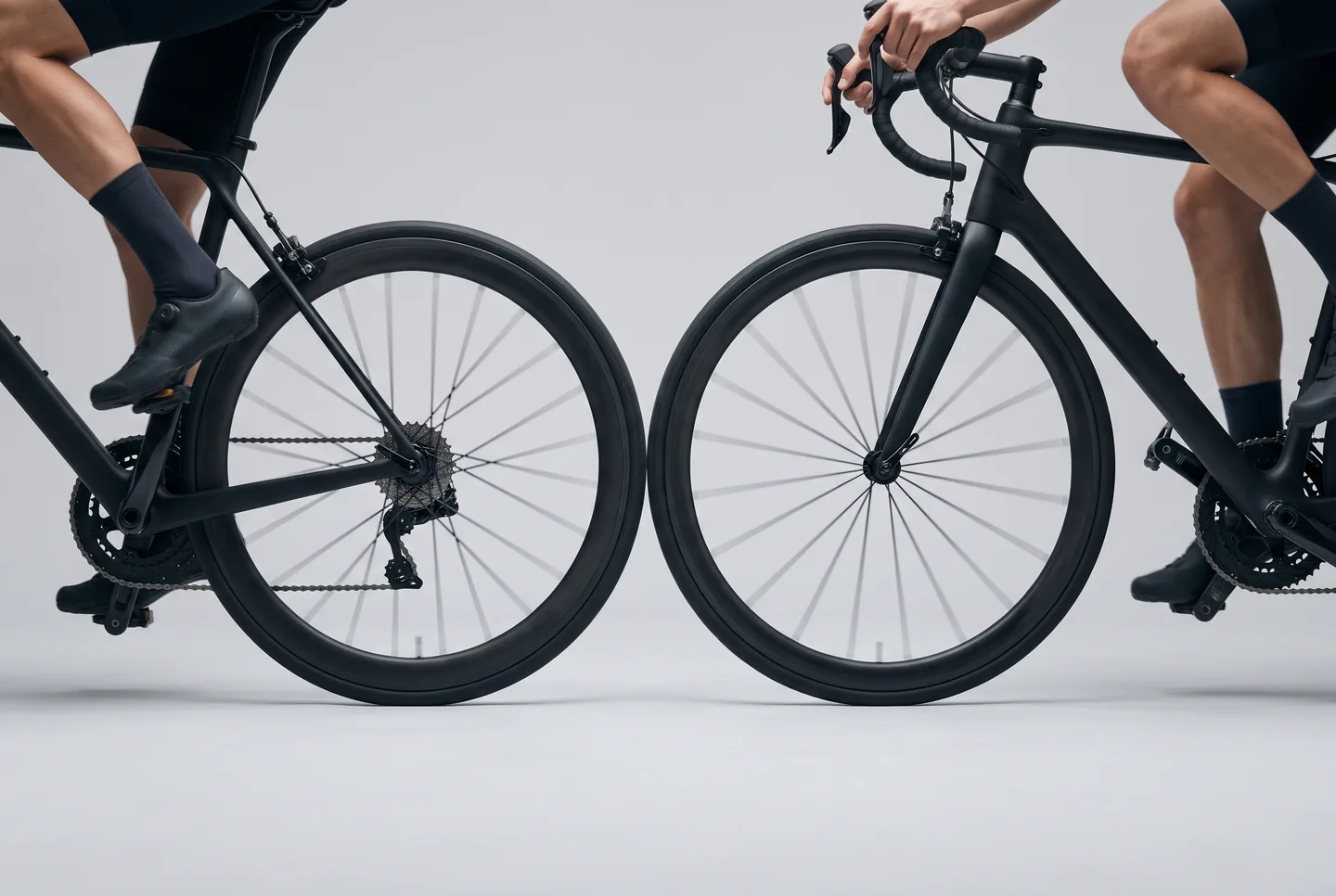
- Never overlap wheels. Don’t let your front wheel sit alongside the rear wheel of the rider in front. If they move over, you go down. Look up the road, past the rider ahead of you.
- Closer means less margin. You save more the closer you get1,2, but at 20 cm (8 in) you have almost no time to react if the rider in front brakes or swerves. Ride at a gap you can hold without tensing up.
- No aero bars in a group. You need to be able to reach the brakes at all times.
- Triathlon often doesn’t allow it. Many races ban drafting, so check the rules for yours.
When it doesn’t help much
On steep climbs. You’re going slowly, and at low speed air has little effect on your effort, so the draft doesn’t do much either.
In a crosswind, the draft moves off to one side and you save less1.
If you do all the pulling. The rider on the front saves very little2,3.
Sources
We read every source ourselves. They’re all public pages you can read for free.
- Politecnico di Milano, 2016. Belloli, Giappino, Robustelli and Somaschini, Procedia Engineering. Two riders with hands on the hoods, on rollers, in a wind tunnel at 50 km/h (31 mph): air resistance of the rider behind and the rider in front at gaps of 5 to 100 cm (2 in to 3 ft), with crosswinds up to 5°. Article
- Blocken and colleagues, 2013. Computers & Fluids. Computer simulation of two riders at 54 km/h (34 mph), sitting upright, in the drops and in a time trial position, from 1 cm to 1 m (0.4 in to 3 ft) apart, checked in a wind tunnel. The introduction sums up older tests (Kyle, McCole, Zdravkovich). Article
- Blocken and colleagues, 2018. Journal of Wind Engineering and Industrial Aerodynamics. Computer simulation of two groups of 121 riders at 54 km/h (34 mph), checked in a wind tunnel: air resistance of each rider compared with riding alone. Article
- Monash University, 2015. Barry and colleagues, Sports Engineering. Four athletes in single file 12 cm (5 in) apart in a wind tunnel at 65 km/h (40 mph), as in the team pursuit: air resistance in each position. Study (PDF)