GUIDES · WEIGHT
Lightening your bike: what a gram is worth.
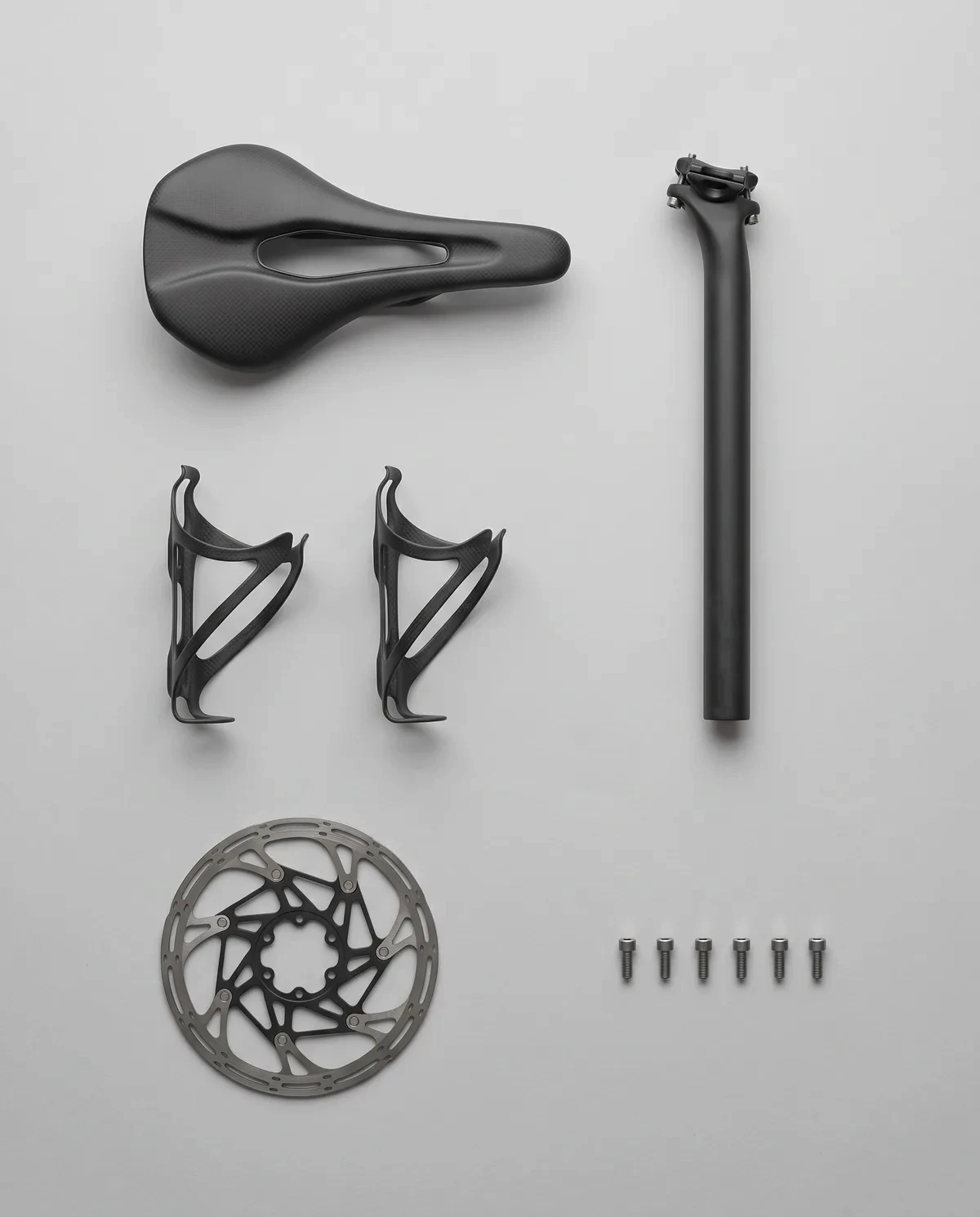
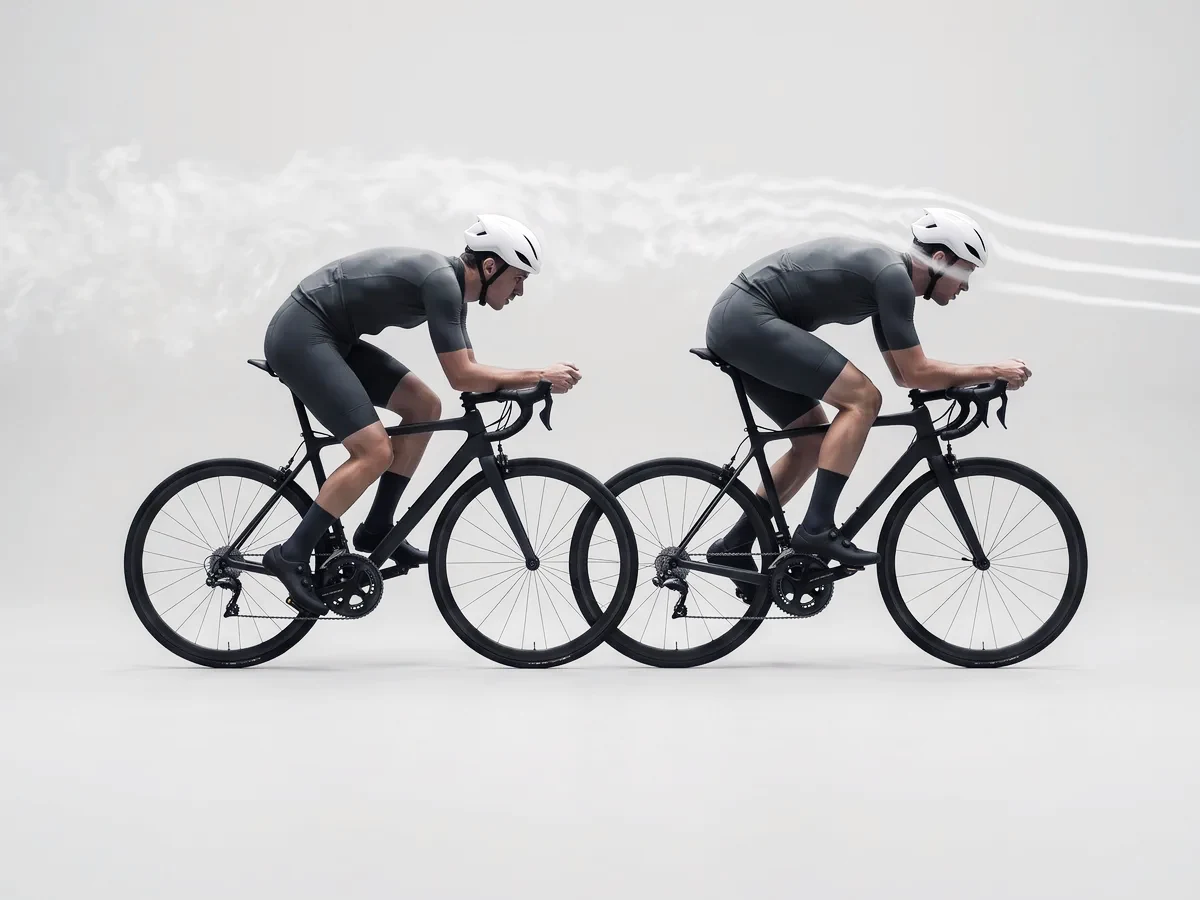
You feel every kilo on a climb and hardly notice it on the flat. On the example gravel ride, 1 kg (2.2 lb) is worth about 45 seconds, but shaving grams gets expensive. Saving 100 g costs anywhere from about €25 to €1,200, depending on the part. Before you start lightening your bike, sort out your tires, chain and aero first.
45 s
What 1 kg (2.2 lb) less is worth on the example gravel ride, 62 km (39 mi) with 780 m (2,560 ft) of climbing. On the example MTB ride it’s 73 s.
−0'50"
All twelve gravel weight upgrades together on the same ride. That’s about 1.10 kg (2.4 lb) less, for €7,350.
36 s
What 1 kg (2.2 lb) less is worth on a 10 km (6.2 mi) climb at 7% at 200 W. Over the same 10 km on the flat, it’s about 1 second.
€25–1,200
What it costs to save 100 g, from foam grips to a top-end derailleur. Almost all the weights are manufacturer claims.
What a kilo is worth
When you ride, you’re working against air, tire rolling resistance and, on climbs, gravity. The weight of bike and rider affects two of them. Rolling resistance grows with weight, and gravity depends on weight and grade1.
On the flat, gravity isn’t holding you back, so only rolling resistance is left, and one more kilo on top of over 80 kg (176 lb) changes very little. On a climb, almost all your power goes into hauling you and the bike up. The steeper the road, the slower you go, so the air matters less and weight matters more1.
Using the calculator’s model over 10 km (6.2 mi) at 200 W, 1 kg less is worth about 1 second on the flat and 36 seconds on a 7% climb. On that climb, 1 kg is just over 1% of the total weight, and it cuts your time by about 1%.
SECONDS GAINED WITH 1 KG (2.2 LB) LESS OVER 10 KM (6.2 MI)
At 200 WAt 250 W
Flat
3% climb
5% climb
7% climb
10% climb
Rotating weight. None of these parts sits at the rim. Rotors and cogs spin near the hub, so the calculator counts them as static weight, and a gram there is worth the same as a gram on the frame.
What the tests say
The math. TOUR, a German magazine, calculates that on a 10 km (6.2 mi) alpine climb at 7% and a steady 250 W, 1 kg less saves only about 25 seconds, the same as having 2.5 W more. On the flat, it says, the effect is barely measurable2. Our model gives 28 seconds on the same climb at 250 W, with our 84.1 kg (185 lb).
CyclingAbout ran the same calculation for a touring cyclist at 200 W over 100 km (62 mi), with 98 kg (216 lb) of rider, bike and luggage. One extra kilo cost 10 seconds on the flat, 30 seconds with 1,000 m (3,280 ft) of climbing at 2%, and 1'30" with 2,000 m (6,560 ft) of climbing at 4%3.
A real-world test. In 2010 an English doctor, Jeremy Groves, rode his 43.5 km (27 mi) round-trip commute 56 times. Each day he flipped a coin to pick between his 13.5 kg (30 lb) steel bike and a 9.5 kg (21 lb) carbon one. He averaged 1 h 47'48" on the steel bike and 1 h 48'21" on the carbon one, a difference small enough to fall within the test’s margin of error4.
The test measured time, not power, and on a city commute traffic, stoplights and wind all play a part. Still, it shows clearly that 4 kg less out of about 90 kg of bike and rider wasn’t enough to show up on the clock4.
How much each part saves
The calculator has 16 upgrades that only save weight. For each one we count the grams saved over a stock part, with a central value and a range, because it depends on what you’re running now.
Almost all these weights are manufacturer claims, or come from magazines that report those claims. That’s why 15 of the 16 weight upgrades in the calculator are labeled CLAIMED. The bolts are labeled ESTIMATED, because that number is our own calculation. There are 12 upgrades on road and gravel and 14 on the MTB, where the frame and the derailleur, shifters and brakes are labeled ESTIMATED too. When someone actually weighs the parts, sometimes the numbers match and sometimes they don’t. A bottle cage claimed at 18 g weighed 215, a pair of shifters claimed at 689 g weighed 708, and a derailleur claimed at 262 g weighed 2606.
WHAT 100 G LESS COSTS
| ITEM | LESS | PRICE | PER 100 G |
|---|---|---|---|
| Grips (MTB) | 60 g | €15 | €25 |
| Bar tape | 30 g | €35 | €117 |
| Thru-axles, pair | 50 g | €80 | €160 |
| Bottle cages, pair | 35 g | €60 | €171 |
| Seatpost | 90 g | €180 | €200 |
| Handlebar and stem (MTB) | 125 g | €340 | €272 |
| Rotors, pair | 45 g | €140 | €311 |
| Saddle | 70 g | €250 | €357 |
| Titanium bolts | 30 g | €110 | €367 |
| Cassette | 100 g | €375 | €375 |
| Pedals | 50 g | €220 | €440 |
| Crankset | 100 g | €500 | €500 |
| Shock (MTB) | 80 g | €400 | €500 |
| Frame | 300 g | €3,000 | €1,000 |
| Fork (MTB) | 100 g | €1,100 | €1,100 |
| Derailleur, shifters and brakes | 200 g | €2,400 | €1,200 |
Where the numbers come from.
- Handlebar and stem (MTB). An aluminum handlebar weighs 278–340 g and a carbon one 215–254 g7. One brand that makes both claims 310 and 233 g8. We found no source for the light stem. In the calculator: 80 to 170 g.
- Bottle cages. Carbon cages weigh 12 to 30 g each, aluminum 22–26 g, and plastic or composite 41–50 g5,9. A pair saves anywhere from almost nothing, if you already have light aluminum ones, to about 75 g. In the calculator: 10–75 g.
- Bar tape. Light tape weighs 39–56 g and regular tape 74–95 g. The 4.6 mm version of one tape weighs 50 g more than its 1.8 mm version10. In the calculator: 15–50 g.
- Grips (MTB). A pair of lock-on grips weighed by a reviewer came in at 106 to 114 g depending on the version, and a silicone pair without lock-on collars at 60 g11. The maker of the lightest lock-on grips claims 68 g12, and the maker of a pair of XC foam grips claims 40 g13. In the calculator: 20–75 g.
- Rotors. A light 160 mm rotor weighs 104–120 g, and a stock one 114 to about 155 g14,15. A pair saves about 15 to 70 g, depending on your current rotors. In the calculator: 15–70 g.
- Thru-axles. Bikerumor says light axles weigh 39 g less than stock at the front and 40 g less at the rear16. In the calculator, for the pair: 30–80 g.
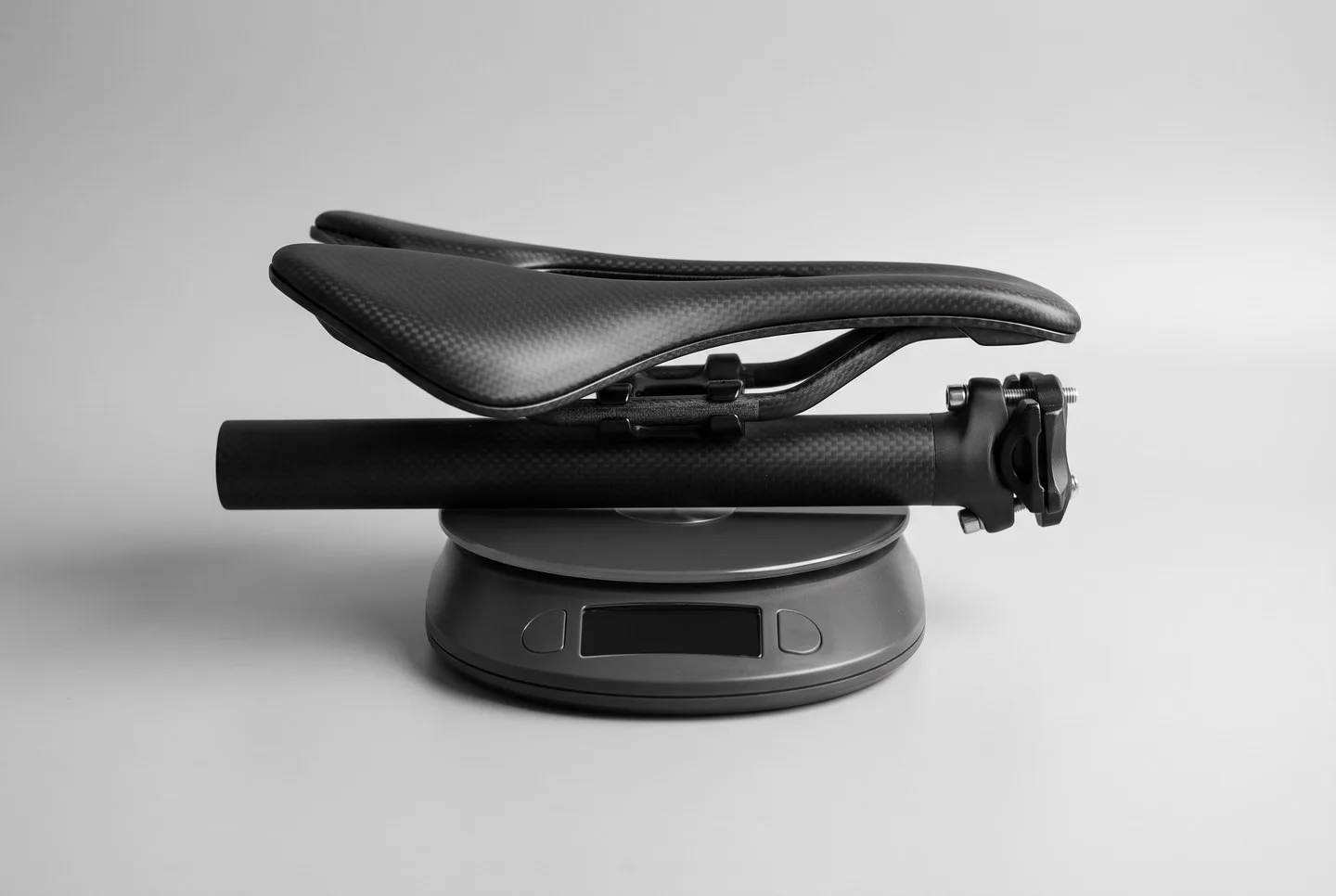
- Saddle. A saddle with steel rails weighs 220–320 g, with titanium rails 230–238 g, and with carbon rails 138–204 g17. Going from steel to carbon saves about 20 to 180 g, and from titanium about 25 to 100 g. On a stock bike, though, the rails are usually alloy. The same model weighs 225–232 g with alloy rails and 190–196 g with carbon rails, 35 g less38,39. In the calculator: 35–150 g, with 70 as the central value.
- Seatpost. Aluminum seatposts weigh 155–259 g and carbon ones 136–220 g, almost all of it claimed18. A light aluminum post can weigh less than a carbon one. In the calculator: 25–130 g.
- Cassette. For 12-speed road, one brand claims 361 g for its mid-range 11-34 cassette, 345 g for the next one up and 253 g for the top-end one, so 16 to 108 g less19. BikeRadar weighed another brand’s top-end 10-36 cassette at 226 g6. On the MTB, the German magazine BIKE says a mid-range 10-52 cassette weighs 452 g and the top-end one 379 g, 73 g less20. In the calculator: 90–110 g on road and gravel, 60–100 g on the MTB.
- Titanium bolts. Titanium weighs 4.43 g/cm³ and steel 7.85, so the same bolt in titanium is 44% lighter21. Swapping every steel bolt on an MTB saves about 50 g22. In the calculator: 15–45 g, our own estimate.
- Crankset. On the road, one brand’s three cranksets have claimed weights of 685–754 g19. BikeRadar weighed one with carbon arms, smaller chainrings and a built-in power meter at 574 g6. That’s about 110–180 g less, but a crankset like that costs about twice our €500. On the MTB, weighed on a scale, the mid-range crankset came in at 745 g, the next level up at 712 g and the top-end one at 561 g, so 33 to 184 g less40. In the calculator: 30–180 g, with 100 as the central value.
- Pedals. On the road, a mid-range pair weighs 260 g, a high-end pair 234–248 g, and one of the lightest pairs 183 g23. On the MTB, one brand claims 120 g per pedal for its XC model and about 190 g for its tougher ones, a 140 g difference per pair24. In the calculator: 20–70 g on road and gravel, 30–140 g on the MTB.
- Fork (MTB). A light 100 mm XC fork weighs about 1,330 g. Bike Perfect says it’s 100–140 g lighter than two rivals and almost 200 g lighter than the previous model25. The same brand’s 120 mm fork weighs 1,537 g26. In another test of current XC forks, the differences ranged from about 40 to 140 g41. In the calculator: 40–200 g, with 100 as the central value, because an 11.9 kg (26.2 lb) MTB already has an XC fork. The 200 g is the difference from the previous model or from the 120 mm fork25,26.
- Shock (MTB). The maker says a regular 190×45 shock weighs 313 g and a light one in the same size 236 g, about 75 g less27,28. In the calculator: 50–100 g.
- Derailleur, shifters and brakes. On the road, for shifters, rear and front derailleurs and disc calipers, the maker claims 258 g less going from mid-range to top-end, and 98 g less for the next level up19. On the MTB, weighed on a scale, the lightest derailleur in the range was 50 g lighter than the mid-range one40. We found no data for the brakes, so on the MTB this upgrade is an estimate. In the calculator: 100–260 g on road and gravel, 50–250 g on the MTB.
- Frame. By the claimed figures, a mid-range aluminum frame and a mid-range carbon frame of the same model weighed almost the same, 1,131 and 1,149 g. The top version weighed almost half that29. Two high-end carbon frames weighed 785 and 641 g, 144 g apart30. We have no source for the MTB, so there it’s an estimate. In the calculator: 140–500 g on road and gravel, with 300 as the central value, and 140–800 g on the MTB.
What it’s worth on your ride
The calculator simulates your ride twice at the same power, once at your current weight and once with 1 kg less. The difference is what a kilo is worth on your ride. Each upgrade is then worth its grams times that number, so 120 g is worth 0.12 of a kilo. You’ll find it at the bottom of the plan, under “How we calculated it”.
To see what a kilo is worth on your ride without building the whole plan, use the weight savings calculator.
On the example gravel ride, 62 km (39 mi) with 780 m (2,560 ft) of climbing in 2 h 38', 1 kg is worth about 45 seconds. On the example MTB ride, 35 km (22 mi) with 900 m (2,950 ft) in 2 h 30', it’s worth 73 seconds, because there’s more climbing and you’re slower. On the example road ride, 80 km (50 mi) with 900 m (2,950 ft), it’s 35 seconds.
On the example gravel ride, the frame is worth about 13 seconds, between 6 and 22. The derailleur, shifters and brakes are worth 9 seconds, the crankset, seatpost and cassette 4 each, the saddle 3, the pedals, bottle cages, axles and rotors 2 each, and the bar tape and bolts 1 each. All twelve together, without rounding each one, come to about 1.10 kg (2.4 lb) less and 0'50", for €7,350. On the example MTB ride, the handlebar and stem are worth about 9 seconds, the fork 7 (between 3 and 15), the shock 6 and the grips 4. On your ride it could be more or less, depending on how much you climb and how fast you go.
What it costs. We count the price of the new part from online stores, as shown in the table above. Bar tape, grips, rotors, cassettes, chainrings and cleats all wear out. If yours are due for replacement, check them in the calculator and we only count the difference. Bar tape costs €35, for example, but if yours needed replacing we count €20, because you would have spent the other €15 anyway. If you find a better price, you can change it on the ladder and it reorders itself.
The range. Each upgrade has a low and a high value, because how much you save depends on what you’re running now. If you know the real weights, use “Add your own component”. Enter what the new part weighs and what the old one weighs, and we’ll put it on the ladder in place of our upgrade.
NUMBERS FROM THE CALCULATOR
On the example ride for each discipline, with a 74 kg rider. Each upgrade is counted on its own, without the others.
| Seconds · cost · rank | ROAD | GRAVEL | MTB |
|---|---|---|---|
| Carbon bottle cagespair | −0'01"€6015th | −0'02"€6011th | −0'03"€605th |
| Light bar tape | −0'01"€3513th | −0'01"€3512th | — |
| Light thru-axlespair | −0'02"€8014th | −0'02"€8013th | −0'04"€806th |
| Carbon seatpost | −0'03"€18016th | −0'04"€18014th | — |
| Light brake rotorspair | −0'02"€14017th | −0'02"€14016th | −0'03"€16013th |
| Carbon saddle | −0'02"€25021st | −0'03"€25017th | −0'05"€25011th |
| High-end cassette | −0'03"€37522nd | −0'04"€37518th | −0'05"€33015th |
| Titanium bolts | −0'01"€11018th | −0'01"€11019th | −0'02"€11014th |
| Light pedals | −0'02"€22019th | −0'02"€22020th | −0'05"€2209th |
| Carbon crankset | −0'03"€50023rd | −0'04"€50022nd | −0'07"€50017th |
| Lighter frame, same geometry | −0'10"€3,80026th | −0'15"€3,00023rd | −0'35"€4,50020th |
| Top-end derailleurs, shifters and brakes | −0'07"€2,40025th | −0'09"€2,40025th | −0'10"€1,40019th |
| Ultralight foam grips | — | — | −0'04"€154th |
| Carbon handlebar and light stem | — | — | −0'09"€3408th |
| Lighter shock | — | — | −0'06"€40016th |
| Lighter fork | — | — | −0'07"€1,10022nd |
—: not counted in that discipline. Updated from the calculator on NOVEMBER 18, 2026.
Where to start
The calculator ranks everything by euros per second, and weight upgrades almost always come after the rest. On the example gravel ride they start at the twelfth step, after tires, tubeless, chain, helmet, shoe covers, aero clothing, pulleys and wheels. Tubeless is worth 2'16" for €45 and a waxed chain 1'10" for €50. Gaining 0'50" by cutting weight takes all twelve upgrades, for €7,350.
Among the weight upgrades, it makes sense to start with the ones that cost the least per 100 g, and to do them when the part needs replacing anyway:
- Grips and bar tape, about €25 and €117 per 100 g. They’re cheap and they wear out, though here comfort matters more than the seconds.
- Axles and bottle cages, €160–171.
- Seatpost, €200, and handlebar and stem on the MTB, €272.
- Rotors, saddle, bolts, cassette, pedals and crankset, €311–500. Choose a saddle for comfort before weight. Rotors, cassette, crankset and pedals make sense when your rotors, cogs, chainrings or cleats are worn out, since the calculator only counts the difference. One manufacturer says a 1.8 mm rotor should be replaced when it wears down to 1.5 mm31.
- Fork, shock, frame, derailleur and shifters, €500 to €1,200. People replace these for other reasons, and the time gained is small.
Titanium bolts and torque specs
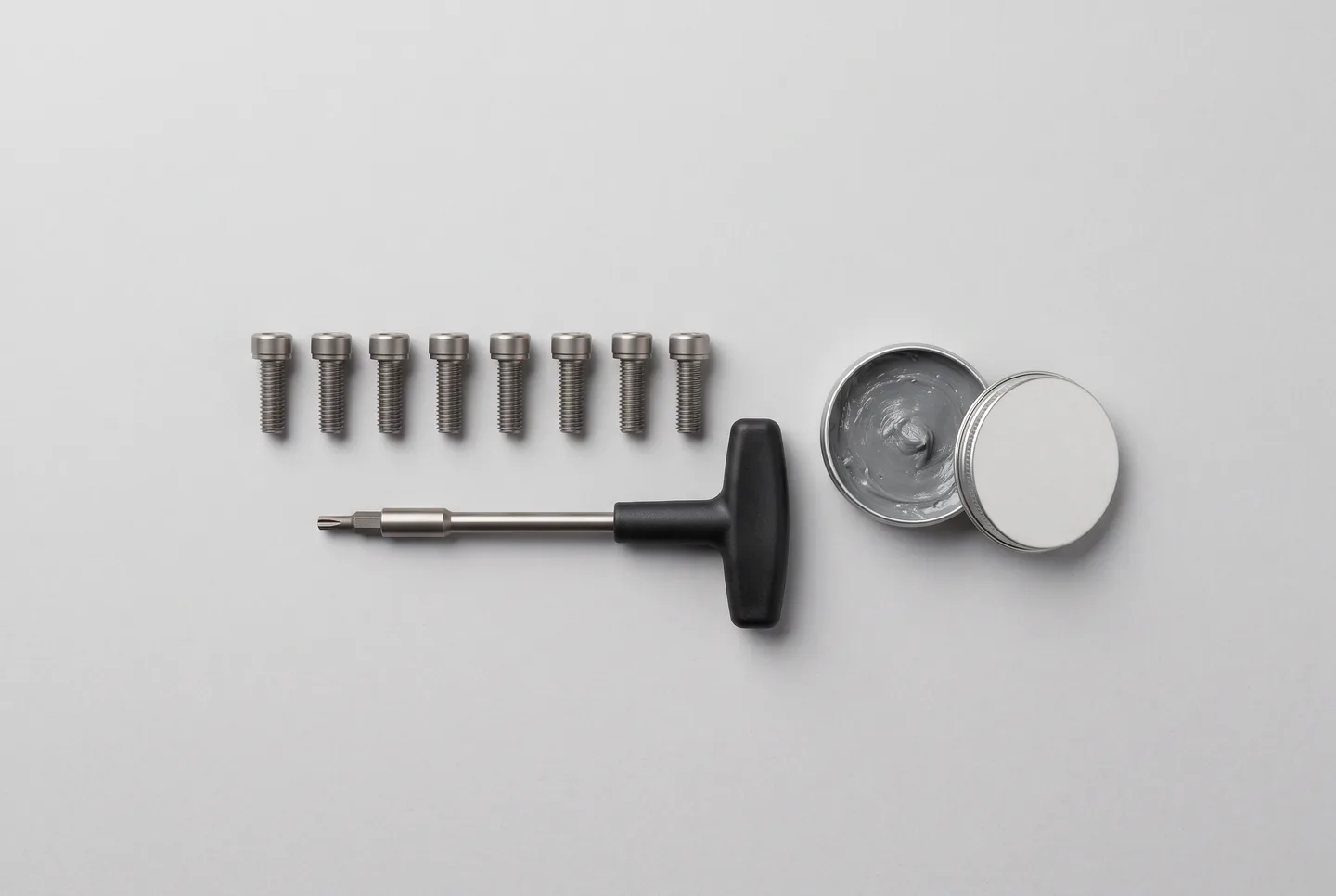
Titanium bolts are the classic upgrade for saving a few grams, about 30 g across the whole bike in the calculator. Titanium weighs 44% less than steel21. BikeRadar says it’s generally not as strong as steel, and that on critical parts like stem bolts and brake caliper bolts you’re better off sticking with steel22.
How to install them.
- Use anti-seize, except on rotor bolts. Titanium can gall, meaning it cold-welds to the threads and takes so much force to undo that you can strip the head22. Anti-seize puts a layer between the metals and protects the threads32.
- Torque to spec. Use a torque wrench and the part maker’s value. Too tight and the bolt damages the threads or the part, too loose and it works free as you ride. Torque specs vary a lot by brand, from 2 to 6.2 N·m for rotor bolts alone. Generic charts are only a rough guide33.
- No grease on rotors, and only bolts approved by the brake maker. Don’t grease or oil rotor bolts, because braking heat can carry the oil onto the rotor. They go in with threadlocker, which new bolts sometimes already have, and get tightened in a star pattern34.
The seatpost. It has to go into the frame at least as far as the minimum insertion mark. If there’s no mark, insert at least 2.5 times its diameter, or it can break. A carbon post in a carbon frame usually goes in dry, and in a metal frame you grease it, but check the manufacturer’s instructions first. If it slips even at the right torque, use carbon paste35.
Fork and shock. Getting the sizes right comes before weight. The fork needs the right steerer for your headset, the right brake mounts and the right axle for your wheel, and it’s best to stay within 20–25 mm of the original travel36. For the shock, eye-to-eye length and stroke are what matter. It mounts to the frame with an eyelet or a trunnion, and the bike maker specifies the hardware37.
When it’s not worth it
If you mostly ride on the flat. There, 1 kg is worth about a second every 10 km (6.2 mi), and aero matters much more. TOUR says the rider’s body makes up 80% of the air resistance, and swapping a flapping jacket for close-fitting clothing is easily worth 25 W at 35 km/h (22 mph)2.
If your bike is already light. There are only a few grams left to cut, and they cost more. A light aluminum seatpost can weigh less than a carbon one18, and two high-end carbon frames were just 144 g apart30.
If your tires, chain and aero aren’t dialed in yet. On the example gravel ride, fast-rolling tires are worth 3'24" for €95, while all the weight upgrades together are worth 0'49" for €7,350. Tires, tubeless and waxed chains each have their own guide.
If you just like the idea. That’s fine. In the calculator, some of these upgrades show up under “For the looks”. They’re only worth a few seconds, but they change how the bike looks, and if that makes you want to ride more, it counts too.
Sources
We read every source ourselves. They’re all public pages you can read for free. Prices are approximate, from online stores in November 2026. We don’t link to the stores, because the site doesn’t tell you where to buy.
- Steve Gribble. The cycling power formulas: gravity, rolling resistance and air, and how weight enters the first two. Page
- TOUR, 2026. What 1 kg less is worth on a 10 km (6.2 mi) climb at 7% at 250 W, on the flat, and what air is worth in comparison. Article
- CyclingAbout, 2016. What each extra kilo costs at 200 W over 100 km (62 mi), on the flat and uphill, simulated for a touring cyclist. Article
- Groves, BMJ, 2010. Randomized trial over 56 commutes with a 13.5 kg (30 lb) steel bike and a 9.5 kg (21 lb) carbon one. Study
- road.cc, 2023. Review of a carbon bottle cage, weighed and compared with other carbon and aluminum ones. Review
- BikeRadar, 2024. A top-end road groupset weighed piece by piece, with the claimed weights alongside: shifters, derailleur, crankset with carbon crank arms, cassette. Article
- OutdoorGearLab, 2025. Carbon and aluminum MTB handlebars tested, with weights. Article
- PNW Components, 2024. Component maker. Claimed weight of its carbon and aluminum MTB handlebars. Article
- BikeRadar, 2025. Bottle cages tested, with weight and material. Article
- Cycling Weekly, 2026. Review of a light bar tape, with the weights of other tapes and of versions of different thickness. Review
- Cyclingnews, 2026. MTB grips tested: some pairs of lock-on grips weighed by the reviewer, one silicone pair without a lock-on collar. Article
- Singletracks, 2024. The lightest lock-on grips: claimed weight of the pair. Article
- Syncros. Maker. Product page for XC foam grips, with the claimed weight. Product page
- road.cc, 2023. Review of a light 160 mm, 1.8 mm rotor, compared with a stock rotor. Review
- Bikerumor. A light 160 mm rotor weighed and compared with the stock rotors it replaced. Article
- Bikerumor. Light thru-axles: how much less they weigh than stock ones. Article
- Cyclingnews, 2026. Road saddles, with the weight and the material of the rails. Article
- Cyclingnews, 2022. Carbon and aluminum road seatposts, with weights, mostly claimed. Article
- BetterShifting, 2026. Three 12-speed road groupsets from the same maker, with the claimed weights of shifters, derailleur, front derailleur, calipers, crankset and cassette. Article
- BIKE, 2020. German magazine. Mid-range and top-end 10-52 MTB cassettes, with weights. Article
- University of California, Davis. Mechanics of materials handout: density of steel and titanium alloy. Table (PDF)
- BikeRadar, 2025. The worst MTB upgrades according to the editors: how much you save with titanium bolts, galling and where not to use them. Article
- Cyclingnews, 2026. Road pedals tested, with the weight of the pair. Article
- BikeRadar, 2024. Claimed weights of one maker’s pedals, road and MTB. Article
- Bike Perfect, 2021. Review of a light 100 mm XC fork, compared with two competitors and with the previous model. Review
- Singletracks, 2020. Claimed weights of two XC forks, 100 and 120 mm. Article
- SRAM. Maker. Product page for a regular 190×45 shock, with the claimed weight. Product page
- SRAM. Maker. Product page for a light 190×45 shock, with the claimed weight. Product page
- BikeRadar, 2018. Weights claimed by the maker for an aluminum frame and two carbon ones of the same model. Article
- Cycling Weekly, 2020. Claimed weights of two high-end carbon frames, the new one and the previous one. Article
- TRP. Brake maker. Rotor manual: minimum thickness and bolt torque. Manual (PDF)
- Park Tool. Threads: grease, anti-seize paste and threadlocker. Guide
- Park Tool. Torque specs: why they matter and the values makers specify. Guide
- Park Tool. How to remove and install a brake rotor. Guide
- Park Tool. How to remove and install a seatpost: minimum insertion, grease and carbon paste. Guide
- Singletracks, 2026. What to check when changing the fork on an MTB. Article
- Marzocchi. Suspension maker. The measurements you need to choose a shock. Page
- Fizik. Spec page of a saddle with alloy rails: claimed weight. Spec page
- Fizik. Spec page of the same saddle with carbon rails: 190–196 g claimed. Spec page
- The Pro’s Closet. A retailer weighs three levels of the same MTB groupset on the scale: crankset, derailleur, shifter, cassette. Article
- bike-test.com, 2025. Test of a light XC fork, with the weights of its competitors and of the 120 mm model. Test