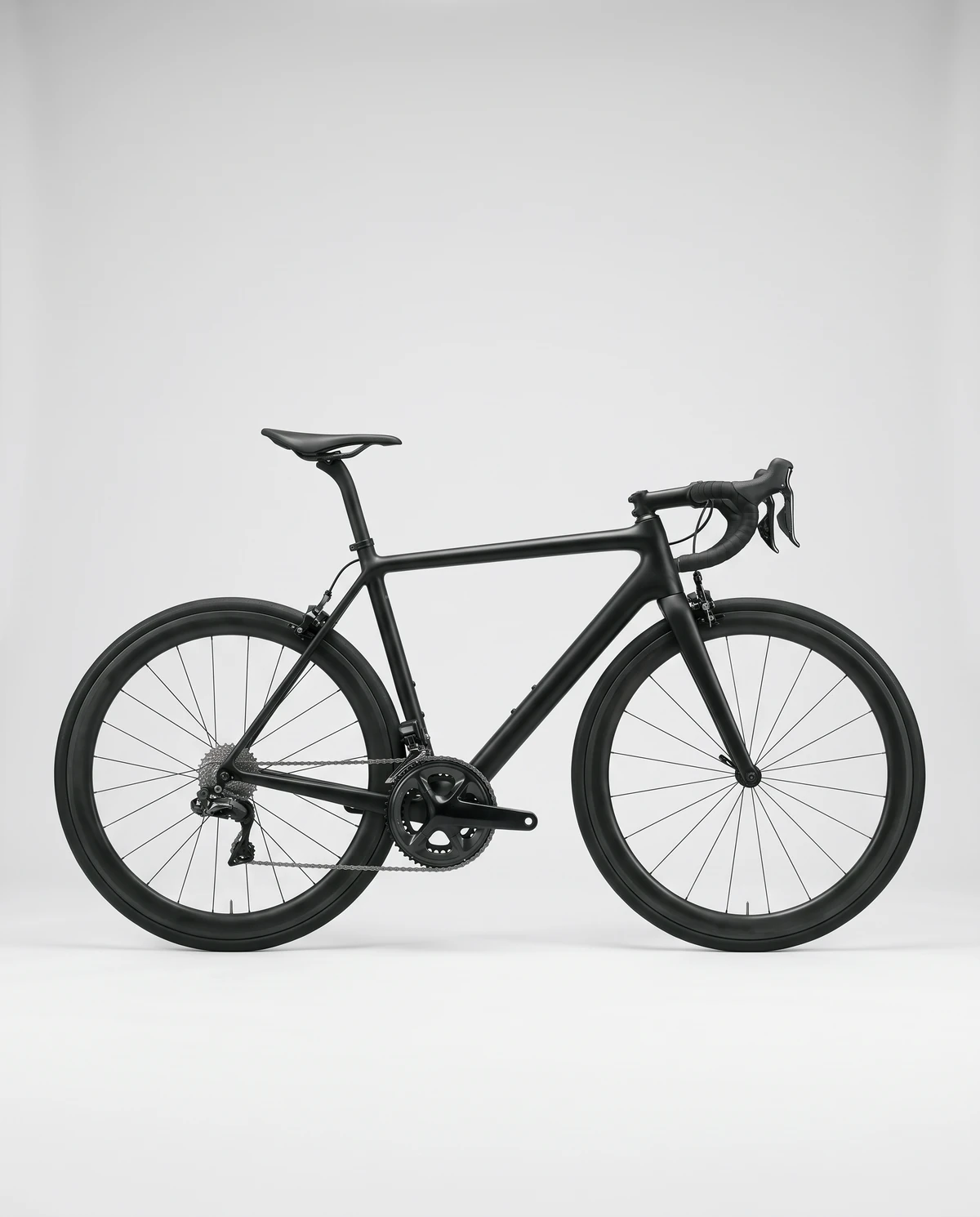
CALCULATOR · WEIGHT
What 1 kg less is worth on your ride
Describe your ride and see how many seconds a kilo less is worth, whether it comes off the bike or off you. It uses the same math as the MARGINE calculator. It runs the ride twice at the same power, once at your current weight and once at the lighter weight.
YOUR RIDE
The weight you drop can come off the bike or off you. When you’re climbing, a kilo is a kilo. For 200 grams, enter 0.2 kg (0.44 lb).
Profile
The profile sets how the elevation gain is spread out. Flat and rolling rides have lots of short ups and downs. Mountain rides have a few long climbs.
Bike
Your position
Pick the one you hold for most of the ride. On a TT bike, it’s your position on the aero bars.
Tires
My numbers (optional)
If you know your CdA and Crr from a test, enter them here. They replace our estimates for position, tires and surface.
1 KG LESS IS WORTH
−0'35"
Over 80 km with 900 m of climbing, at the same power.
- Power
- 201 W
- Same as
- +1.3 W
- Ride time
- 2h51'26"
| Climbs | −39 s |
|---|---|
| Descents | +6 s |
| Flat | −2 s |
We assume a rider weighing 74 kg plus 1.5 kg for helmet, shoes and clothing, on a road bike weighing 8.6 kg. CdA is 0.38 m² in a medium position. Crr is 0.0055 with normal tires and butyl tubes on pavement. Air density is 1.2 kg/m³ and 2.5% is lost in the drivetrain. We split the ride the way the full calculator does, into 16 km of climbs and descents at a 5.3% grade, 48 km of short ups and downs at 2% and 16 km of flat road. Power stays the same from start to finish, descents included, and each section is ridden at a steady speed, with no momentum carried over and no braking. We cap speed at 60 km/h. We also assume no wind, no drafting and no stops.
How we calculate it
The calculator splits the ride into 50 m (164 ft) sections and finds the speed on each one using the model by Martin and colleagues, as described in a review by Crouch and colleagues1. The watts you put into the pedals go into lifting you and the bike, and into overcoming rolling resistance and air resistance. Martin and colleagues tested it on the road with a power meter. The model’s watts and the measured watts matched almost exactly, with a typical gap of 2.7 W2. Our math uses the steady-speed part of the model and leaves out acceleration.
If you enter an average speed, the calculator finds the steady power that gets you through the ride in that time. Then it runs the ride again at that power with the lighter weight. The difference between the two times is the big number. It’s the same math as in the full calculator, which shows it at the bottom of the plan, under “How we calculated it.” You’ll find the starting values (CdA, Crr, bike weights), with sources, in our list of starting values.
In our math, weight only goes into gravity and rolling resistance, and both use one number for rider, bike and clothing together. That’s why a kilo counts the same on the bike or on you. Wheel weight matters a little more only when you accelerate, and the math leaves accelerations out. There’s more on this in the guide on whether rider weight or bike weight matters more.
Where you save time
Almost all of it comes on the climbs. You’re slow there, and most of your watts go into getting you up. On the flat a kilo only changes rolling resistance, so it’s worth just a few seconds. In the table, “Climbs” and “Descents” include the short ups and downs too.
On descents it goes the other way. At the same power, a kilo less makes you a little slower, because gravity pushes you less. That’s why descents get a plus sign in the table. We cap descending speed at 60 km/h (37 mph) on road and TT bikes, 45 km/h (28 mph) on gravel and 35 km/h (22 mph) on a mountain bike. Once you hit that, weight doesn’t change anything. In real life you often stop pedaling on a descent and brake before the corners, so the number there is only a rough guide. But a kilo less certainly won’t make you descend any faster.
On short ups and downs, momentum carries you over the top, and the math can’t see that. On rides with lots of short ups and downs, a kilo is worth less than what we show.
The math can’t do a completely flat ride. As in the full calculator, the short ups and downs in every profile always go up and down at 2%, which makes 10 m of elevation gain for every kilometer of them (53 ft per mile). If you enter less elevation gain than that, the calculator tells you under the result, and a kilo is worth a little more than on a flat ride.
1 KG (2.2 LB) LESS ON THE EXAMPLE RIDES
| RIDE | POWER | 1 KG | SAME AS |
|---|---|---|---|
| Road, 80 km, 900 m | 201 W | 35 s | +1.3 W |
| Gravel, 62 km, 780 m | 179 W | 45 s | +1.5 W |
| MTB, 35 km, 900 m | 162 W | 73 s | +1.7 W |
| TT, 90 km, 600 m | 190 W | 25 s | +1.0 W |
A kilo or a few watts
On the example road ride, a kilo less is worth the same as 1.3 W more. On a climb it’s worth more. TOUR, a German magazine, calculates that over 10 km (6.2 mi) at 7% and 250 W, a kilo less saves about 25 seconds, the same as 2.5 W more. On the flat, the magazine says, the effect is barely measurable3. With our math, for a 74 kg (163 lb) rider on an 8.6 kg (19 lb) bike, it’s about 28 seconds on the same climb.
The number depends mostly on how much you climb and how fast you go. The more climbing and the slower you go, the more a kilo is worth. At the same speed, the more you weigh, the less a kilo is worth, because it’s a smaller share of the total. At the same power, though, a heavier rider climbs slower and spends longer on the climb, so a kilo saves them a few more seconds. For a single climb, there’s the climbing watts and VAM calculator.
Taking a kilo off the bike costs a lot. We go into that in the guide on how to lighten your bike. Body weight depends on health, nutrition and training, and we don’t give advice on changing it here. The math keeps your power the same. If the weight comes off your body, your watts can change too, and the math doesn’t know that.
Sources
- Crouch, Burton, LaBry and Blair, 2017. Scientific review of cycling aerodynamics in Sports Engineering. It covers the power model by Martin and colleagues, weight mattering more than air when the road climbs, air density and CdA in different positions. Study (PDF)
- Martin, Milliken, Cobb, McFadden and Coggan, 1998. Journal of Applied Biomechanics. The power model tested on the road with a power meter: R² 0.97 between calculated and measured watts, standard error 2.7 W. Abstract
- TOUR, Josh Welz, July 12, 2026. German magazine. What 1 kg less is worth on a 10 km (6.2 mi) climb at 7% at 250 W, and on the flat. Article