GUIDES · DRIVETRAIN
Waxed chain, drip wax or oil: how many watts and how to do it.
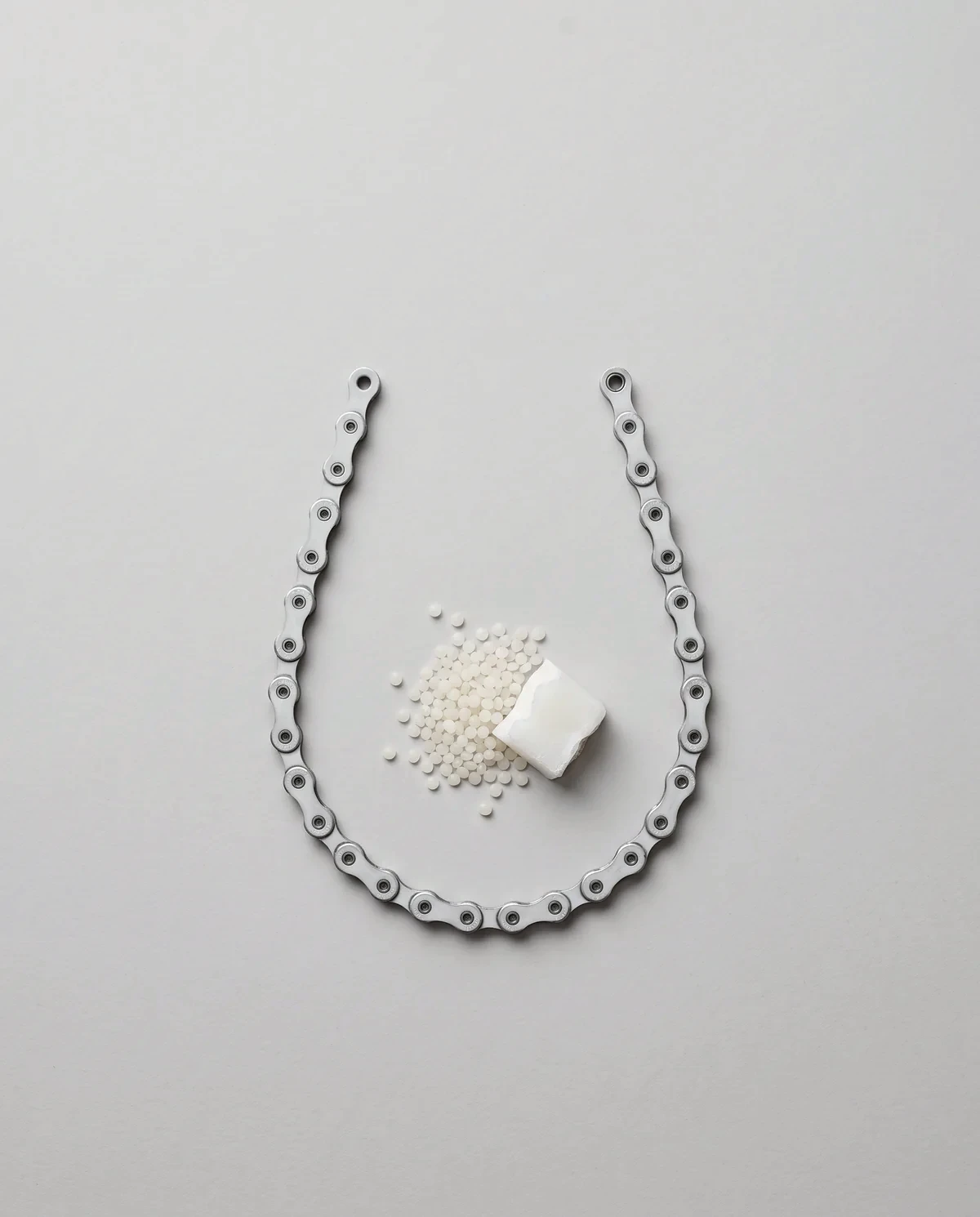
A dirty chain wastes watts and wears out fast. Wax keeps it clean, which is worth 1 to 6 W at 250 W, and the chain lasts much longer. The catch is a deep clean before the first waxing and a fresh dip about every 300 km (190 mi). Here you’ll also find a comparison with drip wax and oil.
1–6 W
What you save at 250 W over oil. It’s not much if the chain was already clean and well lubed, and a lot if it was dirty.
−1'10"
What it’s worth on the example gravel ride, 62 km (39 mi) with 780 m (2,560 ft) of climbing, for about €50 of wax and solvents.
300 km
How often to rewax on dry roads (about 190 mi). Off-road, every 6–8 hours, and right away after rain.
2×
The chain lasts at least twice as long as with a typical oil, even with plenty of water and dirt.
Where the watts go
A clean chain gets almost all your power to the cogs. In the lab it was up to 98.6% in the 1999 Johns Hopkins University test1, and over 98% in the Purdue University test2. The rest goes to friction. Each link bends as it wraps onto the teeth and straightens as it comes off, while the pins, plates and rollers rub against each other. The smaller the cog, the more the link bends and the more you lose1.
Lube helps those parts slide. Oil also picks up dust and grit, though, and it stays between the links3. That dirt is what slows the chain down and wears it out5,6.
In the 1999 test, the three lubes tried all gave the same efficiency, and the chain did almost as well with no lube at all. The authors said that outside the lab, lube matters mostly because it keeps dirt out1. Later tests on a bench accurate to ±0.02 W found a few watts between lubes even on a clean chain, and confirmed that dirt costs extra watts5. Dirty and worn chains are covered in the guide on the maintenance that costs you watts.
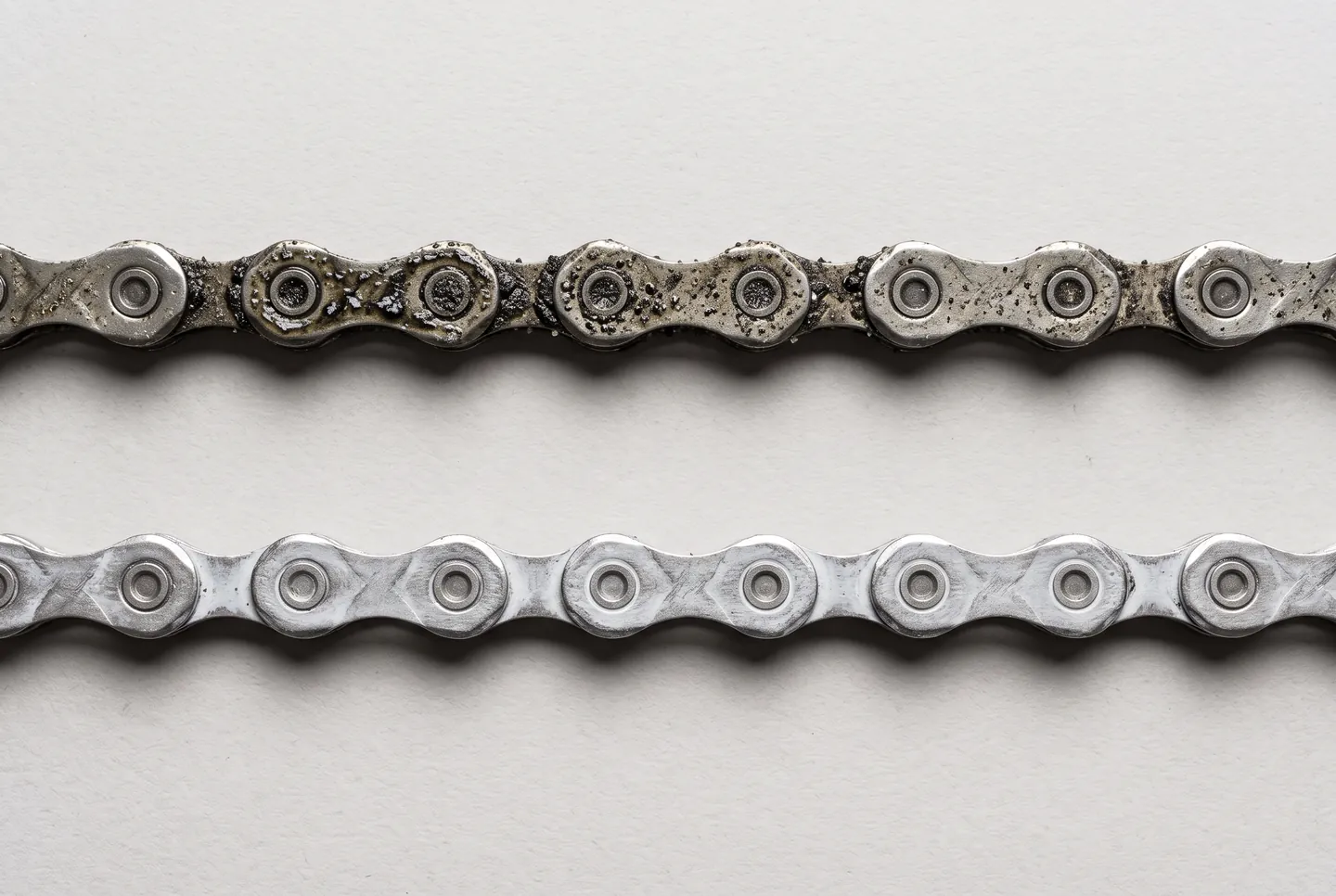
What wax does
With immersion wax, you melt the wax in a pot, dip the chain and let it cool. Once it’s cold the wax is dry and hard. It doesn’t grab dirt the way oil does, so much less gets between the links. Each time you rewax, the old wax melts off into the pot and the chain starts over almost clean3.
There’s also liquid drip wax. You put it on like an oil and let it dry, usually overnight5,6. Further down there’s a comparison of hot wax, drip wax and oil. In the rest of this guide, waxed means hot waxed, by immersion.
What the tests say
Friction. In 2013 and 2014 Friction Facts, an American lab, bench-tested the friction of a long list of lubes for Velo magazine. The bench simulated 250 W with a stated accuracy of ±0.02 W, and each result was the average of three chains. In the 2013 test with clean chains, paraffin was the fastest, 0.24 W better than the best lube and 3.05 W better than the worst. In 2014 a wax with additives came in 0.14 W better than paraffin, and the best drip wax beat paraffin by a few hundredths of a watt. The spread from first to last was 3.68 W5.
In 2013, eight of those lubes also ran for an hour under load with gravel, dirt and water. Four lost about 2 W. They were a grease, a drip wax, a regular oil and a biodegradable oil. Another drip wax lost more than 3.5 W and left the chain dry. Paraffin actually improved by over half a watt, and the only other lube that improved was an oil. By the end, paraffin was nearly 6 W better than the worst lube5.
Keep in mind that Friction Facts was already selling waxed chains when it ran these tests, and the 2013 article says so. In 2015 it sold that business to a component maker5,7.
Durability. Purdue University ran seven waxes and two dry lubes on a bench for dozens of hours. The best waxes stayed consistent for more than 60 hours, while the dry lubes got worse in under 302.
Wear. Zero Friction Cycling, an Australian lab that also sells waxes and chains, runs chains for thousands of kilometers on a motor-driven drivetrain, adding set amounts of dust and water, and measures how much they stretch4,6. On 11-speed and up, a chain should be replaced at 0.5% stretch8. Here’s how many chains you’d wear out in 5,000 km (3,100 mi):
CHAINS WORN OUT EVERY 5,000 KM (3,100 MI)
Typical mid-range drip lubeThe two best immersion waxes tested
Dust
Water and dirt
Lots of water and dirt
With dry dust, chains on the best waxes hardly wear at all. With water and mud the advantage gets smaller, but the chain still lasts more than twice as long as with a typical oil6. The averages across every product Zero Friction Cycling tested point the same way. With water and dirt, chains on immersion wax wear less than a third as much as on liquid drip lubes without wax4. A chain that stretches less also wears the cassette and chainrings less, while one run past its limit wears them out early8.
Hot wax, drip wax or oil
They’re the three most common ways to lube a chain. Hot wax is the immersion wax in this guide. Drip wax goes on drop by drop, like an oil, and then you let it dry. Oil is the classic drip lube, and it stays wet on the chain6.
Wear. Here we don’t scale to 5,000 km (3,100 mi) as in FIG. 03. We count over the whole Zero Friction Cycling test instead. It runs 6,000 km (3,700 mi), alternating clean, dusty, wet and dirty stretches. The chain is never cleaned, only relubed, 30 times in all. Many drip lubes don’t make it to the end, so part of their data is estimated4,6.
CHAINS WORN OUT IN 6,000 KM (3,700 MI) OF TESTING
| TYPE | AVERAGE | TOP 5 |
|---|---|---|
| Hot wax | 0.79 | 0.39 |
| Drip wax | 1.61 | 1.05 |
| Oil | 3.66 | 1.77 |
On average, drip wax wears the chain twice as much as hot wax, and oil more than four times as much. Products of the same type vary a lot, though. The five best oils come close to the drip wax average4.
Friction. In Velo’s tests with clean chains, the best drip wax of 2014 was even with paraffin. Drip waxes only work well if they have a lot of wax, though. The ones with too much solvent, which evaporates after you put them on, were at the bottom of the rankings. Regular oils landed in the middle in 20135. After an hour of dirt and water almost all of them lost watts, but paraffin didn’t. The numbers are above, in “What the tests say”.
How much work. Oil is the easiest. Put a drop on the chain, wipe off the extra and go. It’s also the one to top up during a ride, because wax doesn’t go back on well out on the road6. With drip wax, the chain needs a thorough degreasing the first time, same as for hot wax, and it’s worth cleaning the chainrings, cassette and pulleys too4,6. Then it’s one drop per link and a night to dry, so put it on after a ride, not before. To clean it, a rag is enough, or boiling water poured over the chain while you backpedal6. Hot wax means taking the chain off for every dip, but it lasts longer. In Velo’s tests the fastest drip wax lasted about 500–650 km (300–400 mi) in good weather, and paraffin went over 1,000 km (650 mi) before it dried out5. To make the chain last, though, it’s better to rewax sooner, about every 300 km (190 mi)4.
Cold and wet. Below freezing, waxes harden, and oil is the only practical choice. On salted roads, both waxes need cleaning and redoing right away, or the chain rusts fast6. For constantly wet conditions, Velo recommended a heavy oil in 20135. In wear tests with water and dirt, though, hot wax stays ahead4,6.
What it costs. Oil costs less each time you put it on. But it wears the chain, cassette and chainrings more, and in the long run it costs more4,6.
Which to pick. If you don’t mind taking the chain off about every 300 km (190 mi), hot wax wears the chain the least, and it has the least drag once it gets dirty. If you’d rather skip the pot, drip wax is a middle ground. Put it on in the evening and let it dry overnight. If you ride in the cold a lot or want something that goes on in seconds, use oil. Clean the chain often, because with oil it’s the dirt that wears it out4,5,6. For mountain biking and gravel, where hot wax needs redoing every 6–8 hours, you can add a little drip wax between dips, as explained below6. The calculator only has hot wax. Drip wax and oil don’t have their own entry.
What it’s worth on your ride
In the calculator, a clean, waxed chain is worth 1.2% of your power, or 3 W if you ride at 250 W. The range goes from 0.4% to 2.4%, which is 1 to 6 W at 250 W. The low end, 1 W, is against a clean chain with a good lube. Against the best lube on the bench, the gap was 0.24 W or even less. The high end, 6 W, is close to the gap measured between paraffin and the worst lube after an hour of dirt and water5. That’s for a chain you lube now and then, with any lube. If you pick “Clean, with a good lube” under “Your chain”, we count 0.2%, from 0.1% to 0.4%, or 0.25 to 1 W at 250 W5.
The watt figures we use were all measured at 250 W. The calculator scales them in proportion to your power, which is a simplification.
On the example gravel ride, 62 km (39 mi) with 780 m (2,560 ft) of climbing, it’s worth about 1'10", between 0'20" and 2'10". On your ride it could be more or less, depending on your power and speed.
What it costs. The calculator counts about €50. That’s chain wax at about €35–50 for 450–500 g, plus mineral spirits and alcohol at €3–4 a liter. It’s what you pay for the first waxing. After that you only buy more wax, and a bag lasts thousands of kilometers4. A liter of mineral spirits and a liter of alcohol are enough to degrease a new chain, and for a second chain you can filter and reuse the mineral spirits4,9. A slow cooker starts at about €33, and a thermometer, quick-link pliers and reusable quick links add about €30–40. If you already own them, you don’t spend that.
NUMBERS FROM THE CALCULATOR
On the example ride for each discipline, with a 74 kg rider. Each upgrade is counted on its own, without the others.
ROAD
−1'00"
- Cost
- €50
- Per second
- €0.83
- Rank
- 3rd of 27
GRAVEL
−1'10"
- Cost
- €50
- Per second
- €0.71
- Rank
- 3rd of 26
MTB
−1'20"
- Cost
- €50
- Per second
- €0.62
- Rank
- 3rd of 23
Updated from the calculator on NOVEMBER 18, 2026.
How to do it
What you need.
- A 1.5- to 3-liter (1.5–3 qt) slow cooker that you only use for wax4.
- Chain wax, in blocks or pellets.
- Two or three jars with lids, mineral spirits or a strong degreaser, and denatured or isopropyl alcohol3,9.
- A steel wire hook. A spoke or a bent coat hanger works9.
- A reusable quick link and pliers to open it, so you can take the chain off and put it back on without pushing out any pins4,9.
- A chain tool if the chain is new, since new chains usually come too long and need cutting to length10.
- A kitchen thermometer, gloves and safety glasses3,9.
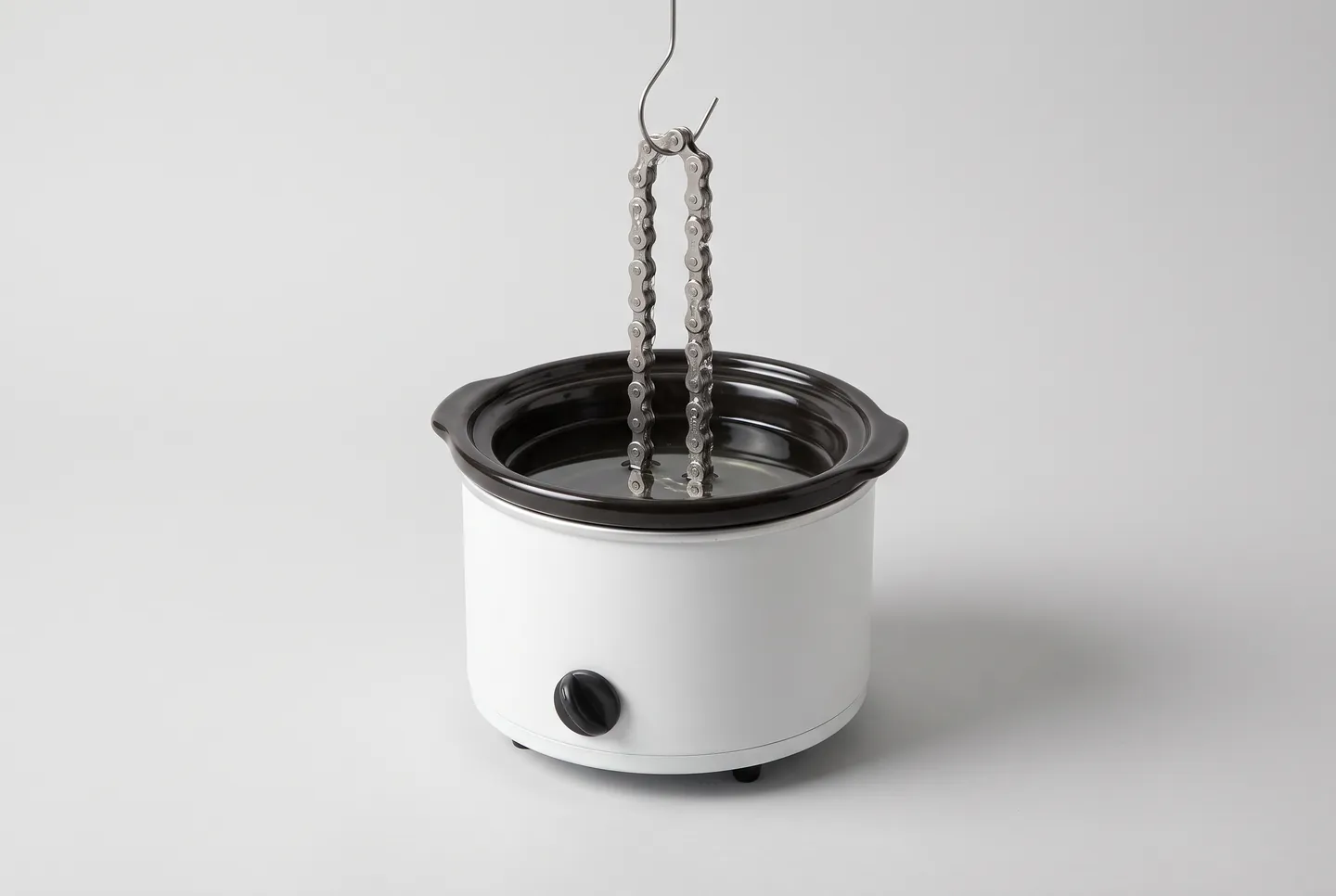
The steps. It’s best to start with a new or nearly new chain9.
- Degrease the chain. Even a new chain needs cleaning, because it comes coated in factory grease. Put it in a jar with mineral spirits, close the lid and shake for a few minutes until the liquid turns dark. Repeat with clean spirits, at least two or three times. Then give it a couple of minutes in alcohol and let it dry completely. It’s ready when it feels dry and metallic and the links move freely9.
- Melt the wax. Fill the slow cooker halfway and turn it on. It takes 30–45 minutes. It doesn’t need to get very hot. Keep it between 70 and 90 °C (160–195 °F), and always below 93 °C (200 °F). Check with the thermometer3,9.
- Dip the chain. Hang it on the hook, lower it into the wax and swirl it around for anywhere from half a minute to a few minutes5,9.
- Hang it to cool. Lift it out, let the wax drip onto a sheet of aluminum foil and leave it hanging for about twenty minutes9.
- Break the links free. Once it’s cold the chain is stiff. Flex the links by hand, or run the chain over a round tube, until they all move9.
- Put it on. Turn the pedals by hand for half a minute. The chain may skip for the first 10 minutes of riding, so don’t shift under load. After 20–30 minutes the wax has bedded in9.
Fire risk. Never melt wax in a regular pot on the stove, because if it gets too hot it can catch fire. Use the slow cooker. Keep mineral spirits and alcohol away from flames and sparks, work somewhere well ventilated with gloves and safety glasses on, and keep kids and pets away. You can filter and reuse dirty mineral spirits, and when it’s time to get rid of them, don’t pour them down the drain3,9.
How often to rewax
- On dry roads, about every 300 km (190 mi)4,9. The people who run the wear tests recommend 200–250 km (125–155 mi) so the chain and drivetrain last longer4. Some riders go up to 400 km (250 mi)9, and some wax makers claim up to 1,000 km (620 mi)3. You’re better off on the low side.
- Off-road, every 6–8 hours of riding at most4.
- After rain, dry the chain and rewax as soon as you can. A wet chain with the wax gone rusts quickly, so don’t leave it until the next day4. In the wet, wax lasts about half as long5. After salted roads, clean it and rewax right away6.
You’ll know it’s time when the chain starts to get noisy or squeak9. That can happen fast. On Velo’s test bikes, the paraffin chain went from quiet to noisy in a few minutes5.
You don’t need to degrease again to rewax. If you rode in the dry, just dip it in the pot again. After wet or dusty rides, it helps to rinse it in hot water first, in an open container and never a closed one, and dry it well before it goes back in the wax3,9.
With two chains, you can ride one while you wax the other4,9. Keep an eye on the quick link. Some are single-use, and even reusable ones have a limit, up to 5 times on some. Replace it when it snaps shut with no resistance3,4,9.
Between dips you can top up with a drip wax, though it picks up a bit more dirt. Don’t put oil on top of wax, because the two mix into a paste that traps dirt. If the chain stays oily, it needs degreasing again6,9. Replace the wax in the pot when chains still feel oily after they’ve cooled9.
When it’s not worth it
If your chain is already clean and you use a good lube, there aren’t many watts to gain. With clean chains, the gap between paraffin and the best lube was 0.24 W in 2013, and in 2014 the best drip wax matched it5. The real gain comes from keeping the chain clean, and wax makes that easier.
If you often ride in rain or mud, you’ll have to rewax much more often, and the chain only lasts a bit over twice as long as with a typical oil. Against the best wet-weather lubes, the gap gets even smaller4,6.
If you don’t want to take the chain off every 300 km (190 mi), drip wax is a middle ground. The comparison is above, in hot wax, drip wax or oil.
Two things to know. A waxed chain sounds a bit different from an oiled one and gets noisy sooner, even while it’s still lubed. That’s normal3,6. Wax also flakes off a little, so if you ride a trainer, put a mat under the bike9.
Sources
We read every source ourselves. They’re all public pages you can read for free. Prices are approximate, from online stores in November 2026. We don’t link to the stores, because the site doesn’t tell you where to buy.
- Johns Hopkins University, 1999. Spicer, Ehrlich, Bernstein and Richardson measure chain efficiency on a bench, with different sprocket sizes and chain tensions, with and without lube. Press release on ScienceDaily
- Purdue University. Dowd, Cavanaugh and Månsson test seven waxes and two dry lubes on a bench, from 200 to 500 W, for dozens of hours. Some of the lubes were supplied by the owner of a wax brand, who according to the authors had no role in the study’s design or analysis. Study on engrXiv
- Cyclingnews, 2025. Immersion waxes: temperature, chain prep, claimed intervals, quick links. Article
- Zero Friction Cycling. Australian lab that also sells waxes and chains. Waxing instructions: prep, intervals, rain, quick links. Plus wear-test data over thousands of kilometers. Instructions · Wear data
- Velo, 2013 and 2014. Friction Facts tests of lubes at 250 W, with clean chains and after an hour of dirt and water. The PDF is a reprint that adds a product to the summary chart. The two articles (PDF)
- CyclingAbout, 2025. Compiles Zero Friction Cycling’s wear data, scaled to 5,000 km, with dust, with water and dirt, and with lots of water and dirt. Article
- Bicycle Retailer, 2015. Friction Facts’ treated-chain business goes to a component maker. Article
- Park Tool. When to replace the chain: 0.5% elongation for 11-speed and up, 0.75% up to 10-speed. Guide
- BikeRadar, 2026. How to wax a chain, step by step, with the safety rules. Article
- Park Tool. Chain length: a replacement chain is usually longer than needed and has to be cut with a chain tool. Guide