GUIDES · DRIVETRAIN
1x or 2x: what cross-chaining costs.
In a lab test at 250 W, a drivetrain with a single chainring lost 12.24 W on average and one with two chainrings lost 9.45 W, so the 1x lost 2.8 W more. On the calculator’s example gravel ride, that’s almost a minute and a half. It’s only one test, though, and estimates from the same lab say a well-chosen 1x loses almost as little as a double. Cross-chaining matters too, and small ring with small cog wastes the most. This guide covers the test numbers, where the losses come from and how to get the most out of the drivetrain you have.
1'30"
What the test’s average 2.8 W gap between 1x and 2x is worth on the example gravel ride, 62 km (39 mi) with 780 m (2,560 ft) of climbing.
6 W
How much more the 1x lost than the double in its hardest gear, 48×10 versus 53×11. Both ratios are about 4.8.
2.86 W
What you save by using 53×15 instead of 39×11. It’s almost the same gear, but on the big ring and with less cross-chaining.
0.3 W
Roughly what each cog away from a straight chainline costs (0.2 W for the first). Seven cogs out, it’s about 2 W.
The test
In 2019 Velo had two 11-speed road drivetrains with the same gear range tested in CeramicSpeed’s lab, at 250 W and 95 rpm1. The 1x had a 48-tooth chainring and a 10–42 cassette. The double had 53- and 39-tooth chainrings and an 11–34 cassette. Both chains were degreased and lubed with the same oil.
The 1x lost 12.24 W on average across its 11 gears. The double lost 9.45 W across its 15 best gears, leaving out the most cross-chained combinations. That’s a 2.8 W difference. On the big ring, the double lost less than the 1x on every cog. On the small ring, it only lost less on the seven biggest cogs1.
Who ran the test. The measurements were made by Jason Smith, who founded Friction Facts and is the technical director of CeramicSpeed, a company that sells drivetrain parts. The two drivetrains came from different brands, with different chains, and in earlier tests the chain from the double’s brand already had less friction. Some of the difference may come from that1.
Where the losses come from
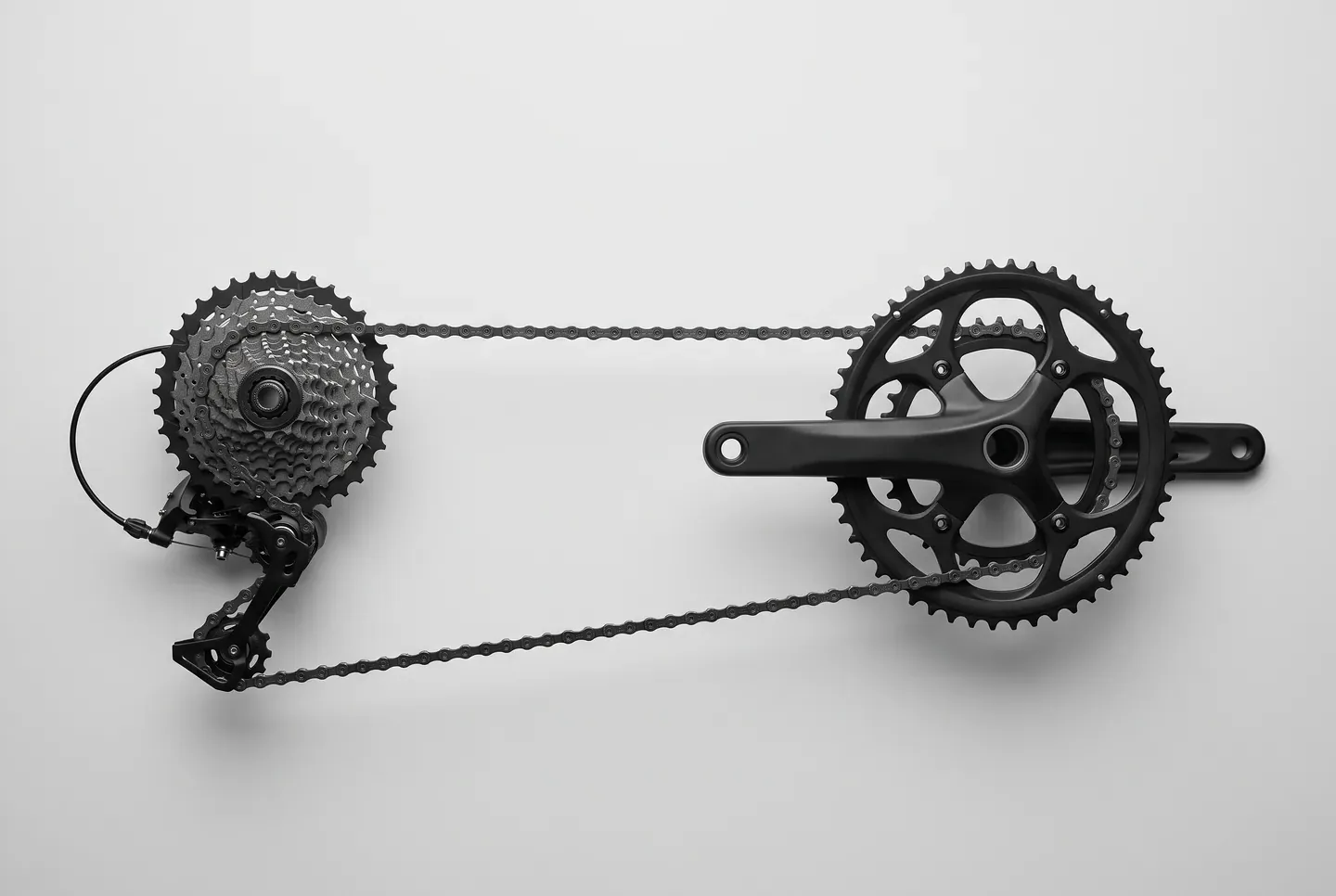
Most of the watts are lost in the chain, and the derailleur pulleys matter less. Every time a link engages a cog or chainring it bends, and the smaller the cog, the more it bends. That’s why the smallest cog loses the most on either chainring1,2.
Tension matters too. At the same power and cadence, a smaller chainring puts more tension on the chain, and a tighter chain has more friction. That’s why, for the same gear, the big ring loses less than the small one2. The 1x in the test ran a 48-tooth chainring and a 10-tooth cog, so the chain bent more and was under more tension than with a 53 and an 111.
Cross-chaining
WATTS LOST IN THE DRIVETRAIN AT 250 W
| GEAR | CROSS-CHAINED | ALIGNED |
|---|---|---|
| Small ring, smallest cog 39×11 | 9.84 W | 8.24 W |
| Small ring, straight chain 39×17 | 6.89 W | 6.89 W |
| Small ring, largest cog 39×28 | 7.43 W | 6.14 W |
| Big ring, smallest cog 53×11 | 8.72 W | 8.03 W |
| Big ring, straight chain 53×14 | 6.97 W | 6.97 W |
| Big ring, largest cog 53×28 | 7.69 W | 5.65 W |
You’re cross-chained when the chainring and cog aren’t lined up. The steeper the angle, the more you lose, about 0.3 W for each cog away from a straight chainline (0.2 W for the first), up to about 2 W seven cogs out2,3.
Small-small is the worst. Small ring and small cog stack both losses, because the chain is angled, tightly bent and under high tension. In 39×11 it lost 9.84 W, and in 53×15, almost the same gear, 6.98 W. Big-big costs less. 53×28 lost about 0.7 W more than 39×21, which is almost the same gear on the small ring2.
When to switch chainrings. On the double in the test, shifting to easier gears, it paid to drop off the big ring after the 21-tooth cog. Shifting to harder gears, it paid to get off the small ring after the 172. Other cassettes give different numbers, but the rule still holds: stay off the small ring in the small cogs. Shorter chainstays put the chain at a steeper angle, so it loses more2. We have a guide on road bike gearing.
With a 1x
With a single chainring, the chain runs straight in the middle of the cassette and at an angle at both ends. The biggest cog costs little, for the same reason big-big does. The smallest cog costs more, because the chain is angled and tightly bent, and with a chainring smaller than a 53 it’s also under more tension3.
Narrow-wide chainrings, with alternating narrow and wide teeth to keep the chain on a 1x, added no measurable friction in Friction Facts’ tests1,3.
A bigger chainring helps. Jason Smith’s estimates, as reported by Rappstar, say a 1x with a big chainring and a wide-range cassette doesn’t lose measurably more than a double. With a 48 and a 10–34 cassette, it’s about 1 W more in the hard gears3. Those are estimates, not measurements. In Velo’s test, with a 10–42 cassette and chains from different brands, the measured gap in the hardest gear was 6 W1.
Aero. Without a front derailleur the bike has a little less drag. In the wind tunnel test Velo cites, that was worth about 3 W at 48 km/h (30 mph)1,3. The power needed to push through the air grows with the cube of speed, so at the example gravel ride’s average of 23.5 km/h (15 mph) it would be about 0.3–0.4 W.
What it’s worth in seconds
In the calculator, 1 W is worth about 27 seconds on the example road ride, 31 on the gravel ride and 42 on the slower MTB ride. If the test’s average 2.8 W gap applied, it would be about 1'10" on the road ride, 1'30" on the gravel ride and 2'00" on the MTB ride.
Treat these as an upper limit, not an average. The test was run at 250 W on road drivetrains, and average power on the example rides is lower, between 162 and 201 W, so the losses in watts are probably smaller. Gravel and MTB drivetrains use different cassettes and chainrings, and none of these sources measured them.
The chain matters more. A dirty chain can lose several watts more than a clean, well-lubed one4, as much as the gap between 1x and 2x or more. Waxed chains have their own guide.
What to do
- If you ride a double. Stay off the small ring in the small cogs. Big-big costs less, but on the three biggest cogs it pays to shift to the small ring2.
- If you ride a 1x. On fast stretches, don’t sit in the smallest cog for long if you can use the next one up and spin a bit faster.
- If you’re choosing between them. A few watts aren’t a good reason to switch drivetrains. On gravel and MTB, simplicity, chain retention and how it copes with mud matter too.
- Whatever you ride. Keep the chain clean and lubed.
Enter your ride in the calculator to see what drivetrain upgrades are worth, starting with the chain.
Sources
We read every source ourselves. They’re all public pages you can read for free. The measurements in sources 1, 2 and 3 are by Jason Smith, of Friction Facts and later CeramicSpeed, which sells drivetrain parts.
- Velo, 2019. Lennard Zinn, test of an 11-speed 1x and an 11-speed double road drivetrain in CeramicSpeed’s lab, at 250 W and 95 rpm: 12.24 W versus 9.45 W on average, 6 W more in the hardest gear; where the losses come from; the wind tunnel without a front derailleur. Article
- CeramicSpeed, Friction Facts. Report on cross-chaining and chainring size: watts lost in all 22 gears of a 53/39 double with an 11–28 cassette, cross-chained and aligned, at 250 W and 95 rpm; when to switch chainrings; the effect of chainstay length. Report (PDF)
- Rappstar, 2020. Jordan Rapp, analysis of Jason Smith’s data on 1x drivetrains: losses per cog of misalignment, narrow-wide chainrings, estimates for different 1x setups, the wind tunnel without a front derailleur. Article
- Velo, 2013 and 2014. Friction Facts lube tests at 250 W, with clean chains and after an hour of dirt and water. The PDF is a reprint that adds a product to the summary chart. PDF