GUIDES · DRIVETRAIN
Road bike gearing: 50/34, 52/36 and which cog for climbing.
Your gear sets how far you travel with each turn of the pedals, from almost 10 meters in 50×11 to just over 2 in 34×34. On an 8% climb at 200 W, a 74 kg (163 lb) rider does about 10 km/h (6 mph). In 34×34 that’s a cadence of 76 rpm, and in 39×28 it’s 55. This guide covers what 50/34 and 52/36 mean, development, climbing cadence and your speed in the hardest gear.
76 rpm
Your cadence at 8% with 200 W in 34×34, for a 74 kg (163 lb) rider on a road bike.
2.13 m
How far you travel per pedal revolution in 34×34. In 50×11 it’s 9.68 m.
71 rpm
The average cadence of pros on long Grand Tour climbs in a 2001 study. On the flat it was about 90.
52 km/h
Your speed (32 mph) in 50×11 at 90 rpm.
What 50/34 and 52/36 mean
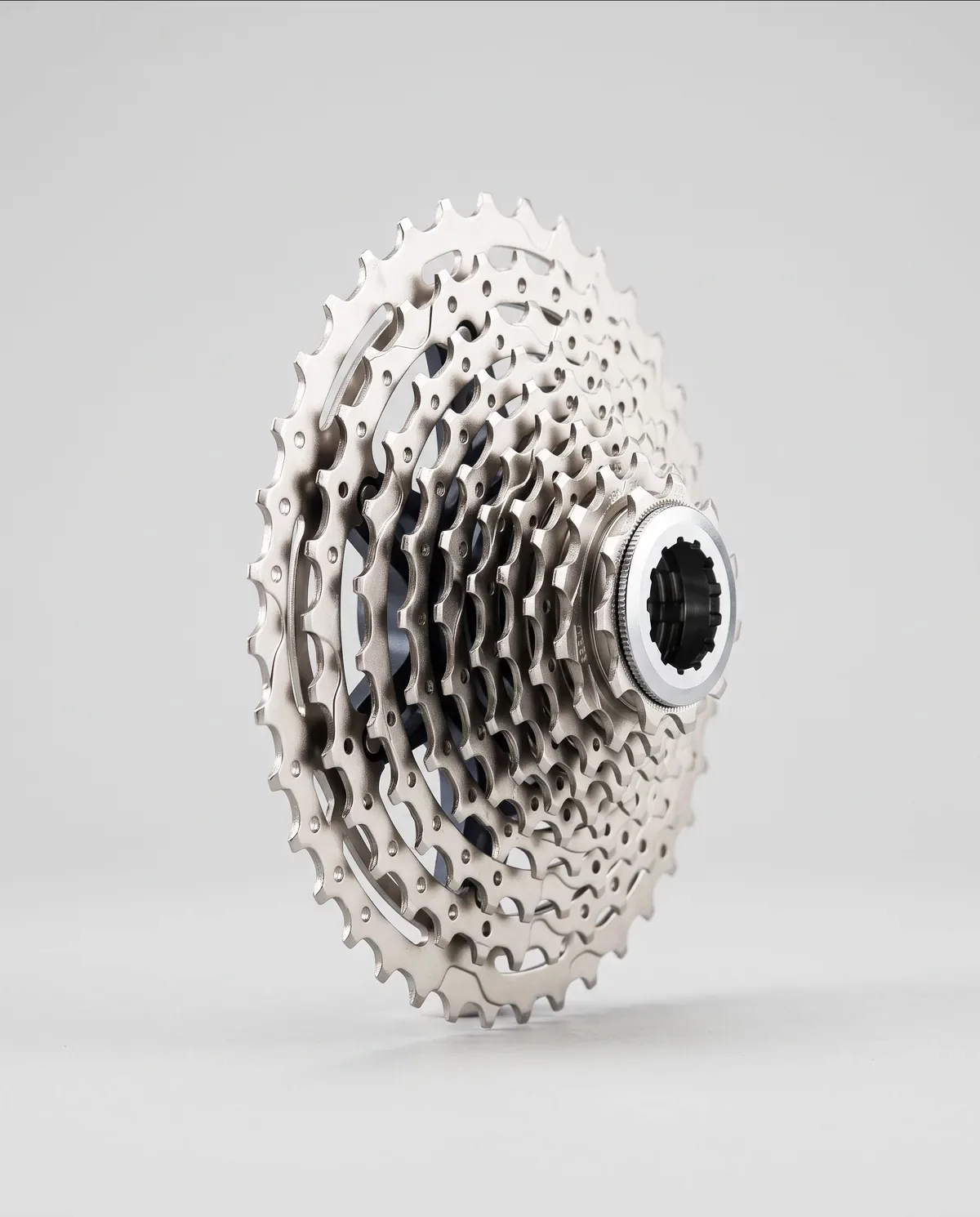
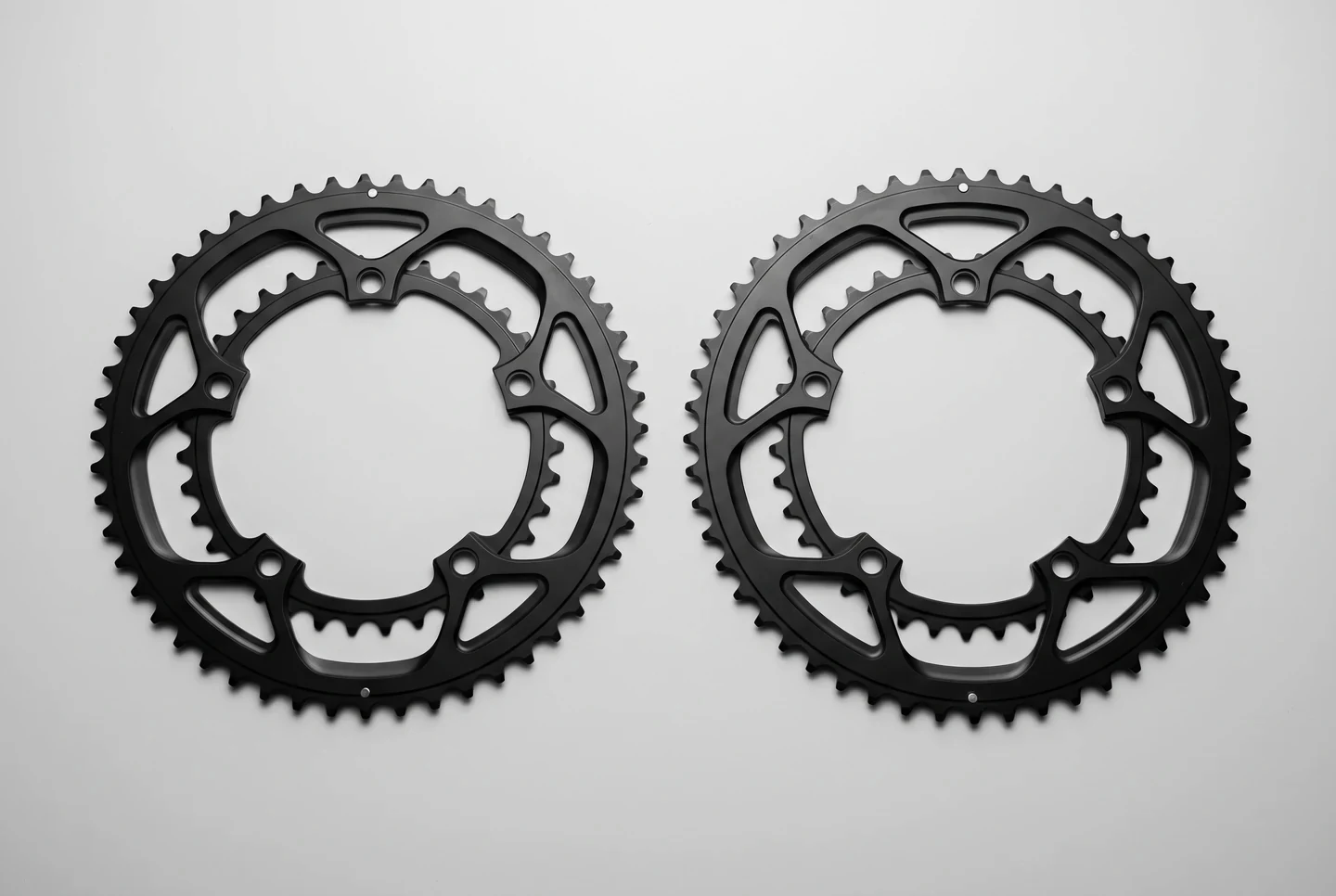
Up front there are two chainrings, so 50/34 means one with 50 teeth and one with 34. At the back is the cassette, for example with cogs from 11 to 34 teeth. The gear ratio is the chainring teeth divided by the cog teeth. In 50×11 the wheel turns 4.5 times for every turn of the pedals, and in 34×34 just once.
To compare gears, it helps to look at development, meaning the distance you cover with each turn of the pedals. It’s the gear ratio times the wheel circumference1. A 700c wheel with a 28 mm tire is about 2.13 m around.
DEVELOPMENT: METERS PER PEDAL STROKE
| COG | CHAINRING 34 | 36 | 50 | 52 |
|---|---|---|---|---|
| 11 | 6.58 m | 6.97 m | 9.68 m | 10.07 m |
| 13 | 5.57 m | 5.90 m | 8.19 m | 8.52 m |
| 15 | 4.83 m | 5.11 m | 7.10 m | 7.38 m |
| 17 | 4.26 m | 4.51 m | 6.26 m | 6.52 m |
| 19 | 3.81 m | 4.04 m | 5.61 m | 5.83 m |
| 21 | 3.45 m | 3.65 m | 5.07 m | 5.27 m |
| 25 | 2.90 m | 3.07 m | 4.26 m | 4.43 m |
| 28 | 2.59 m | 2.74 m | 3.80 m | 3.96 m |
| 30 | 2.41 m | 2.56 m | 3.55 m | 3.69 m |
| 34 | 2.13 m | 2.26 m | 3.13 m | 3.26 m |
36×34 gives the same development as 34×32, 2.26 m. The ratio is what counts, not the individual tooth counts. That’s why a 52/36 with a big cassette can give you almost the same low gears as a 50/34 with a smaller cassette.
To run the numbers for your own gears, wheel and cadence, use the bike gear and speed calculator.
What cadence
Cadence is how many times you turn the pedals per minute. There’s no single right cadence for everyone, but studies do tell us a few things:
- Pros. In the Grand Tours, seven pros averaged 71 rpm on long climbs, 89 on flat stages and 92 in time trials2.
- The harder you push, the higher your best cadence. For six elite cyclists, the most economical cadence was 60 rpm with no load and 80 rpm at 350 W3. In a study of 14 track cyclists, the cadence where their legs made the most power rose from about 66 rpm at the first lactate threshold to about 85 at maximal oxygen uptake4.
In practice, the pros in the 2001 study stayed around 70 rpm on climbs. If you drop toward 50, you’re pushing about 40% harder on each pedal stroke than at 70 for the same watts. That’s when you need an easier gear.
Crank length also changes how hard you push on each pedal stroke: there’s a guide on 165, 170 or 172.5 mm cranks.
Which cadence riders choose on their own, which one is the most economical and what studies say about low-cadence training: there’s a guide on ideal cycling cadence.
Climbing: the easiest gear
To find your climbing cadence, we work out your speed with the calculator’s model, a simplified version of the model by Martin and colleagues as laid out by Crouch and colleagues5,6, and divide it by the gear’s development.
CLIMBING CADENCE IN THE EASIEST GEAR, 200 W
| GRADE | 34×34 | 34×30 | 34×28 | 39×28 |
|---|---|---|---|---|
| 6% · 12.4 km/h | 97 rpm | 86 rpm | 80 rpm | 70 rpm |
| 8% · 9.8 km/h | 76 rpm | 67 rpm | 63 rpm | 55 rpm |
| 10% · 8.0 km/h | 63 rpm | 55 rpm | 52 rpm | 45 rpm |
| 12% · 6.8 km/h | 53 rpm | 47 rpm | 44 rpm | 38 rpm |
At 200 W, or 2.7 W/kg for a 74 kg (163 lb) rider, 34×34 keeps you above 60 rpm up to about 10%. In 39×28 you’re already down to 55 rpm at 8%.
With fewer watts your cadence drops. At 150 W in 34×34, you’re turning about 58 rpm at 8% and about 47 at 10%. At 250 W, in the same gear at 8%, you’re at about 94 rpm. Your easiest gear won’t make you faster at the same watts, but it lets you keep your cadence up. If you don’t put out a lot of watts on climbs, it’s the first gear to look at.
Weight changes your climbing speed too, and with it your cadence. We have a guide on how many watts you need to climb.
On the flat and downhill: the hardest gear
SPEED IN THE HARDEST GEAR
| GEAR | 80 RPM | 90 RPM | 100 RPM |
|---|---|---|---|
| 50×11 | 46.5 km/h | 52.3 km/h | 58.1 km/h |
| 52×11 | 48.3 km/h | 54.4 km/h | 60.4 km/h |
| 53×11 | 49.3 km/h | 55.4 km/h | 61.6 km/h |
| 50×12 | 42.6 km/h | 47.9 km/h | 53.2 km/h |
In 50×11 at 90 rpm you’re doing 52 km/h (32 mph). 52×11 and 53×11 give you 2–3 km/h (1–2 mph) more at the same cadence. Holding 52 km/h solo on the flat would take about 780 W, so these gears are mostly useful on descents, in sprints and in fast groups.
On the flat, big gears matter less than you might think. At 200 W on the flat with no wind, the example rider does about 32 km/h (20 mph). In the 50-tooth chainring, the 17 or 19 cog is enough, at about 84 or 94 rpm. We have a guide on average speed on a road bike.
Which to choose
- 50/34 with a big cassette. It has the easier gears of the two. It makes sense if you ride climbs steeper than 8–10% or put out less than about 3 W/kg on climbs.
- 52/36. Its gears are a bit harder. In 36×34 at 8% and 200 W, you’re turning about 72 rpm instead of 76.
- A single chainring. You lose the front derailleur and the small chainring, but you also have fewer gears, so covering the same range means bigger jumps between cogs. We have a guide on 1x vs 2x.
Before you change chainrings or cassette, check the manufacturer’s specs. For the rear derailleur, look at the largest cog it takes and the total capacity it can handle. For the front derailleur, look at the largest chainring and the difference between chainrings it can take. If you change sizes, you usually need to change the chain length too.
In the calculator you can enter your ride, your weight and your power, and it also shows you where your money goes furthest.
Sources
We read every source ourselves. They’re all public pages you can read for free. For the studies by Lucía and colleagues, Foss and Hallén, and Martin and colleagues, we read the abstract.
- Sheldon Brown. Gear ratios, development and gain ratio: how to calculate them, with examples. Page
- Lucía, Hoyos and Chicharro, 2001. Medicine & Science in Sports & Exercise. Cadence of seven pros in the Grand Tours: 71.0 rpm on long climbs, 89.3 on flat stages, 92.4 in time trials. Abstract
- Foss and Hallén, 2004. European Journal of Applied Physiology. Six elite cyclists at 60, 80, 100 and 120 rpm: the most economical cadence rises from 60 rpm with no load to 80 rpm at 350 W. Abstract
- Dunst, Hesse and Ueberschär, 2024. Frontiers in Physiology. 14 professional track cyclists, on a cycle ergometer: the cadence at which they produce the most power rises with intensity, from about 66 rpm at the first lactate threshold to about 85 at maximal oxygen uptake. Study (PDF)
- Crouch, Burton, LaBry and Blair, 2017. Scientific review of cycling aerodynamics, in Sports Engineering: the power model by Martin and colleagues. Study (PDF)
- Martin, Milliken, Cobb, McFadden and Coggan, 1998. Journal of Applied Biomechanics. The power model tested on the road with a power meter: R² 0.97 between calculated and measured watts, standard error 2.7 W. Abstract