GUIDES · DRIVETRAIN
165, 170 or 172.5 mm cranks: which to choose.
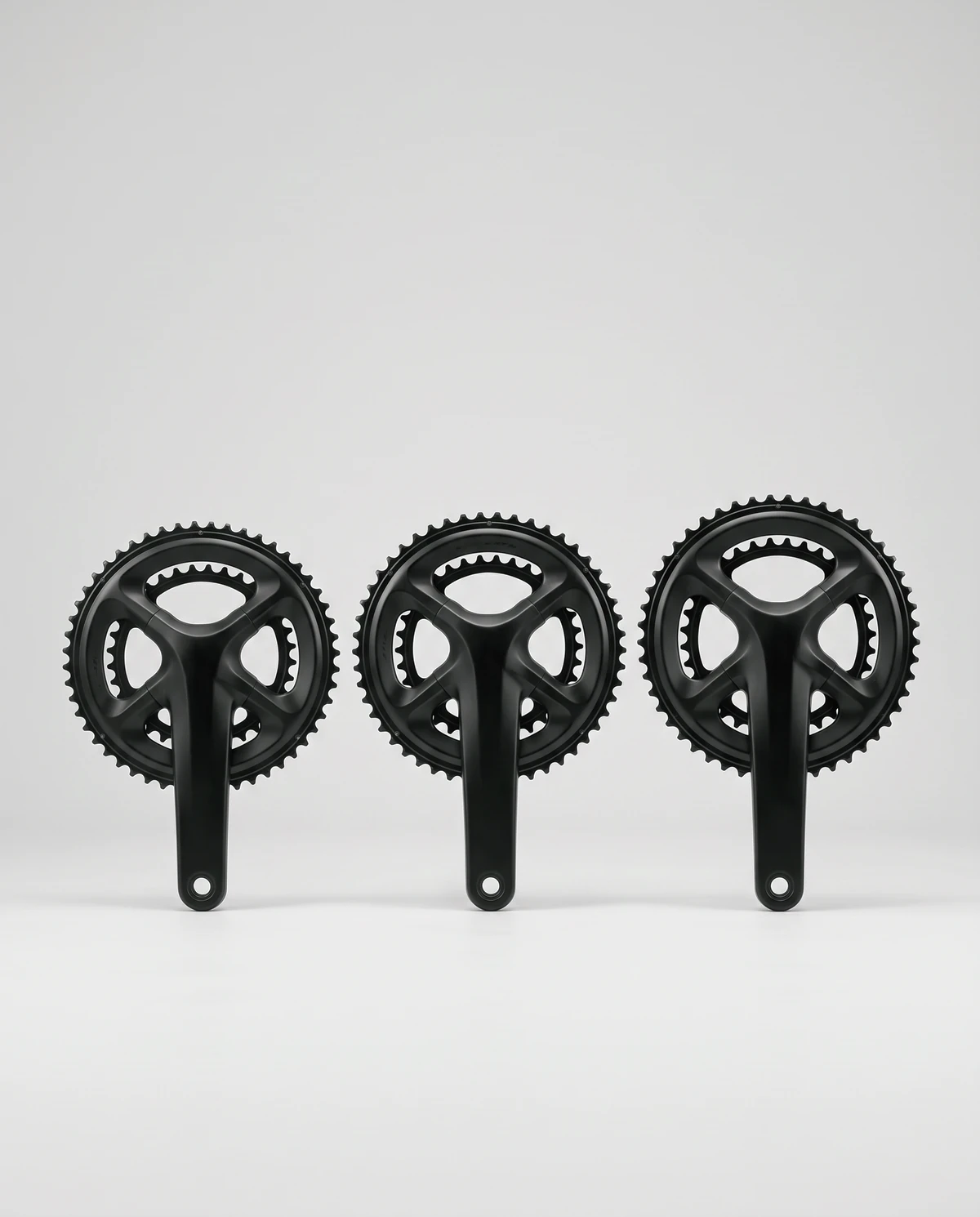
With a crank 5 mm longer or shorter than your own, studies find no difference in efficiency. For peak power, the 170 is among the best lengths. What changes is how your hip and knee move. So the choice comes down to comfort and position, not watts.
4%
At most, how much peak sprint power changed between the best and the worst crank, in tests from 120 to 220 mm on 16 trained cyclists.
±5 mm
With a crank 5 mm shorter or longer, efficiency and heart rate didn’t change significantly.
+1.7°
How much more your knee bends at the top of the stroke with a crank 5 mm longer. Your hip bends about 1° more.
20%
For peak power, the best length was about 20% of leg length. But the 170 shouldn’t cost most adults much.
Power
In 2001 Martin and Spirduso had 16 trained cyclists do all-out sprints with 120, 145, 170, 195 and 220 mm cranks. Peak power ranged from 1,149 W with the 220 to 1,194 W with the 145. That’s less than 4% between the longest and the best. With the 145 and the 170 it was higher than with the 120 and the 2201.
The 165, 172.5 and 175 weren’t tested, but they fall between the 145 and the 195. The authors say the 170 shouldn’t cost most adults much power1.
The best cadence changes. With a shorter crank, peak power came at a higher cadence: 136 rpm with the 120 and 110 with the 2201.
Efficiency
A sprint is a special case. On a ride, what counts is gross efficiency, meaning how much of the energy you burn turns into watts at the pedals.
Ferrer-Roca and colleagues had 12 amateur cyclists ride at 150, 200 and 250 W, always at about 90 rpm. Each one used their own crank, 172.5 or 175 mm, one 5 mm shorter and one 5 mm longer, in random order. Between tests they moved the saddle and handlebar to keep the saddle-to-pedal distance and the saddle-to-bar drop the same2.
EFFICIENCY WITH 5 MM MORE OR LESS
| POWER | −5 MM | THEIR OWN | +5 MM |
|---|---|---|---|
| 150 W | 18.6% | 18.4% | 18.7% |
| 200 W | 20.5% | 20.4% | 20.5% |
| 250 W | 22.0% | 21.5% | 21.6% |
Efficiency and heart rate didn’t change significantly2. In the table the average differences are half a point at most, less than the variation from one cyclist to another.
What changes for your legs
With a longer crank, the pedal travels around a bigger circle. At the top of the stroke, your hip and knee bend more. With a crank 5 mm longer than your own, the knee bent about 1.7° more and the hip about 1° more. Between the shortest and the longest, so over 10 mm, it was about 3° and 2°. The ankle didn’t change2.
The authors say these changes don’t show up in energy cost, but over time they could cause discomfort. That’s also why, if you’re torn between two sizes, they suggest the shorter one2.
Barratt and colleagues tested cranks from 150 to 190 mm on 15 trained cyclists, at 90 rpm and 240 W. With the longer crank, the knee tended to push a little less and the hip a little more, but the differences weren’t significant. The authors say you can change length without changing how your hip, knee and ankle share the work3.
AT 90 RPM
| CRANK | PEDAL SPEED | FORCE ON THE PEDAL |
|---|---|---|
| 165 mm | 1.56 m/s | +3.0% |
| 170 mm | 1.60 m/s | — |
| 172.5 mm | 1.63 m/s | −1.4% |
| 175 mm | 1.65 m/s | −2.9% |
At the same cadence, with the 165 the pedal moves a little slower and you need about 3% more force than with the 170. There’s a guide on road bike gearing.
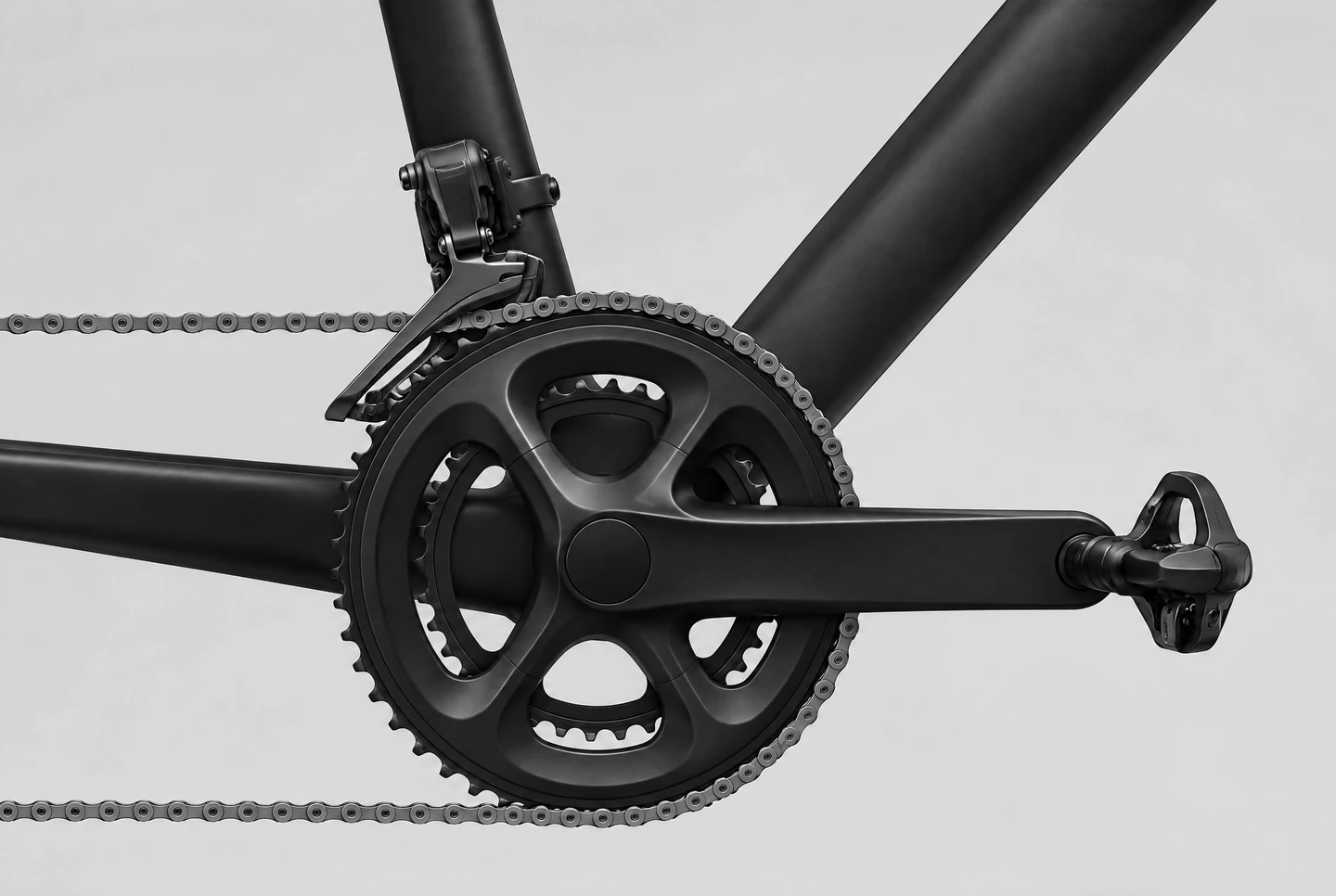
Position
With a shorter crank, at the top of the stroke your leg folds up less against your torso. Barratt and colleagues say this may help riders who want a lower torso, such as those using aero bars, and riders with knee osteoarthritis. This is the authors’ hypothesis, and they didn’t test it3. The guide on riding position explains what riding lower is worth.
None of the three studies measured how much you gain aerodynamically with a shorter crank. That’s why we don’t give a number in seconds.
Which to choose
If your crank feels fine, keep it. There’s no reason to change it for watts1,2.
If your knees or hips feel cramped at the top, or you want to ride lower, a crank 5 mm shorter might help3, and in the study it didn’t cost any efficiency2.
If you’re torn between two sizes, the authors of one of the studies suggest the shorter one2.
If you change length, note that in the study they kept the same distance from saddle to pedal2. In practice, the shorter the crank, the higher the saddle, by about the same amount. It’s best done with a bike fitter.
What the studies don’t tell you
The tests last from a few seconds to a few minutes, in the lab1,2,3. None of them followed cyclists for months on a new crank. The 20%-of-leg-length rule is for peak sprint power, not for a long ride, and it explains only a small part of the differences between one cyclist and another1.
Sources
We read every source ourselves. They’re all public pages you can read for free.
- Martin and Spirduso, 2001. European Journal of Applied Physiology. 16 trained cyclists, all-out sprints with cranks from 120 to 220 mm: peak power, best cadence, best length relative to the leg. Abstract
- Ferrer-Roca and colleagues, 2017. Journal of Sports Sciences. 12 amateur cyclists at 150, 200 and 250 W with their own crank, one 5 mm shorter and one 5 mm longer: efficiency, heart rate, hip, knee and ankle angles. Article
- Barratt and colleagues, 2016. Medicine & Science in Sports & Exercise. 15 trained cyclists at 90 rpm and 240 W with cranks from 150 to 190 mm: how the hip, knee and ankle work. Article