GUIDES · DRIVETRAIN
Bike chain: when to replace it and how to measure wear.
Mileage won’t tell you when to replace a chain. You have to measure it. On 11-speed and up, replace it once it has stretched 0.5%; on 10-speed and below, at 0.75%. Wait too long and a new chain won’t fix it, because you’ll need a new cassette and sometimes new chainrings too. This guide covers how to measure a chain, when to replace it and how long it can last.
0.5%
The stretch at which you replace the chain on 11-speed and up. On 10-speed and below, it’s 0.75%.
1.5 mm
How much longer 24 links get at 0.5%, going from 304.8 to about 306.3 mm.
0.75%
On 11-speed and up, this is where the cassette needs replacing too.
2,000–20,000 km
How long a chain can last (about 1,240–12,400 mi), depending on the lube and how well you look after it.
Why the chain stretches
The distance from one chain pin to the next is 12.7 mm, or half an inch. That’s the pitch, and it’s the same on every derailleur bike chain2. Over time the pins and the bushings they turn in wear down, and the pitch gets longer. We call it chain stretch, but the metal isn’t actually stretching. It’s wear2.
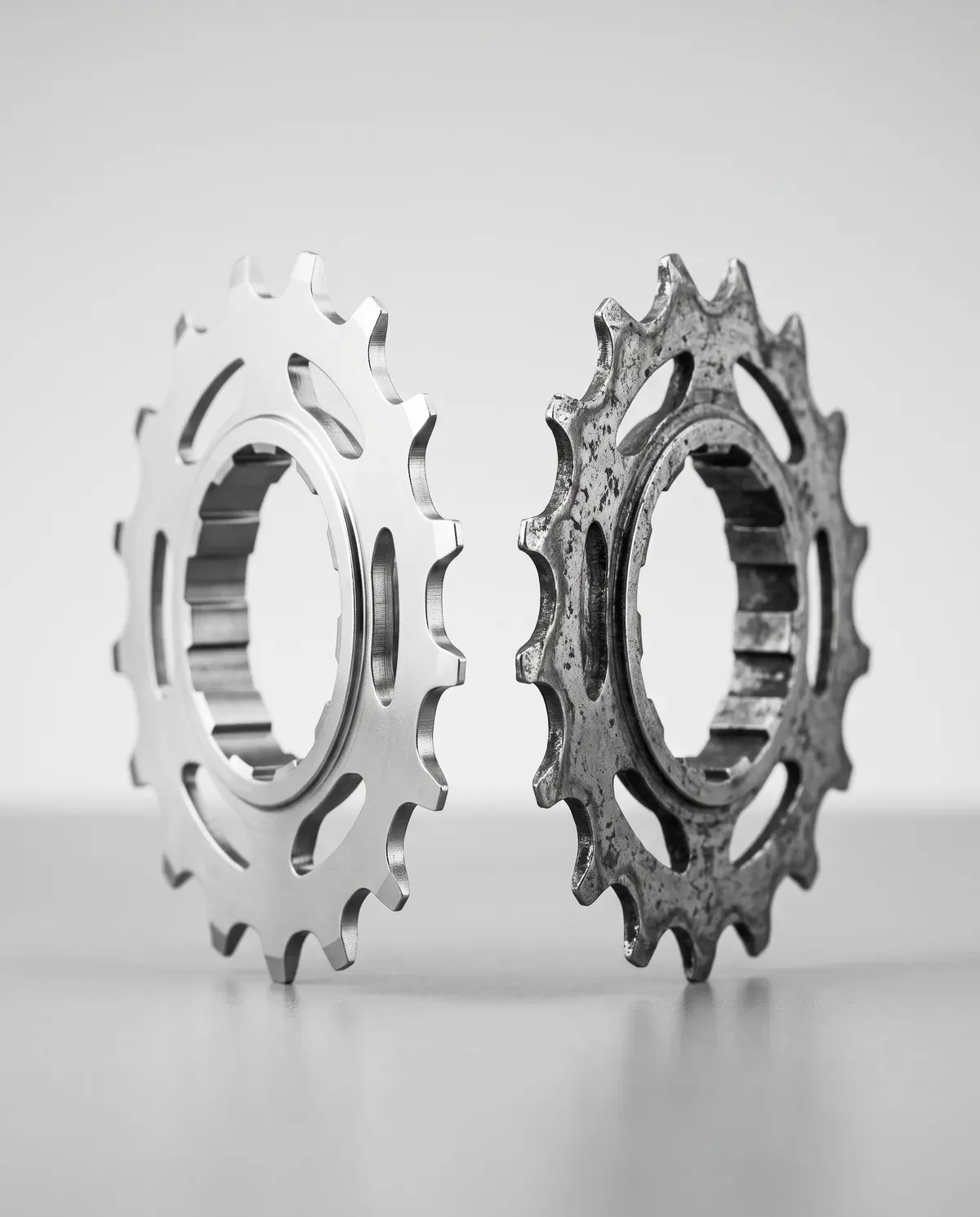
A stretched chain doesn’t sit properly on the teeth of the cogs and chainrings anymore, so it wears them out. Shifting also gets slower and less precise3. The rollers wear too and develop more side-to-side play. That makes shifting worse, but it doesn’t damage the other parts2.
When to replace it
The limit depends on how many speeds your drivetrain has1.
WHEN TO REPLACE CHAIN AND CASSETTE
| SPEEDS | CHAIN | CASSETTE TOO |
|---|---|---|
| 11, 12 or 13 | 0.5% | 0.75% |
| 6 to 10 | 0.75% | 1% |
| Single-speed | 1% | — |
On 11-speed and up, a chain at 0.75% should be replaced along with the cassette2. At 1% the chain is shot, and the cassette probably is too2. The drivetrain maker’s instructions may give slightly different limits. If you have them, go by those.
How to measure it
With a chain checker. This is the easiest way. You drop it onto the chain, and if the tip falls in between the rollers, the chain has hit that limit. Most checkers have two or three limits, for example 0.5%, 0.75% and 1%1. Some push against the rollers in opposite directions and pick up roller play as well, so they can read a little high. Checkers that measure in one direction only read the stretch2.
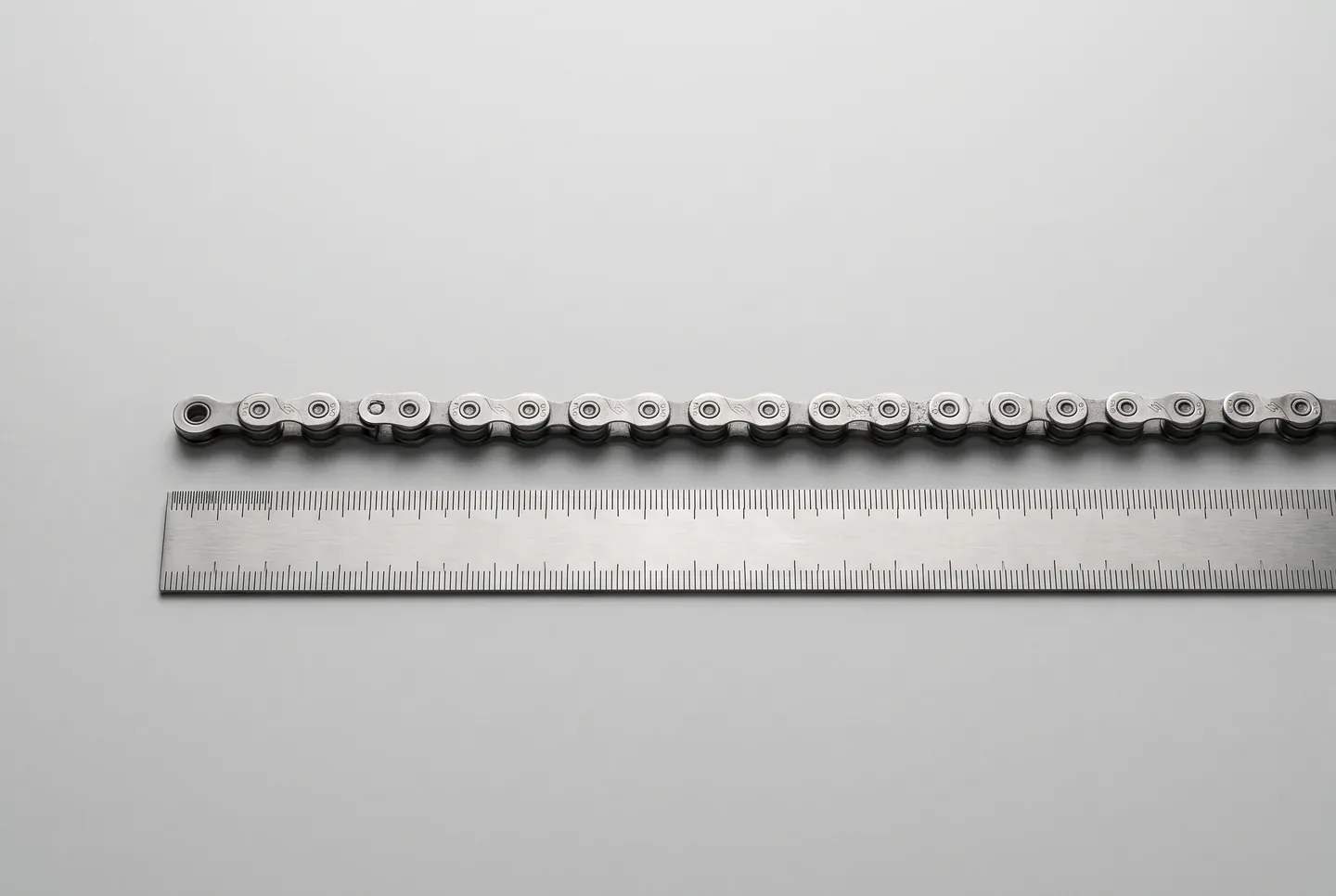
With a ruler. Line up the zero with the center of a pin and look at the pin 24 links down. On a new chain it sits exactly at 12 inches, or 304.8 mm. On 11-speed and up, if it’s 1/16 inch past that, about 1.6 mm, the chain needs replacing12. That’s roughly 0.5%. On 10-speed and below, the 0.75% limit is about 2.3 mm over. It’s a rough measurement1, since you’re reading a couple of millimeters, and a ruler marked in inches makes it easier.
24 LINKS WITH A RULER
| CHAIN | LENGTH | EXTRA |
|---|---|---|
| New | 304.8 mm | — |
| 0.5% | 306.3 mm | 1.5 mm |
| 0.75% | 307.1 mm | 2.3 mm |
| 1% | 307.8 mm | 3.0 mm |
Getting an accurate reading. Chains don’t wear evenly, so measure in at least three places2. Clean and dry the chain first, because dirt and a lot of lube make it look less worn than it is2. Don’t measure across the quick link, which wears more slowly2.
How long it lasts
There’s no mileage that works for everyone. Distance doesn’t tell you how worn a chain is, so you have to measure it2. Neither Shimano nor SRAM gives a mileage interval for cassettes and chainrings, because it depends too much on where you ride, the lube, the maintenance and how you shift3.
Depending on the lube and how you look after it, a chain can be worn out at 2,000 km (1,240 mi) or last 20,000 km (12,400 mi)4. Dirt mixed with lube turns into a grinding paste that wears it out faster2. Our guide on waxed chains has the data from the wear tests.
So it pays to check it often, especially if you ride a lot of dirt. A dirty chain costs you watts as well, and we cover that in the guide on the maintenance that costs you watts.
If you wait too long
If you replace each chain before it hits the limit, you can go through several on the same cassette and chainrings2. Wait too long and the chain wears those out too, and replacing them costs a lot more than a chain3.
SRAM gives these signs that they’re worn3:
- The cassette. You put on a new chain and it skips on the cogs when you push hard.
- The chainrings. The drivetrain feels rough and noisy, and the teeth start to look like shark fins. If you can see daylight between the teeth and a new chain, they’re probably worn.
- The small chainring. A new, clean chain clings to the teeth and gets dragged up toward the frame (chain suck).
If you replace the cassette or chainrings, put on a new chain too. A worn chain ruins new parts quickly3.
What to do
- Get a chain checker. It only takes a few seconds to check.
- Check often. Do it with a clean chain, in at least three places2.
- Replace it in time. At 0.5% on 11-speed and up, at 0.75% on 10-speed and below1.
- Keep it clean and lubed. That’s probably what matters most for making it last24.
Enter your ride in the calculator to see what a clean, waxed chain is worth next to the other upgrades.
Sources
We read every source ourselves. They’re all public pages you can read for free. Park Tool also makes chain checkers.
- Park Tool. When to replace the chain: 0.5% elongation for 11-speed and up, 0.75% up to 10-speed, 1% for single-speed. How to measure with a chain checker and with a ruler. Guide
- BikeRadar. Chain wear explained: the 12.7 mm pitch, limits for chain and cassette, measuring in three places, a clean chain, types of checkers, several chains on the same cassette, why mileage doesn’t tell you how worn it is. Article
- road.cc. When to replace the cassette and chainrings, with answers from Shimano and SRAM: the signs of wear and no mileage interval. Article
- Velo, 2018. Dave Rome on Zero Friction Cycling’s lube durability tests: chains reaching their limit between 2,000 and 20,000 km, depending on the lube and the maintenance. Article