GUIDES · TIRES
TPU and latex inner tubes: what they’re worth over butyl.
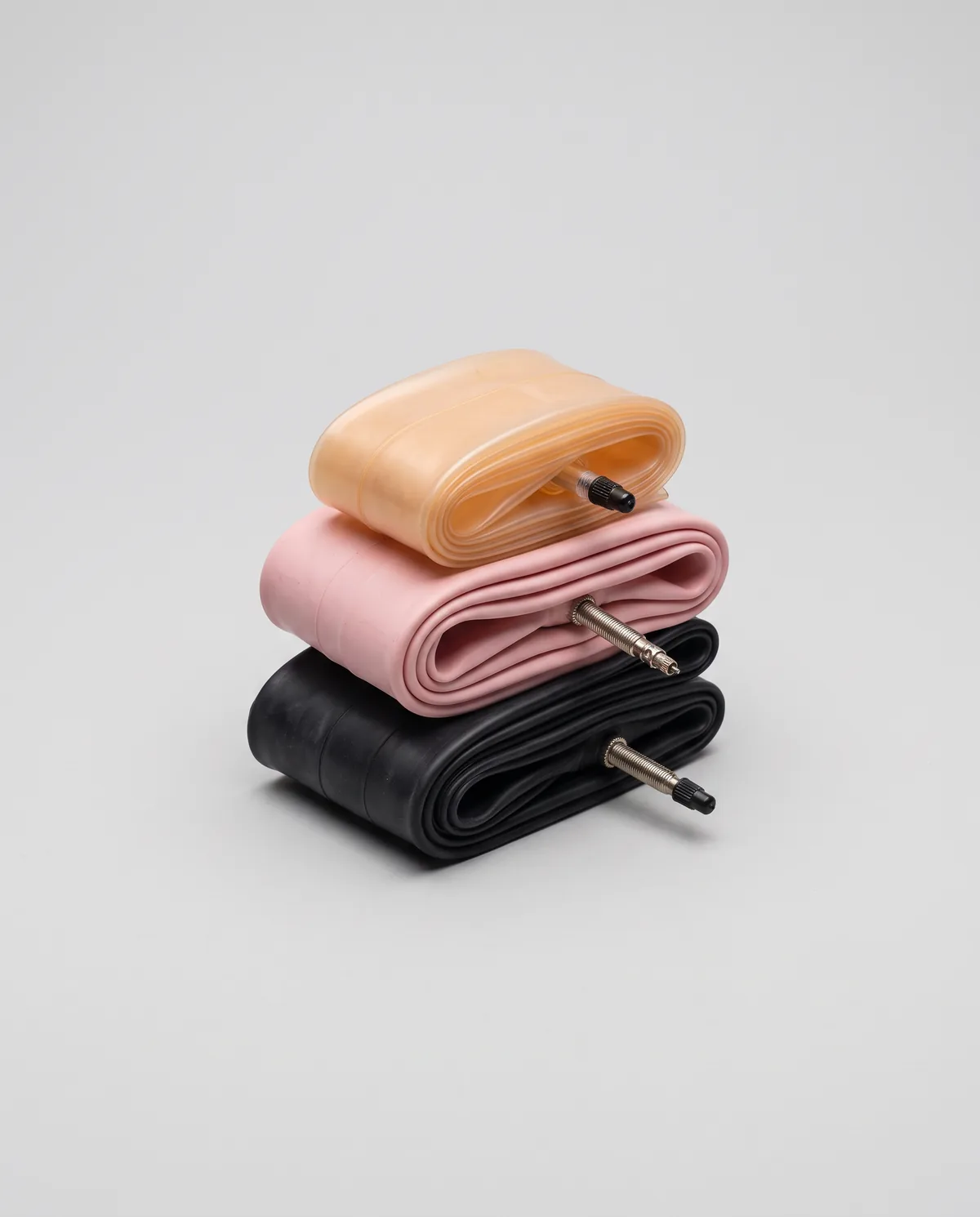
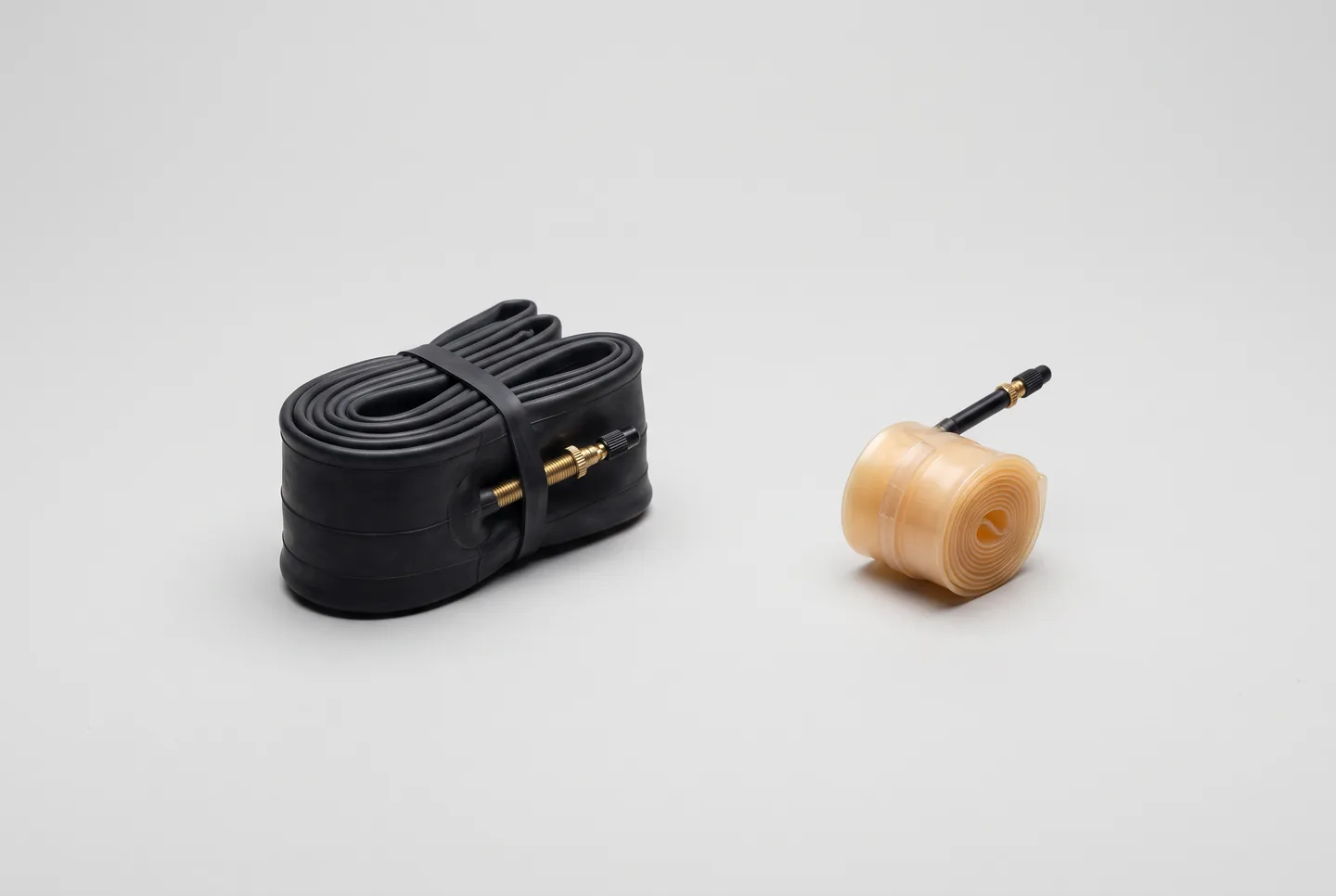
A standard inner tube is made of butyl. Latex and TPU tubes are thinner and more elastic, so they cause less friction inside the tire, and TPU tubes weigh half as much or less. On the same road tire, they save about 0.6 to 3.5 W per tire over a standard butyl tube, depending on the tube and the pressure. Latex and the lightest TPU tubes get close to tubeless, and the others land about halfway. Latex loses air quickly, though, and TPU doesn’t suit every kind of brake.
−1'10"
What the calculator says they’re worth over standard butyl on the example road ride, 80 km (50 mi) with 900 m (2,950 ft) of climbing at 28 km/h (17 mph), for about €40.
0.2 W
How much more the best latex tube lost than tubeless, on the same road tire at the test’s middle pressure.
20–45 g
What almost every TPU road tube weighs. A standard butyl tube weighs about 100 g.
34%
How much air a latex tube lost in a week in a small test. A standard TPU tube lost 5%.
Why the tube matters
As a tire rolls, it flattens and springs back on every turn of the wheel. The tube flexes with it, and some energy gets lost in the tube. Any tube makes a tire roll slower than it would without one. In a test on a road tire, tubes cost 0.2 to 3.8 W more per tire, depending on the tube and the pressure2.
Latex is very elastic, and TPU, a plastic, is thin and light. Latex always causes less friction than butyl. TPU almost always does, but not every TPU tube1,2.
What the tests say
Bicycle Rolling Resistance, road. The lab ran the same 25 mm tire on a drum at 28.8 km/h (18 mph), tubeless and with ten different tubes. Compared with tubeless, latex tubes cost 0.2–0.5 W per tire, TPU tubes 0.4–2.8 W, lightweight butyl 1.3–2.5 W and the standard butyl tube 2.1–3.8 W, depending on the pressure2.
EXTRA WATTS PER TIRE COMPARED WITH THE SAME TIRE TUBELESS
Latex, 50 g
TPU, 25 g
TPU, 39 and 43 g
TPU, 39 g, the worst
Lightweight butyl, 75 g
Butyl, 102 g
In the same site’s bigger test on three road tires, most TPU tubes from 20 to 45 g rolled faster than lightweight butyl, though not all of them did. Latex was the fastest of all1.
MTB. On a 29 × 2.2 tire, latex rolled almost as well as tubeless, falling a little behind at low pressures. The 225 g butyl tube was the slowest, and more so at low pressures. At the lowest pressure, tubeless saved 7.7 W per tire over butyl and latex saved 5.9 W3. The German magazine BIKE tested ten MTB TPU tubes at 20 km/h (12 mph), and they came in at 10.5 to 13.1 W per tire depending on the tube. The latex tube was the fastest, and the lightweight butyl one was slower than the TPU tubes4.
Weight
Almost all TPU road tubes weigh 20 to 45 g, latex tubes 50–80 g, lightweight butyl 72–75 g and standard butyl 102–105 g1,2. MTB TPU tubes range from 42 g up to 144 g, which is as heavy as a 145 g lightweight butyl tube4. A standard butyl MTB tube weighed 225 g and a latex one 140 g3.
On the road, going from standard butyl to TPU saves about 110–170 g across both wheels. On the example ride that’s only a few seconds, and rolling resistance matters a lot more.
Do they hold air?
Air seeps through latex, so you have to pump it up before every ride3, and it loses some air even during a long ride4. Even the lightest TPU tubes hold air better than latex1.
In a small Velo test, four tubes were inflated the same way. After one day the butyl tube had lost about 4% of its air, the latex one 9% and the two TPU tubes 1%. After a week, butyl was down 9%, latex 34%, standard TPU 5% and light TPU 10%. The author notes that the test is too small to be conclusive, and that identical tubes can behave differently5.
Flats, installation and repair
- Flats. TPU tubes vary a lot. In BIKE’s spike test, the force it took to puncture them ranged from 12 to 41 N. Thicker tubes held up better, but how stretchy they are matters too4.
- Installation. Outside the tire, only put the bare minimum of air in a TPU tube. Any more and it stretches out of shape and you have to throw it away4.
- Repair. Regular butyl patches don’t work on TPU tubes. You need TPU-specific patches4.
- Defects. Uneven thickness from manufacturing can make them lose air suddenly4.
- Feel. In a blind test, two out of three testers couldn’t tell a TPU tube from tubeless4.
Rim brakes
With rim brakes, the rim gets very hot on long descents, and TPU doesn’t like heat. At least one maker only recommends its TPU tubes for bikes with disc brakes6. If you have rim brakes, check what your tube’s maker says before you install one.
What they’re worth on your ride
The calculator doesn’t list tubes as a separate upgrade. It counts them under tubeless. If you pick TPU or latex tubes in the tires step, tubeless only gets 30% of its rolling resistance gain, because those tubes already do a lot of the work, and on MTB the weight no longer counts either. Light tubes appear on the tubeless card as an alternative, at about €40.
On the example road ride, 80 km (50 mi) with 900 m (2,950 ft) of climbing at 28 km/h (17 mph), tubeless is worth about 1'40" if you start from butyl and about 0'30" if you start from TPU or latex tubes. That means the calculator puts light tubes at about 1'10" over butyl, or 70% of tubeless. It’s an estimate. In the road test, light tubes got about 70% of the tubeless gain over standard butyl on average, with latex at about 90% and the 40 g TPU tubes at about 60%. Against lightweight butyl they’re worth less2. On the example gravel ride, 62 km (39 mi) with 780 m (2,560 ft) of climbing at 23.5 km/h (15 mph), the same estimate gives about 1'40". For latex that lines up with the MTB test3, but we found no measurements for TPU on gravel. We leave out the weight here, since it’s only a few seconds.
What they cost. In BIKE’s test, the MTB TPU tubes cost about €14 to €35 each, the latex one about €16 and the butyl ones €4 to €154. The calculator counts €40 for a pair. That covers latex and budget TPU tubes, but a pair of typical TPU tubes costs more.
TPU or latex?
- Latex rolls faster. It was the fastest tube in the tests1,2,3,4. It loses air, though, so you have to pump it up before every ride3,5.
- TPU is lighter and holds air much better than latex, about as well as butyl1,5. The lightest ones get close to latex for rolling resistance2, and the thicker ones resist flats better4.
- If you have rim brakes, check what the maker says, especially for TPU6.
- Carry the right patch. TPU needs its own patch kit4.
When it’s not worth it
If you already run tubeless, there’s nothing to gain, because the tire rolls faster without a tube2.
If you can go tubeless, that pays off more, especially on gravel and MTB, where pressures are lower and tubes are heavier3,7. Tubeless has its own guide.
If you don’t want to pump your tires before every ride, skip latex3.
If you have rim brakes and ride long descents, TPU may not be a good fit6.
Sources
We read every source ourselves. They’re all public pages you can read for free, except Bicycle Rolling Resistance’s data on individual tires, which is for subscribers only, so we use the public averages. Prices are approximate. We don’t link to stores, because the site doesn’t tell you where to buy.
- Bicycle Rolling Resistance, 2021 (updated in 2026). TPU, butyl, lightweight butyl and latex tubes on three 25 mm road tires, at 28.8 km/h (18 mph): watts and weights. Article
- Bicycle Rolling Resistance, 2022. The same 25 mm road tire, tubeless and with ten latex, TPU and butyl tubes, at 28.8 km/h (18 mph) and three pressures. Article
- Bicycle Rolling Resistance, 2014. A 29 × 2.2 MTB tire: tubeless, with a latex tube and with a butyl tube, at five pressures. Article
- BIKE, 2024. Ten MTB TPU tubes, plus latex and butyl, tested for weight, rolling resistance at 20 km/h (12 mph) and puncture resistance, with prices and notes on installation and repair. Measured in a tire maker’s lab. In German, with an English translation. Article
- Velo, 2021. How much air butyl, latex and TPU tubes lose in a day and in a week, inflated the same way. A small test, as the author says. Article
- Bikerumor. A tube maker recommends its TPU tubes only for bikes with disc brakes, because of the heat from rim brakes. Maker’s data. Article
- Bicycle Rolling Resistance, 2022. Eight gravel tires, tubeless and with a butyl tube of about 155 g, at four pressures: tubeless saved on average 2.8 to 5.1 W per tire. Article