GUIDES · WHEELS
Deep or light wheels on climbs: the grade where weight wins.
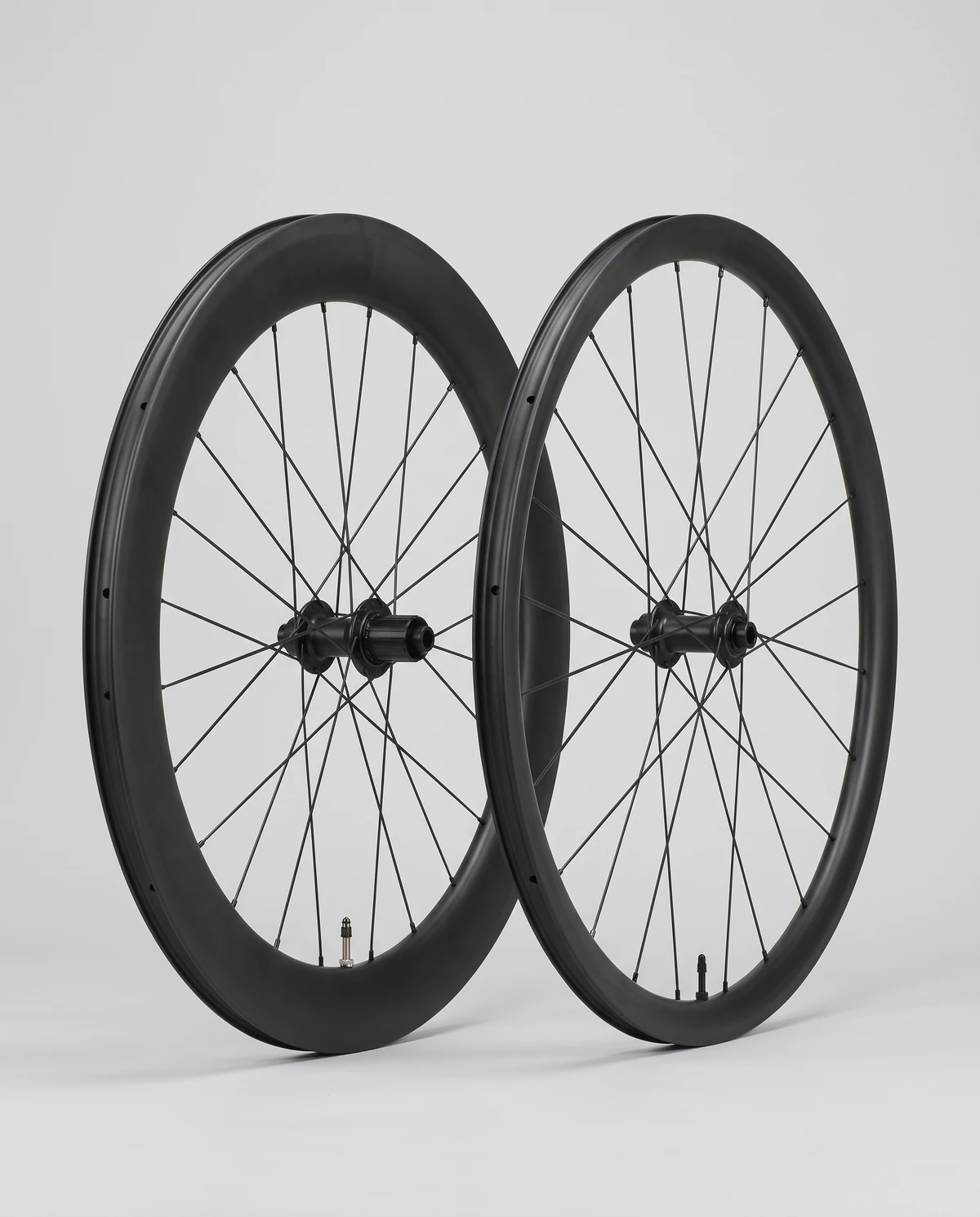
On a climb, a light wheel is only faster than a deep one when the road is steep enough. By our numbers, at 250 W the break-even grade is between 2 and 5%. The differences are 20 seconds or so per 10 km (6.2 mi) at most. On the calculator’s example ride, with its flats and descents, the deep wheels win.
2–5%
The grade above which the light wheels are faster, at 250 W, by our numbers. It depends on how much more the deep wheels weigh and how much drag they save.
8 s
How much faster the light wheels were in a test on a 1.8 km (1.1 mi) climb at 11%. But the rider was putting out 6 W more on the light wheels.
−0'24"
Our own calculation on the example road ride, 80 km (50 mi) with 900 m (2,950 ft) of climbing: deep wheels save you up to this much, even when they weigh 450 g (1 lb) more.
70 g
The claimed weight difference between two carbon wheelsets from the same maker, one 35 mm and one 50 mm deep.
Aero and weight
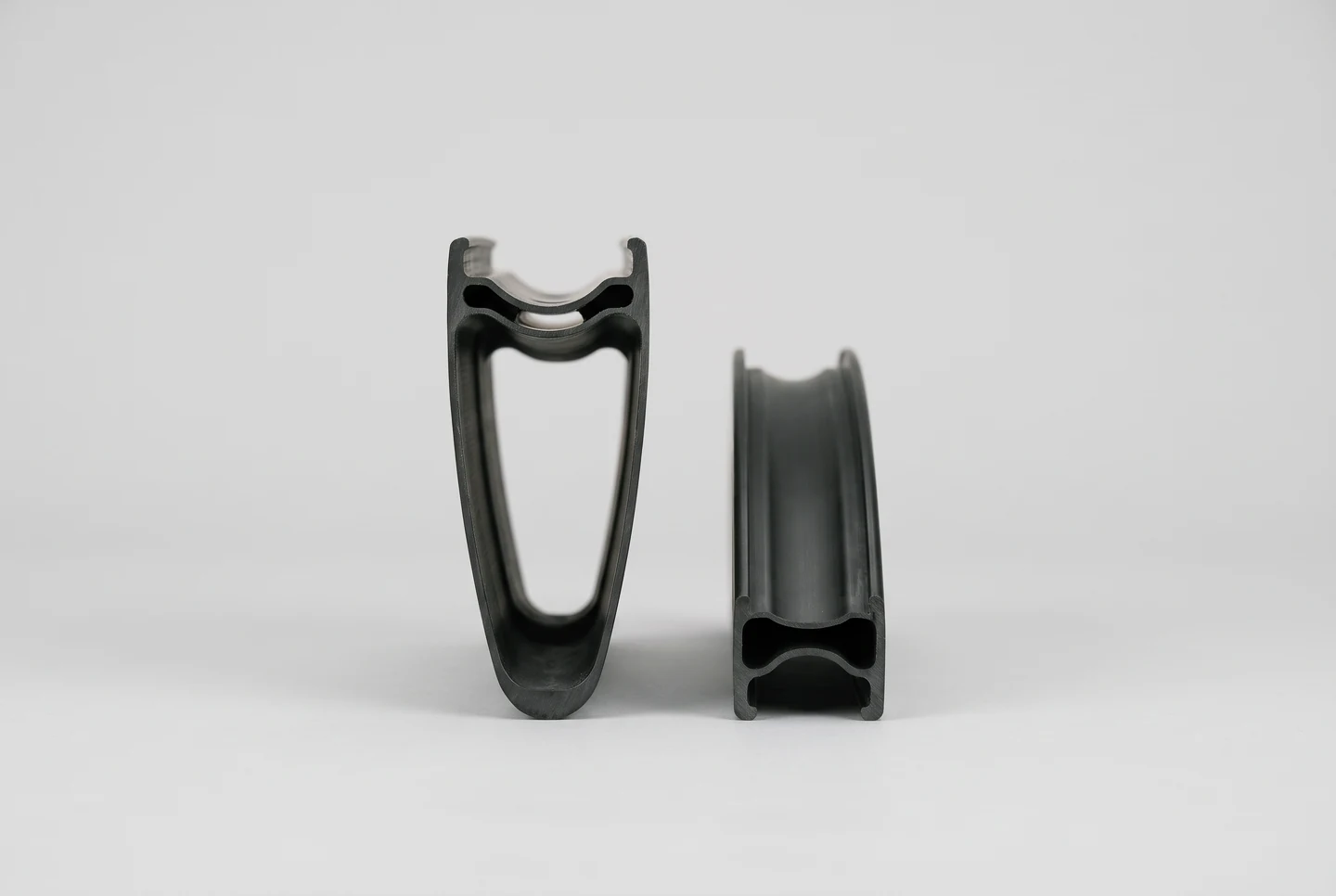
A deep wheel is more aero. A light wheel weighs less. On the flat, drag is what counts, because the watts needed to overcome it grow with the cube of speed. On a climb you’re going slower, so drag matters less and weight matters more4.
On a climb, what counts is how much the wheel weighs, not where the weight sits. The wheel’s rotation only matters when you accelerate, for example in a sprint5. This guide is about climbs ridden at a steady pace. Inertia and sprints are covered in the guide on carbon wheels.
What the tests say
On the road. BikeRadar tested two carbon wheelsets from the same maker: a 60 mm set at 1,669 g and a 32 mm set at 1,213 g. That’s a difference of about 450 g (1 lb), with the same tires and the same bike. The wheels were on loan from the maker1.
At the velodrome the deep wheels did 39.87 km/h (24.77 mph) and the light ones 39.39 km/h (24.48 mph): about a second per km. But the rider was putting out 4 W more on the deep wheels1.
On a 1.8 km (1.1 mi) climb at 11%, at about 300 W, the light wheels took 532 seconds and the deep ones 540: 8 seconds faster on the light wheels. Here, though, the rider was putting out 6 W more on the light wheels. With our model, 6 W on that climb is worth about 10 seconds. The author himself writes that the figures are only a rough guide, and that on the climb the result probably favors the light wheels a little1.
In the wind tunnel. Cyclingnews fitted 50 mm wheels to a road bike that had shallow wheels. With a rider on board, at 40 km/h (25 mph), CdA dropped by 0.0062, which the magazine puts at 5.9 W. The test’s margin of error was 3.9 W, and the magazine writes that it can’t say for certain the deep wheels were faster2.
The numbers, grade by grade
We ran the numbers again with the calculator’s model. For drag, we use the only independent test with a rider, the one from Cyclingnews: 50 mm wheels in place of shallow stock wheels. For weight, we take two cases: 450 g (1 lb) more, as in the BikeRadar test, and 150 g (5 oz) more, a middle case we chose ourselves1,2.
EXTRA SECONDS WITH DEEP WHEELS, 10 KM (6.2 MI) AT 250 W
| GRADE | +450 G | +150 G |
|---|---|---|
| Flat, 0% | −5 | −5 |
| 3% | 0 | −3 |
| 5% | +5 | 0 |
| 7% | +11 | +2 |
| 10% | +17 | +5 |
On the flat, deep wheels save you about 5 seconds per 10 km (6.2 mi). At 3%, with 450 g more, it’s a tie. In the conditions of the BikeRadar test, at 11% and 300 W, our numbers give about 1.5 seconds per km in favor of the light wheels. The test measured about 4, but with 6 W more on the light wheels1.
Between two carbon wheels, one shallow and one deep, the aero difference may be smaller than against stock wheels. In the calculator we use 0.004, which is an estimate. With 0.004 the break-even grade drops by about one percentage point.
BREAK-EVEN GRADE AT 250 W
| DRAG SAVED | +450 G | +150 G |
|---|---|---|
| 0.0062 wind tunnel test | 2.9% | 5.1% |
| 0.004 calculator estimate | 2.2% | 4.2% |
The more power you put out, the higher the break-even grade: a stronger rider goes faster on climbs too, so drag matters more4. Going from 250 to 200 W lowers it by half a point or a little more. Going from 250 to 300 W raises it by about the same.
What deep wheels really weigh
The extra weight depends on the wheels. In the BikeRadar test it was about 450 g (1 lb)1. But two carbon wheelsets from the same maker, 35 and 50 mm deep, have a claimed weight of 1,490 and 1,560 g: a 70 g difference3. With so little extra weight, and with the drag saving from the Cyclingnews test, at 250 W it’s a tie at around 7%. Between 35 and 50 mm, though, the aero difference is probably smaller, and no independent test has measured it.
Over the whole ride
On the calculator’s example road ride, 80 km (50 mi) with 900 m (2,950 ft) of climbing, you ride at about 200 W and the climbs are around 5%. There, 1 kg (2.2 lb) less is worth about 35 seconds and 0.001 of CdA about 6.4. With the drag saving from the wind tunnel test, the deep wheels are worth about 40 seconds, and the extra 450 g costs about 16. In all they gain about 24 seconds. With the drag saving the calculator estimates between carbon wheels, 0.004, they gain about 10. They lose a little on the climbs and make it back on the flats and descents.
If your ride has few climbs or only gentle ones, deep wheels save you time over the whole ride. On descents you go fast, and drag matters a lot4. In a group, though, when you’re sitting on a wheel, drag matters less and the advantage of deep wheels shrinks. There’s a guide on drafting.
When light wheels pay off
Long, steep climbs with a summit finish. If a race ends on a climb, or you only care about your time up a climb, light wheels save you a few seconds. By our numbers, that’s above 3% if the deep wheels weigh 450 g more, and above 5–6% if they weigh 150 g more.
If you put out fewer watts. With fewer watts the break-even grade comes down: at 200 W it’s about 2 to 4%.
In crosswinds. A shallow rim keeps the bike steadier in gusts. For some riders that matters more than the seconds1.
What the numbers don’t tell you
The calculation holds at a constant speed, with no wind and no sprints4. In the wind tunnel the deep wheels were slower with the wind almost head-on and faster with the wind from the side. The magazine thinks the gain is probably smaller out on the road2. In sprints, wheel weight matters a little more5. The CdA of the deep wheels comes from a single test with a rider, at 40 km/h (25 mph), against stock wheels, with a margin of error close to the gain itself2. And there’s only one road test of each kind. They show the trend, not the exact number of seconds1.
Sources
We read every source ourselves. They’re all public pages you can read for free.
- BikeRadar, 2022. 60 and 32 mm carbon wheelsets from the same maker, about 450 g apart: a velodrome test and a test on a 1.8 km (1.1 mi) climb at 11%, with power and times. The wheels were on loan from the maker. Article
- Cyclingnews, 2024. 50 mm wheels against the shallow wheels of a 2015 road bike, in the tunnel with the rider on the bike, at 40 km/h (25 mph) and with wind from different directions. Article
- bici.PRO, 2025. Two carbon wheelsets, 35 and 50 mm: weights and list prices claimed by the maker, 1,490 and 1,560 g. Article
- Crouch, Burton, LaBry and Blair, 2017. Scientific review of cycling aerodynamics, in Sports Engineering: the power model by Martin and colleagues, air drag power rising with the cube of speed, and how much drag matters on the flat and on climbs. Study (PDF)
- University of Illinois, 2007. The physics department’s Q&A service on why wheel weight matters more when you accelerate, but not on climbs. Answer