GUIDES · TIME TRIAL AND TRIATHLON
Clip-on aero bars: what they’re worth and when you can use them.
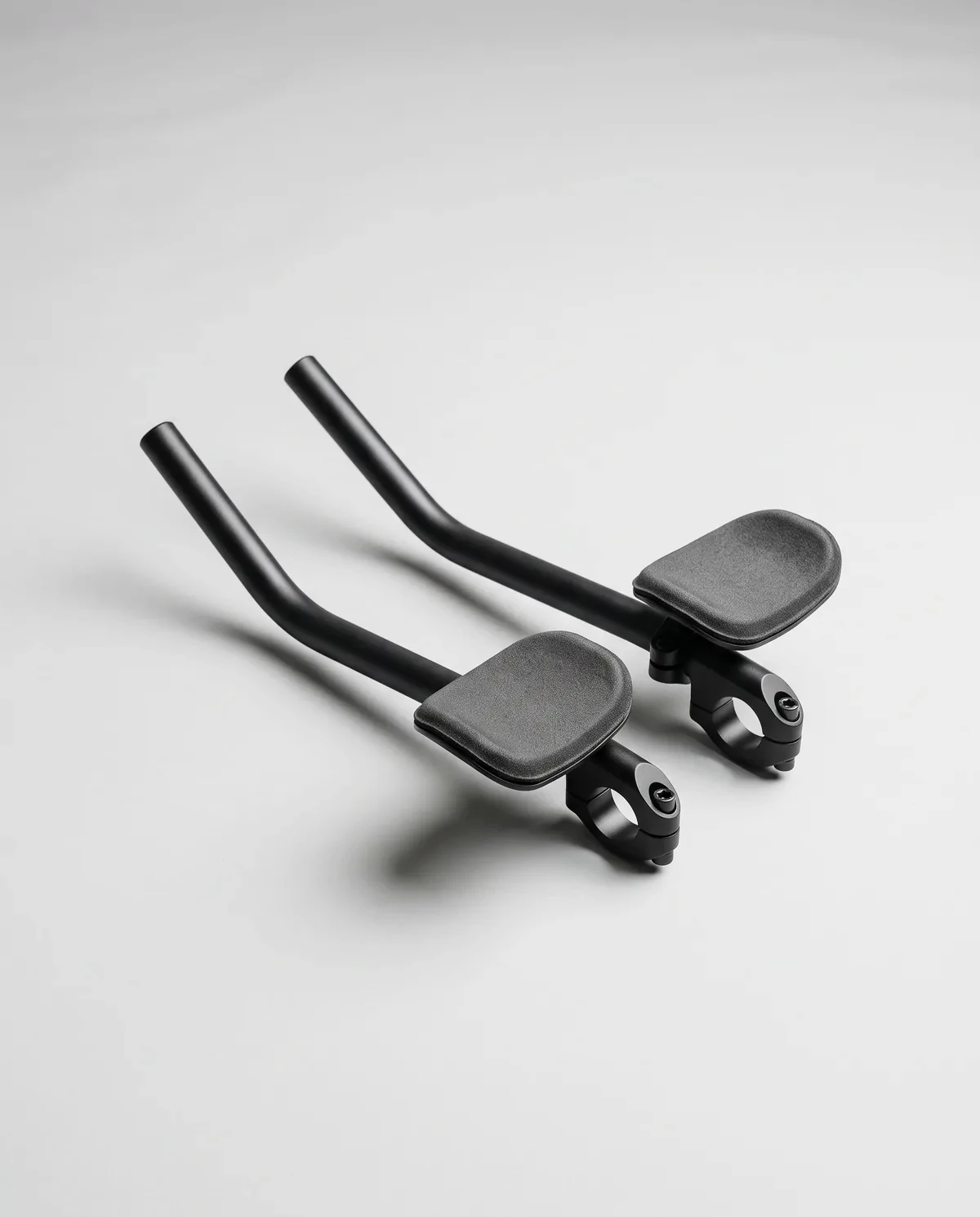
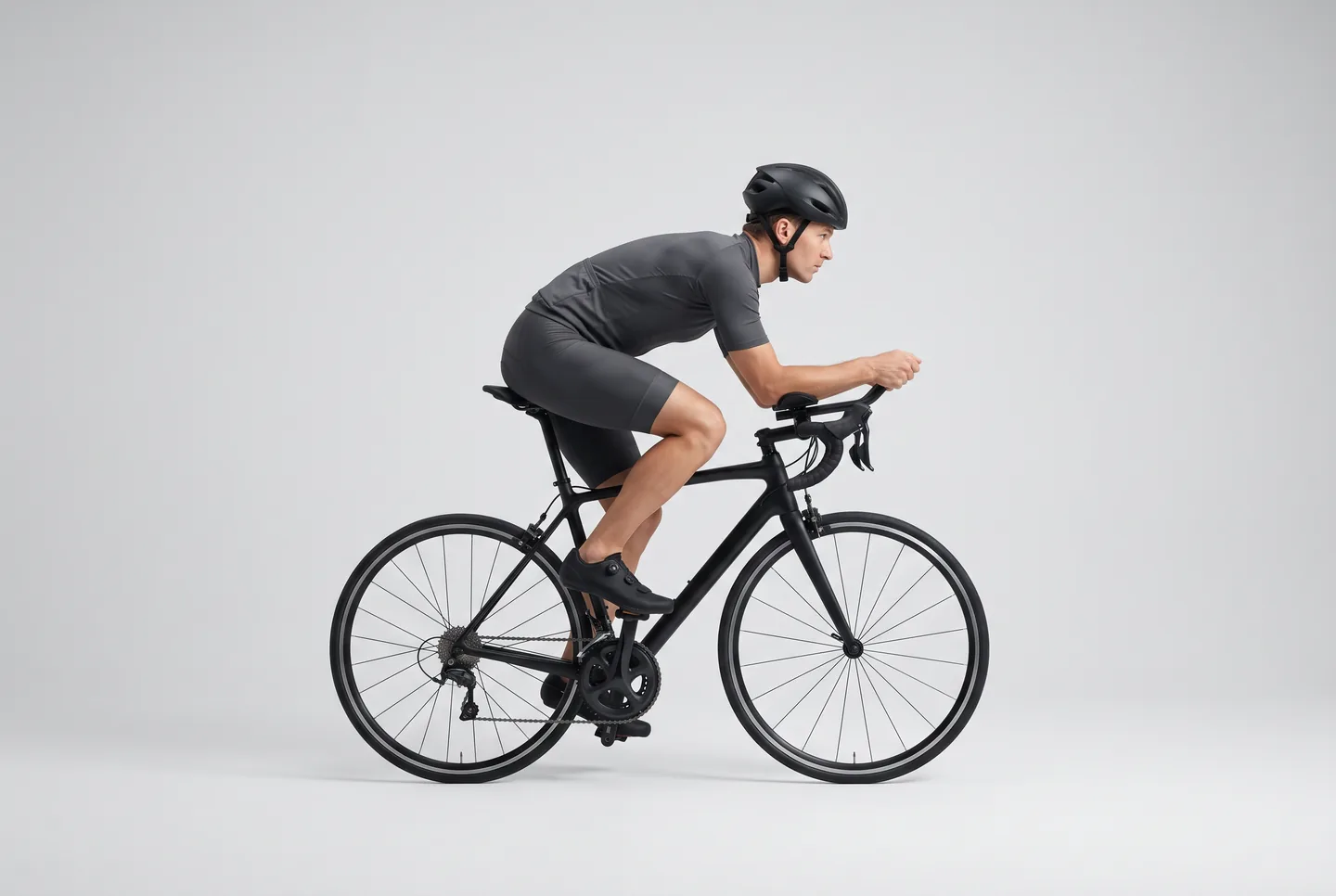
Clip-on aero bars mount on your road handlebar so you can ride with your forearms resting on them, lower and narrower. In the wind tunnel at 35–40 km/h (22–25 mph), they were worth at least 29 W over riding on the hoods or in the drops. If you start from a road bike, the calculator puts them first for seconds per euro. The catch is that the brakes are out of reach, so they’re for time trials and non-drafting triathlons and never for group riding.
29 W
What one rider saved in the wind tunnel at 35 km/h (22 mph), going from the hoods to a pair of basic aluminum aero bars.
−6'10"
What they’re worth on the example time trial, 90 km (56 mi) with 600 m (1,970 ft) of climbing, if you start from a road bike, for about €120.
€0.32
What each second costs. On a road bike they top the time trial ladder, ahead of tires.
−13%
How much one rider’s air resistance dropped in the wind tunnel, going from the drops with straight arms to a time trial position.
Where the watts go
Most of the air you push is moved by your body rather than the bike, which is why your position matters so much. In a wind tunnel test with a rider 183 cm (6 ft) tall weighing 72 kg (159 lb), on the same bike, air resistance (CdA) was 0.270 m² sitting upright, 0.243 in the drops with straight arms and 0.211 on time trial aero bars. In the drops, the body alone made up more than two thirds of that, at 0.167 m²1. Going from the drops to the aero bars cut drag by 13%.
On the aero bars your forearms rest on the pads, your hands move forward and together, your shoulders narrow and your torso drops. That shrinks the area you show the wind, from 0.37 m² in the drops to 0.34 m² on the aero bars in the same test1. If you’re considering a proper time trial bike, see our guide on TT bikes versus road bikes with aero bars.
What the tests say
BikeRadar, 2023. In the Silverstone wind tunnel in England, at 35 km/h (22 mph), a rider went from the hoods to a basic pair of aluminum aero bars costing £117 and saved 29.2 W. Angling them up 15–20° saved another 2.12 W, for 31.3 W in all, the figure in the article’s table. The aero bars were the biggest gain in the whole test2.
Cyclingnews, 2008. A pro rider, eight-time Australian time trial champion, went into the wind tunnel. Measurements were taken at 48 km/h (30 mph) and converted to 40 km/h (25 mph). On the same road bike, going from the drops to the aero bars saved 29.4 W. An engineer from a bike and helmet company ran the test, on that brand’s own bikes3.
Cycling Weekly, 2019. This is a sponsored article, paid for by a bike maker. At 40 km/h (25 mph) on the road bike, the aero bars saved 66 W over the starting position, and 83 W once they were set up better. The drops alone were worth 18 W. That makes 48 W from the drops to the aero bars, and 65 W with the better setup4.
WATTS SAVED WITH AERO BARS ON A ROAD BIKE
Aero bars just fittedAero bars set up better
BikeRadar · 35 km/h (22 mph) · from the hoods
Cyclingnews · 40 km/h (25 mph) · from the drops
Cycling Weekly, paid · 40 km/h (25 mph) · from the drops
The three tests aren’t alike. Each used one rider at a different speed, and one started from the hoods while the other two started from the drops. All three still found at least 29 W. The author of the 2008 test warns that numbers from one rider on one bike shouldn’t be generalized3.
Safety
On the aero bars your hands are far from the brakes and you have a bit less control of the bike2. You have to move your hands to brake2, and often to shift too4. On descents, in corners and in traffic, get your hands back on the brakes.
Never in a group. In a group you need to be able to reach the brakes at all times. Most group rides don’t allow aero bars, so if yours are removable, take them off before you head out5. They’re usually banned in road races2.
Carbon handlebars. Some makers of lightweight bars don’t allow any kind of aero bars. Before you buy, ask your handlebar’s maker if it’s OK. You need at least 22 mm of straight, round bar on each side next to the stem. Tighten them to the specified torque with a torque wrench. The wrong torque can crush or damage the bar and lead to a bad crash6,7.
Race rules
- Draft-legal triathlon (World Triathlon, including age-group races): aero bars are banned. Only a traditional drop bar is allowed8.
- Non-drafting triathlon (World Triathlon): the aero bars can’t stick out past the leading edge of the front wheel, and the bar ends have to be plugged. These are the only races where you can ride with your forearms on the pads and your hands on the extensions8. The 2025 IRONMAN rules had the same front-wheel rule, with disqualification for breaking it9. IRONMAN updates its rules every year, so check the current ones.
- UCI time trials. Aero bars are only allowed in time trials, and other races use a traditional bar. The tips of the extensions can reach up to 80 cm in front of the bottom bracket, measured horizontally, for riders under 180 cm, 83 cm for riders up to 189.9 cm and 85 cm for taller riders. The gap between the center of the forearm pad and the highest or lowest point of the extension can be at most 10, 12 or 14 cm for the same height groups. The pads can be tilted up to 30°, up from 15° before 202210.
The rules change often, so before race day read the current ones and your event’s own rules.
What they’re worth on your ride
In the calculator, aero bars show up under TT/Tri when you choose “Bike: Road”. Without them we start from the road air resistance, a CdA of 0.38 m² in the medium position. Aero bars lower it by 0.050 m², with a range of 0.030 to 0.075, to about 0.33. At 32 km/h (20 mph), 0.050 m² is about 21 W.
The low value is a bit under the most conservative test, from Cyclingnews: 29.4 W at 40 km/h (25 mph), or 0.036 m²3. The central value is just under the BikeRadar test, 29.2 W at 35 km/h (22 mph), or 0.053 m²2. The high value is close to the better setup in the paid Cycling Weekly test, 65 W at 40 km/h (25 mph), or 0.079 m²4.
We also count the weight, 300 to 500 g extra, though some aluminum aero bars weigh more. That’s our own estimate, because none of the sources we read gives a figure.
The example time trial is the bike leg of a half-distance triathlon: 90 km (56 mi) with 600 m (1,970 ft) of climbing, averaging 32 km/h (20 mph), with no drafting. On a road bike without aero bars you need about 229 W to hold that speed. There, the aero bars are worth about 6'10", between 3'40" and 9'20". On your ride they could be worth more or less, depending on your speed, how flat the course is and how long you can stay low.
What they cost. The calculator counts €120, since the basic aero bars in the BikeRadar test cost £1172. Each second costs about €0.32, which puts them first on the time trial ladder for a road bike, ahead of tires, tubeless and chain.
If you already have them, check them under “What you already have”. The calculator then starts from a CdA of 0.33 in the medium position, the road value minus what the aero bars are worth. The upgrades then include a bottle between the aero bars, if it’s a triathlon, and a time trial helmet. A real time trial bike starts lower, at 0.28. That’s our own estimate, because no test measures this exact difference.
NUMBERS FROM THE CALCULATOR
On the example time trial, with a 74 kg rider on a road bike without aero bars. Each upgrade is counted on its own, without the others.
Updated from the calculator on NOVEMBER 18, 2026.
How to fit and adjust them
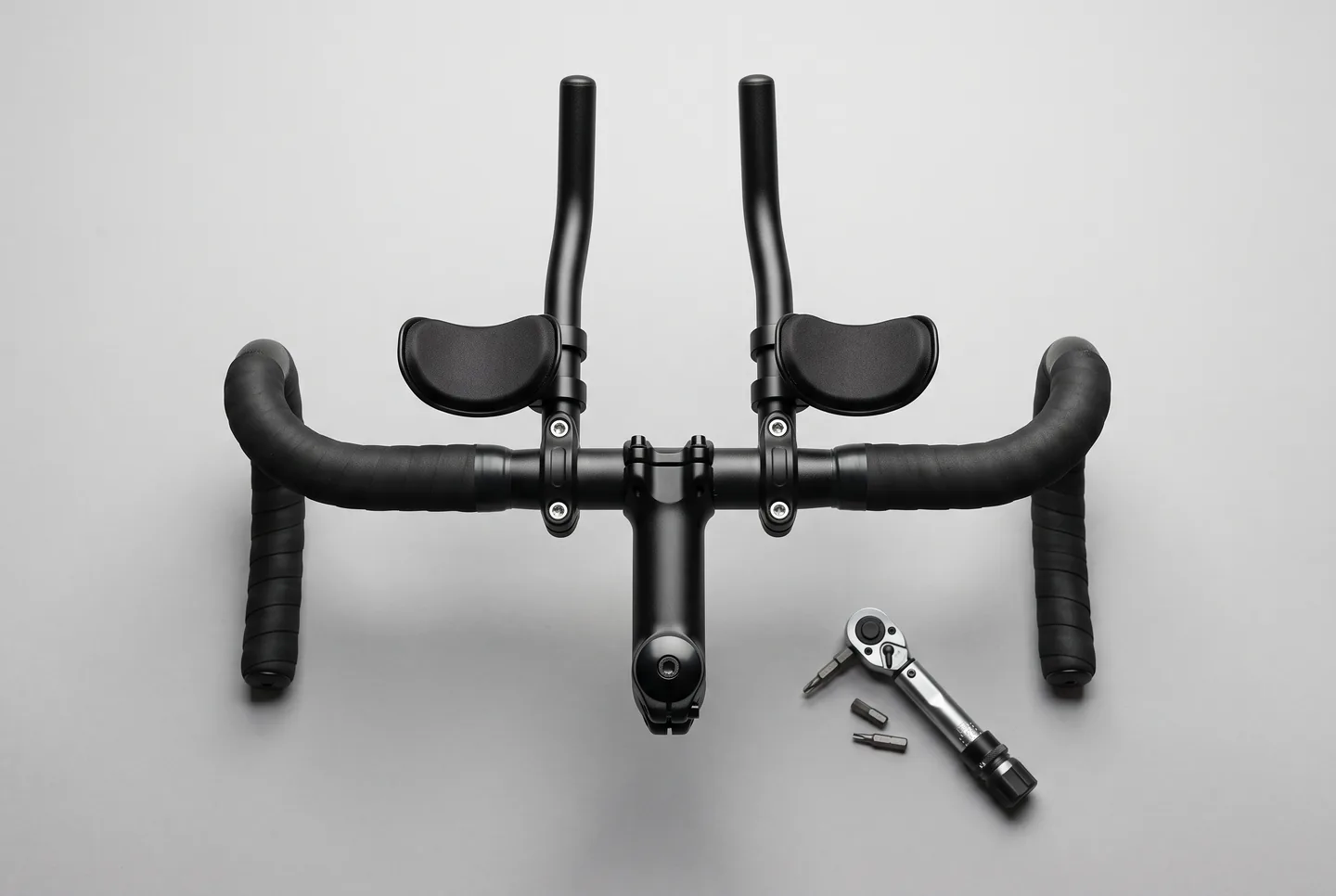
- Check the handlebar. If it’s carbon, ask the maker whether aero bars are allowed. You need at least 22 mm of straight, round tube on each side6, so they usually won’t fit flat-top or aero bars.
- Tighten to the right torque. Use a torque wrench, especially if the handlebar or the aero bars are carbon6,7.
- Adjust the pads. Moving the pads changes width and reach. Your elbow should sit on the pad, and the bars should be as narrow as you can comfortably ride7.
- Set the angle. Level with the ground or angled up a little, but both sides the same7. Angled up 15–20° they were more comfortable, and a bit faster in the BikeRadar test too2.
- Check the cables and steering. Turn the bar all the way in both directions. The cables shouldn’t kink or pull, and the aero bars shouldn’t hit anything.
- Fit the end plugs. Plug the ends of the extensions. They’re required in non-drafting triathlons8, and in a crash a plug hurts less than an open tube.
- Make sure you can see the road. If looking ahead is hard or tiring, the position is wrong. You have to be able to see what’s in front of you2.
- Practice before you race. Do your first rides alone on quiet, straight roads. Get used to moving from the aero bars to the brakes before you actually need to.
Position and comfort
Lower isn’t always faster, because the more you tuck, the more power you lose. A research group at the University of Birmingham worked out the best position for nineteen time trialists. Below 30 km/h (19 mph) a slightly higher TT position pays off. The air saving only outweighs the lost power above 46 km/h (29 mph), and a completely flat back isn’t the best choice11.
Everyone responds differently, too. Nine trained cyclists rode an outdoor velodrome with the pads raised or lowered one centimeter at a time. The changes in air resistance, oxygen uptake and estimated 40 km (25 mi) time varied a lot from rider to rider12.
Fatigue also matters. In the BikeRadar test, riding on the hoods with flat forearms was very tiring after just a few minutes. On aero bars your forearms carry the weight, and with a good setup it’s fairly comfortable2. In a triathlon you also have to run afterward. Ease into it, and work with a bike fitter if you can. The right position is the one you can hold for the whole race at the same power.
When they’re not worth it
If you mostly ride in groups, you can’t use them, because your hands need to stay near the brakes5.
If you do draft-legal triathlons or road races, they’re banned2,8,10.
If your carbon handlebar doesn’t allow them, don’t fit them6.
If you ride slowly or climb a lot, they’re worth less. Below 30 km/h (19 mph) it already pays to sit a bit higher11.
If you can’t stay low for long, you lose power and won’t get the gain measured in the wind tunnel11,12.
Sources
We read every source ourselves. They’re all public pages you can read for free. Prices are approximate. We don’t link to stores, because the site doesn’t tell you where to buy.
- Blocken and colleagues, 2013. A rider in the wind tunnel in three positions, torso upright, in the drops and on time trial aero bars: air resistance and frontal area. In Computers & Fluids; authors’ version. Study (PDF)
- BikeRadar, 2023. Budget aero upgrades tested in the Silverstone tunnel at 35 km/h (22 mph): aero bars, angle, position on the hoods; safety, road races, comfort. Article
- Cyclingnews, 2008. A pro rider in the wind tunnel, at 48 km/h (30 mph) converted to 40 km/h (25 mph): from the drops to the aero bars on the same road bike, from a road helmet to a time trial helmet. Test run by an engineer from a bike and helmet maker, with its own products. Article
- Cycling Weekly, 2019. Sponsored article, paid for by a bike maker: positions on a road bike, with and without aero bars, in the wind tunnel at 40 km/h (25 mph). Article
- Triathlon Magazine Canada, 2017. Group ride rules for triathletes: no time trial bikes or aero bars in the group, hands always near the brakes. Article
- An aero bar maker. Support page: aero bars and carbon handlebars, room for the clamp, bans by some handlebar makers, torque wrench. Page
- 220 Triathlon. How to fit and adjust aero bars: torque wrench, pads, width, angle. Article
- World Triathlon, 2025. Competition rules, edition of December 13, 2025 with the March and April 2026 amendments: handlebars in draft-legal and non-drafting races (5.2 f), positions on the bike (5.8). Rules (PDF)
- Slowtwitch, 2025. The 2025 IRONMAN rules: aero bars must not extend past the leading edge of the front wheel (5.3 c). Article
- UCI. The road time trial rules in force from January 1, 2023: aero bar length by rider height, height and tilt of the pads. Press release
- Fintelman and colleagues, 2014. University of Birmingham: the best time trial position by speed, with data from nineteen time trialists. In Journal of Biomechanics. Abstract
- Faulkner and colleagues, 2024. Nine trained cyclists on an outdoor velodrome, with the pads at different heights: air resistance, oxygen uptake and estimated time over 40 km (25 mi). In Sports Engineering. Study