GUIDES · TIME TRIAL AND TRIATHLON
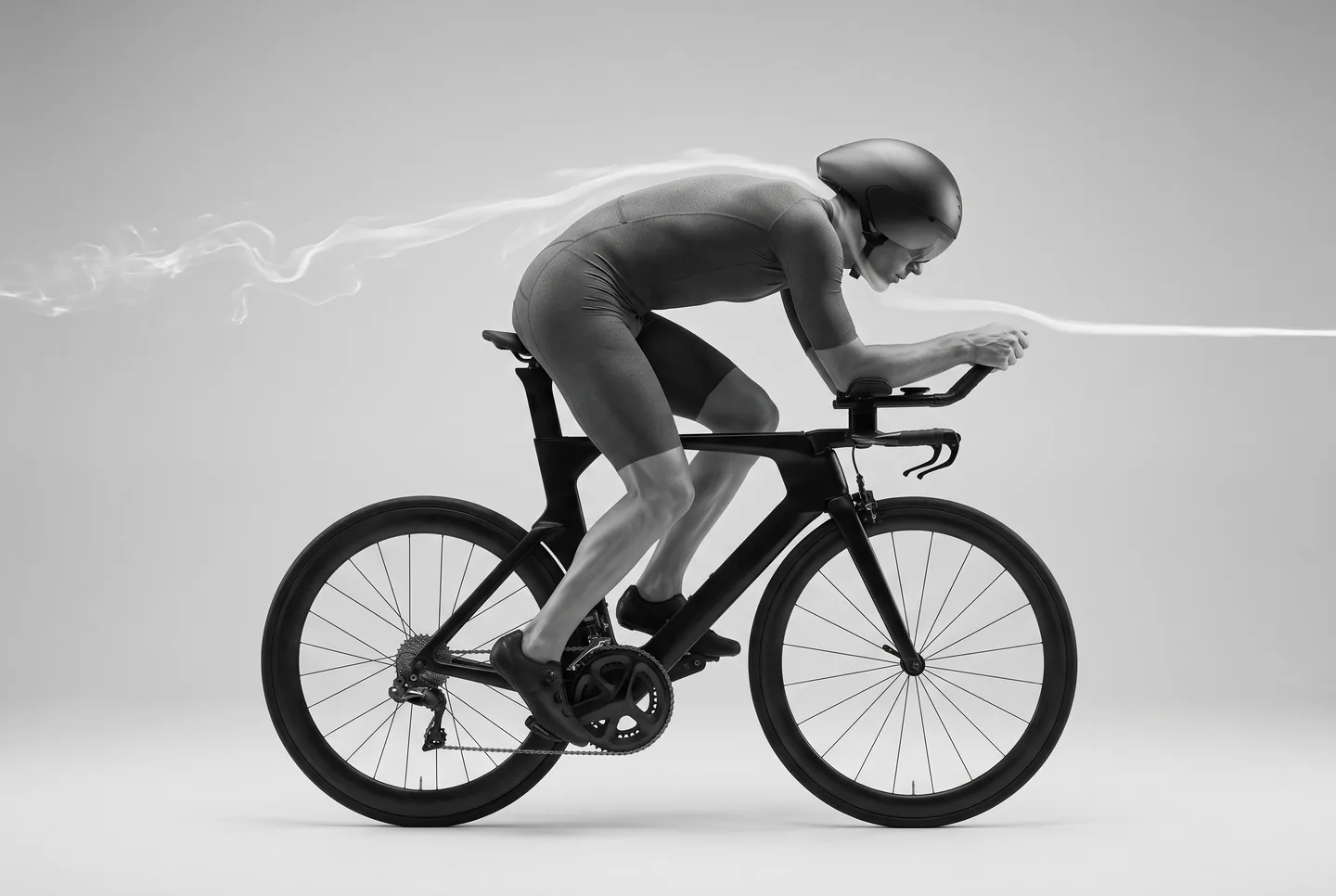
Time trial bike or road bike with aero bars.
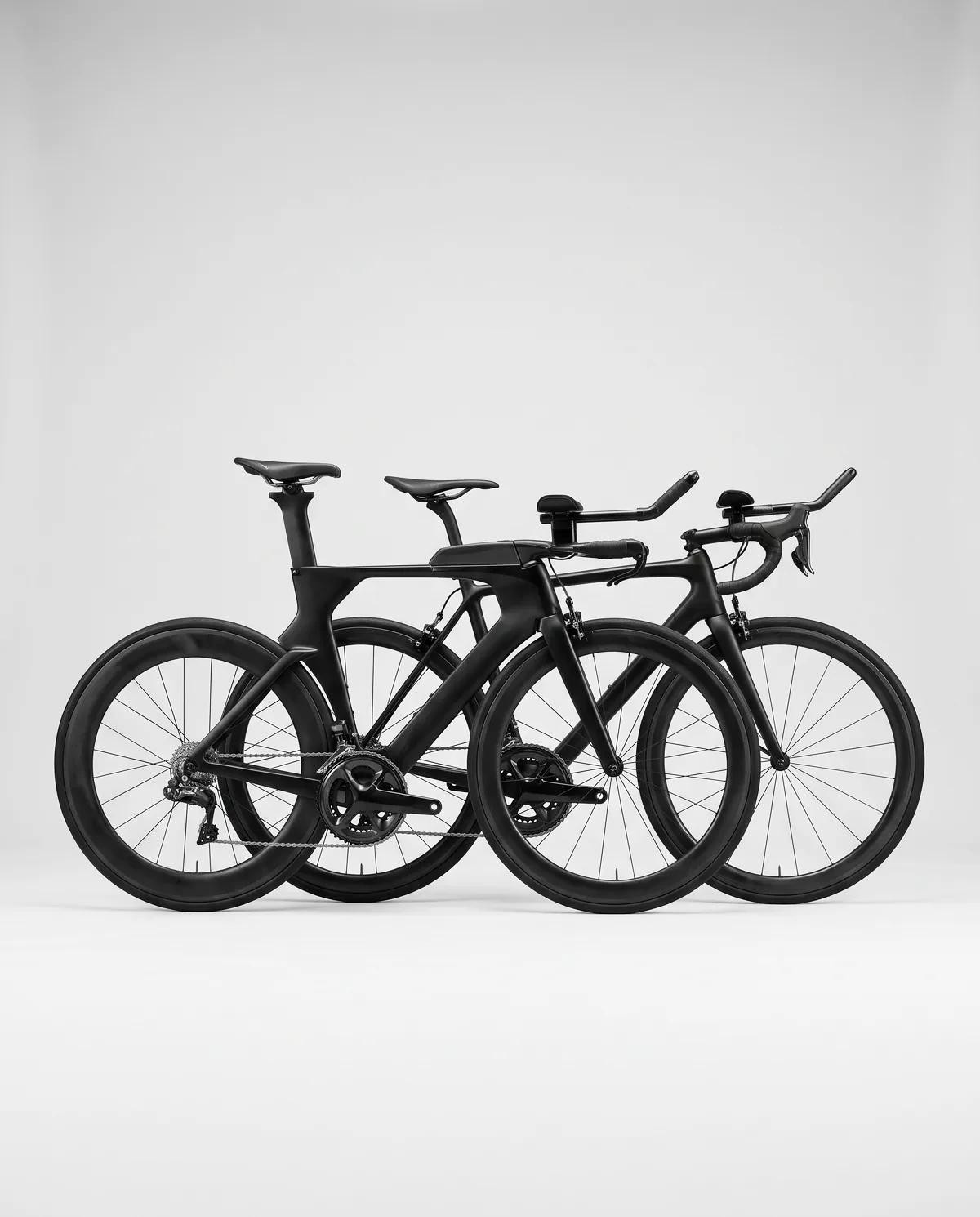
Most of the gain comes from your position rather than the frame. In the wind tunnel, the same rider saved 29.4 W at 40 km/h (25 mph) going from the drops to aero bars on a road bike. Switching to a TT bike, each bike with its own position, saved another 18.5 or 19.3 W, and the author says part of that still came from position. In another test, paid for by a bike maker, the TT bike was only 3–4 W faster than a road bike with well set-up aero bars in the same position. This guide covers the numbers, what they’re worth in minutes and when a TT bike pays off.
0'40"–3'20"
What switching to a TT bike is worth on the example time trial, 90 km (56 mi) with 600 m (1,970 ft) of climbing, using the watts from the two tests at the same weight.
29.4 W
What position alone was worth, going from the drops to aero bars on the same road bike at 40 km/h (25 mph).
3–4 W
The gap between a TT bike and a road bike with well set-up aero bars, in the same position at 40 km/h (25 mph), in a test paid for by a bike maker.
−6'10"
What aero bars on a road bike are worth on the same course, according to the calculator.
What the tests say
WATTS SAVED AT 40 KM/H (25 MPH)
| TEST | SWITCHING TO A TIME TRIAL BIKE | FROM THE DROPS, EVERYTHING COMBINED |
|---|---|---|
| Cyclingnews, 2008 | 18.5 or 19.3 W | about 60 W |
| Cycling Weekly, 2019, paid | 3–4 W | 68 W |
Cyclingnews, 2008. A pro rider, eight-time Australian time trial champion, tried five setups, from a road bike in the drops to a TT bike with a TT helmet. The wind tunnel ran at 48 km/h (30 mph), converted to 40 km/h (25 mph), with the wind head-on or at 10°. The aero bar position was worth 29.4 W, switching to the TT bike 18.5 or 19.3 W, and the TT helmet 8.6 or 9.4 W, about 60 W in all. On a circuit at about 40 km/h (25 mph), the gap between the road bike and the full TT setup was 77 W, 25% of the rider’s power1. An engineer from a bike maker ran the tests on that maker’s bikes, with a single rider, and the author himself warns against generalizing1.
Cycling Weekly, 2019. This is a sponsored article, paid for by a bike maker. At 40 km/h (25 mph), the road bike with well set-up aero bars saved 83 W over riding on the hoods, and the TT bike in the same position saved 86 W. The article puts the bike’s share at about 4 W, or 2.3% of the CdA. At 50 km/h (31 mph), with the wind more head-on, the TT bike saved 21 W over the road bike with aero bars, or 5.9% of the CdA2.
Why position matters more
Most of the air you push is moved by your body rather than the bike3. Aero bars get you lower, bring your arms in and narrow your shoulders, and that’s where the biggest savings are. A TT frame is more aero, but the bike is a small target for the wind compared with the rider.
A TT bike does something else as well. It’s built to keep you in a TT position for a long time, with the saddle further forward over the bottom bracket and the pads at the right distance. On a road bike with aero bars you can’t always get that low. Part of the 19 W in the Cyclingnews test comes from this, but nobody knows how much. No test measures how long you can hold the position, either.
Aero bars have their own guide, with the measurements, the rules and how to fit them.
What it’s worth in minutes
The calculator’s example time trial is the bike leg of a half-distance triathlon: 90 km (56 mi) with 600 m (1,970 ft) of climbing, averaging 32 km/h (20 mph) on a road bike without aero bars, about 229 W, with no drafting. On that course, aero bars on the road bike are worth about 6'10", including their weight.
If you convert the watts from the two tests to CdA, switching to a TT bike is worth about 40 seconds with Cycling Weekly’s 4 W and 3'20" with Cyclingnews’s 19 W, at the same power and weight.
In the calculator, a TT bike starts from a CdA of 0.28 m², versus 0.33 for a road bike with aero bars. That’s our own estimate, and it also accounts for the lower position a TT bike usually allows. With that estimate the difference would be about 7 minutes. That’s more than double what was measured for switching bikes, and it only applies if you actually ride lower on the TT bike. Treat it as the best case.
When it pays off
- If you don’t have aero bars. Start there. They don’t cost much, and in the tests they were worth more than switching to a TT bike.
- If you do a lot of time trials or non-drafting triathlons. A TT bike is built to keep you in position longer, though no test measures by how much. That’s where it can pay off.
- If you do draft-legal triathlons. Aero bars are banned and only a traditional drop bar is allowed, so you can’t race a TT bike with its own bar4.
- If you also ride in groups. TT bikes and aero bars don’t belong in a group, because on the aero bars your hands are far from the brakes5. A road bike with removable aero bars can do both.
In the calculator, under TT/Tri, pick a TT bike or a road bike under “Bike”, and check aero bars under “What you already have” if you have them.
Sources
We read every source ourselves. They’re all public pages you can read for free. Both wind tunnel tests were run or paid for by bike makers.
- Cyclingnews, 2008. A pro rider in the wind tunnel and on a circuit, in five setups from road bike to time trial bike: position, bike and helmet, at 48 km/h (30 mph) converted to 40 km/h (25 mph). Test run by an engineer from a bike and helmet maker, with its own products. Article
- Cycling Weekly, 2019. Sponsored article, paid for by a bike maker: positions on a road bike, with and without aero bars, and a time trial bike in the same position, in the wind tunnel at 40 and 50 km/h (25 and 31 mph). Article
- Crouch, Burton, LaBry and Blair, 2017. Scientific review of cycling aerodynamics, in Sports Engineering: the rider’s body makes up the largest part of the air resistance. Study (PDF)
- World Triathlon, 2025. Competition rules, edition of December 13, 2025 with the March and April 2026 amendments: handlebars in draft-legal and non-drafting races (5.2 f). Rules (PDF)
- Triathlon Magazine Canada, 2017. Group ride rules for triathletes: no time trial bikes or aero bars in the group, hands always near the brakes. Article