GUIDES · TIME TRIAL AND TRIATHLON
Time trial helmet: how many watts it saves and when it’s worth it.
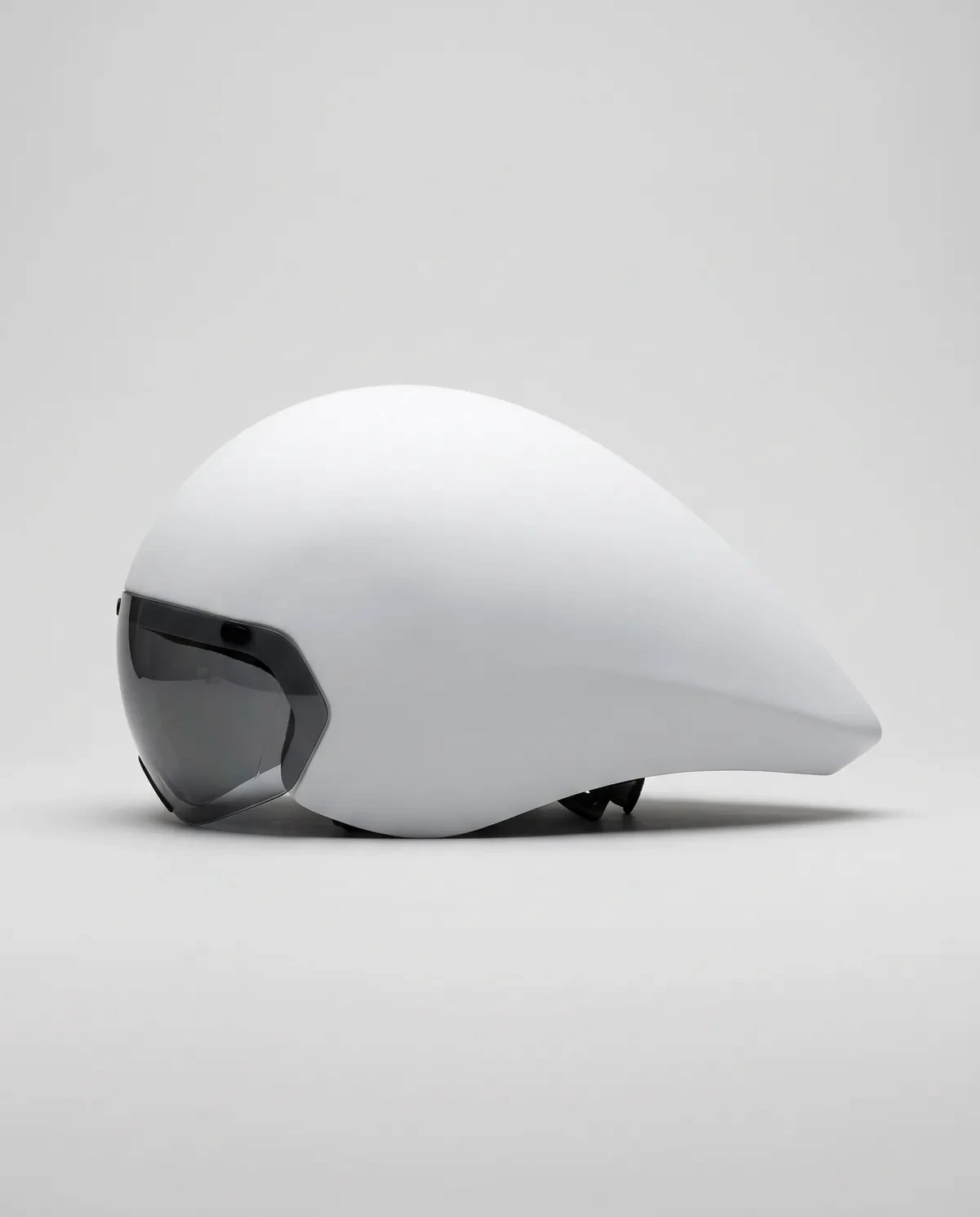
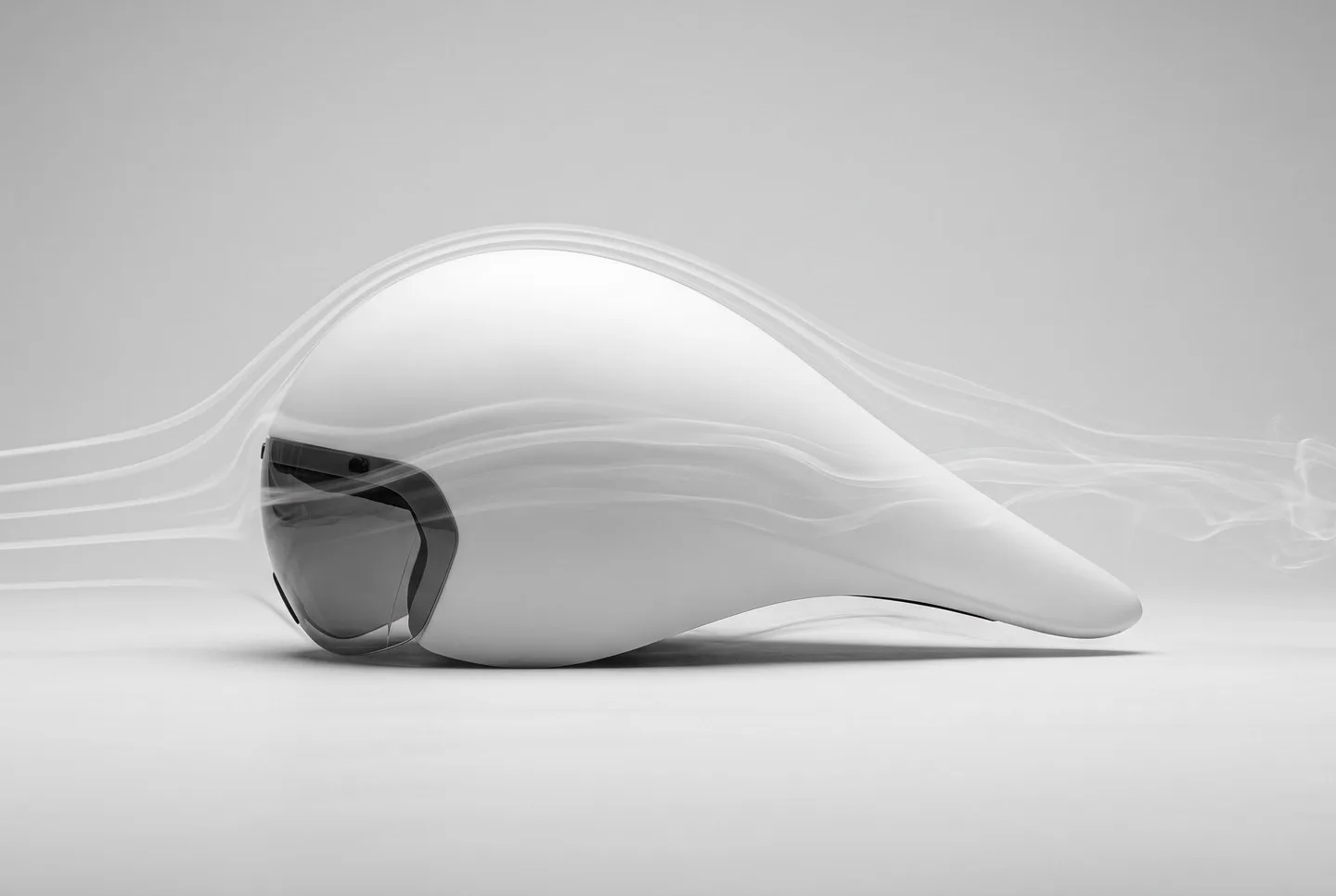
A time trial helmet has an almost closed shell with a long tail, and often a visor. In the wind tunnel at 40 km/h (25 mph), three of them saved 8 to 11 W over a vented road helmet. You only get that if you keep your head still with the tail close to your back, and it’s hotter to wear.
8–11 W
What three time trial helmets, with and without a visor, saved over a vented road helmet at 40 km/h (25 mph) in the wind tunnel.
−1'30"
What it’s worth on the example time trial, 90 km (56 mi) with 600 m (1,970 ft) of climbing at 32 km/h (20 mph), for about €250.
€160
What you pay extra if you needed a new helmet anyway. We count a regular helmet at €90.
13.5 W
The gap at 45 km/h (28 mph) between the best and worst of three time trial helmets, tested on the same bike in the same position.
What the tail is for
A time trial helmet has an almost closed shell and a long tail that runs down toward your back. It’s designed for one fixed position on the aero bars1.
In an MIT thesis that put a mannequin on aero bars in the wind tunnel, time trial helmets had the least drag with the tip of the tail close to the back, which is how most pros ride a time trial. In that position, even the slowest time trial helmet beat the road helmet used for comparison2.
What the tests say
Cyclingnews, 2025. The magazine tested 47 helmets in the wind tunnel at Silverstone, England, all on the same mannequin at 40 km/h (25 mph), with wind from several angles and a measurement error of ±0.74 W. The mannequin was on a track bike in the drops, which is a breakaway position rather than a time trial one. The baseline was a 230 g vented road helmet. The full test is for subscribers only and includes paid product placement from a cycling clothing maker, which the magazine discloses3.
The time trial helmets were the fastest. Three models, tested with and without a visor, saved 7.95 to 11.24 W, and on average 4.26 W more than the aero road helmets3.
WATTS SAVED AT 40 KM/H (25 MPH) COMPARED WITH A VENTED ROAD HELMET
Without visorWith visor
Time trial helmet 1
Time trial helmet 2
Time trial helmet 3
Cyclingnews, 2008. A pro rider in the wind tunnel, measured at 48 km/h (30 mph) and converted to 40 km/h (25 mph). Switching from the road helmet to the time trial helmet saved 8.6 or 9.4 W. The test was run by an engineer from a bike and helmet maker, using that company’s own bikes and helmets4.
220 Triathlon. Averaged over its wind tunnel runs, a time trial helmet was 48 seconds faster than a traditional road helmet over 40 km (25 mi), and 32 seconds faster than an aero road helmet5.
The model matters. The German magazine RennRad tested three time trial helmets on the same time trial bike, in the same position, at 45 km/h (28 mph). The best and worst were 13.5 W apart6.
The makers. One claims a time trial helmet saves more than 10 W at 45 km/h (28 mph) over an aero road helmet, and more than 5 W at 35 km/h (22 mph). Another claims 5 to 18 W over its own vented helmet, depending on speed1. Those are comparisons against their own helmets, so you can’t line them up with the independent tests.
The head and the tail
The MIT thesis tested time trial helmets at 48 km/h (30 mph) in three positions: tip close to the back, tip lifted slightly off it as happens when you get tired, and tip pointing up as when you lift your head on a climb. With a head-on wind and the tip close to the back, the typical time trial helmet added almost no drag to the mannequin, while the road helmet added 1.43 N. With the tip up, the typical time trial helmet went up to about 1 N, and the worst one hit 1.73 N, more than the road helmet2.
So you only get the gain if you keep your head still and low for the whole bike leg. 220 Triathlon also says the advantage is gone if a poor position leaves the tail pointing up, and that head position and a good fit are what count5.
Keep your head down and look ahead with your eyes. You still have to be able to see the road at all times, though. If looking ahead is hard or tiring, the position is wrong7.
Heat and ventilation
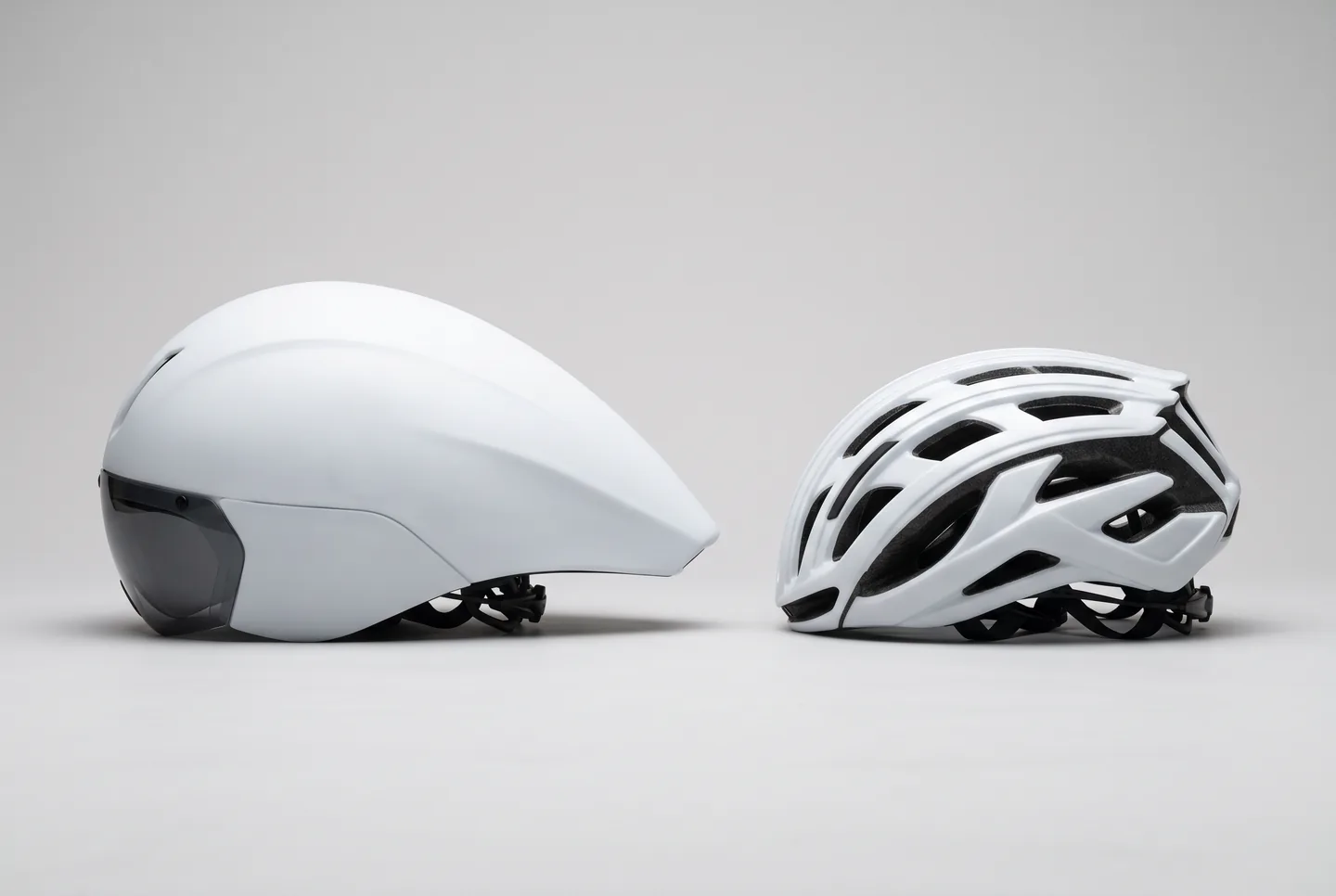
Time trial helmets have few vents and usually run hotter, which matters less in cool weather1. Aero road helmets usually let more air through than time trial helmets, and traditional road helmets let through more still5.
At the University of Texas, ten trained, heat-acclimated athletes rode indoors at 39 °C (102 °F), once in an aero helmet with no vents and once in a vented race helmet. Their heads ran warmer in the aero helmet, both at an easy pace and in a 12 km (7.5 mi) time trial. Core temperature and heart rate didn’t change, though, and neither did power or time in the 12 km time trial8. It was a short test, and no one has measured this over a two- or three-hour bike leg in the sun.
220 Triathlon points out that one women’s Ironman world champion raced in Hawaii in a regular road helmet to stay cooler and more comfortable5.
What it’s worth on your ride
In the calculator, the time trial helmet replaces a road helmet. It lowers your CdA, the air resistance of you and the bike, by 0.010 m², with a range of 0.004 to 0.014. That’s about 8 W at 40 km/h (25 mph), between 3 and 11.5 W, and about 4 W at 32 km/h (20 mph).
The central value is close to the slowest time trial helmet in the 2025 Cyclingnews test, 7.95 W or 0.0097 m²3. The high value is the fastest one in that 2025 test, 11.24 W or 0.0137 m²3. The low value is our own estimate for riders who move their head or lift it a lot, since in the MIT thesis the advantage almost disappeared with the tip up2.
We also count the weight. In the Cyclingnews test, the time trial helmets weighed 420 to 520 g and the vented baseline helmet 230 g. On the example ride, those extra 190–290 g take about 6 seconds off the gain3.
The example time trial is the bike leg of a half-distance triathlon: 90 km (56 mi) with 600 m (1,970 ft) of climbing, averaging 32 km/h (20 mph), with no drafting, on a stock time trial bike. There, the time trial helmet is worth about 1'30", between 0'30" and 2'10". On your ride it could be more or less, depending on how fast you go, how much of the course is flat and how still you keep your head.
If you already have an aero road helmet, the gain is smaller. In the Cyclingnews test, time trial helmets saved 4.26 W more than aero road helmets on average3. The calculator starts from a regular road helmet.
What it costs. The calculator counts €250. In the tests we cite, time trial helmets cost €280 to €350 in 20186 and £250 to £290 in 20253. A higher price doesn’t mean a faster helmet3. If you needed a new helmet anyway, only the difference counts. We take off €90 for a regular helmet, so the time trial helmet costs you €160 more and each second costs €1.78 instead of €2.78. That puts it fifth of 21 upgrades on the time trial ladder, after tires, tubeless, chain and the bottle between the aero bars.
NUMBERS FROM THE CALCULATOR
On the example time trial, with a 74 kg rider on a time trial bike. Each upgrade is counted on its own, without the others.
Updated from the calculator on NOVEMBER 18, 2026.
How to choose one
- Go by independent tests. Makers compare against their own helmets1. A test that puts every helmet on the same mannequin is one you can actually compare across3.
- Think about your position. In the MIT thesis, the fastest helmet changed with head position and wind angle2. Pick a shape that stays close to your back in the position you actually ride on the aero bars.
- Get the right size. Fit matters as much as head position5. Our guide on aero road helmets covers how to measure your head and how to wear a helmet.
- Visor or no visor. In the Cyclingnews test, every helmet was 0.8 to 2.5 W faster with the visor3. Visors are banned in draft-legal triathlons, though9.
- Make sure it’s certified. In triathlon and UCI races, the helmet has to meet an official safety standard1,9.
- Try it before race day. Ride it on your aero bars for the full length of the bike leg, and in race-day heat if you can.
Race rules
- Draft-legal triathlon (World Triathlon): no visor, fixed or detachable, and the helmet can’t cover your ears9. Aero bars are banned there too, so a time trial helmet doesn’t do much.
- Non-drafting triathlon (World Triathlon): the helmet has to be certified, buckled, the right size and unmodified. Visors are allowed9.
- UCI races. The helmet has to be certified to an official safety standard and fit inside a 450 × 300 × 210 mm box. Clothing and accessories, helmet included, can’t change the rider’s shape1. From 2026, time trial helmets with a visor and covered ears are only allowed in road time trials. In other road races you need a traditional helmet with at least three vents, no visor and nothing over the ears10.
The rules change often, so check the current ones and your race’s own rules before you race.
When it’s not worth it
If your race is long and very hot, a helmet with more airflow is more comfortable5,8.
If you move your head a lot or ride with it high, the tail lifts off your back and most of the advantage goes away2.
If you already have an aero road helmet, the gain is about half, 4.26 W on average at 40 km/h (25 mph)3.
If the course is slow or has a lot of climbing, drag matters less and so does the helmet.
If your helmet is fairly new and undamaged, you’d be paying for the whole thing. Wait until it’s due for replacement, when the price difference is smaller.
Sources
We read every source ourselves. They’re all public pages you can read for free, except the full 2025 Cyclingnews test, which is for subscribers. Prices are approximate. We don’t link to stores, because the site doesn’t tell you where to buy.
- BikeRadar, 2025. Time trial helmets in road racing: figures claimed by makers, ventilation, head position, UCI helmet rules. Article
- Sidelko, MIT, 2007. Thesis: time trial helmets and a road helmet in the wind tunnel, at 48 km/h (30 mph), on a mannequin on aero bars, with the head in three positions. Thesis (PDF)
- Cyclingnews, 2025. 47 helmets in the wind tunnel at Silverstone, at 40 km/h (25 mph), on the same mannequin in the drops: watts saved, visor, weight, price. The full test is for subscribers and contains paid product placement by a cycling clothing maker, which the magazine discloses. The magazine earns a commission on purchases made through its links. Article
- Cyclingnews, 2008. A pro rider in the wind tunnel, at 48 km/h (30 mph) converted to 40 km/h (25 mph): from the road helmet to the time trial helmet. Test run by an engineer from a bike and helmet maker, with its own products. Article
- 220 Triathlon. Road, aero road and time trial helmets in the wind tunnel: seconds over 40 km (25 mi), head position, heat. The magazine earns a commission on purchases made through its links. Article
- RennRad, 2018. Three time trial helmets in the wind tunnel, on the same time trial bike and in the same position, at 45 km/h (28 mph). In German. Article
- BikeRadar, 2023. Aero upgrades tested in the wind tunnel: among the position tips, always being able to see the road ahead. Article
- University of Texas, 2013. Lee and colleagues: ten athletes at 39 °C (102 °F) with an aero helmet with no vents and with a vented one. Head and core temperature, heart rate, power, time over 12 km (7.5 mi). Abstract on PubMed
- World Triathlon, 2025. Competition rules, edition of December 13, 2025 with the March and April 2026 amendments: helmets (5.2 g) and handlebars (5.2 f). Rules (PDF)
- Cyclingnews, 2026. The UCI rules changed for 2026: traditional and time trial helmets, vents, visor, ears and maximum dimensions. Article