GUIDES · TIME TRIAL AND TRIATHLON
Bottle between the aero bars: where to carry it in a time trial.
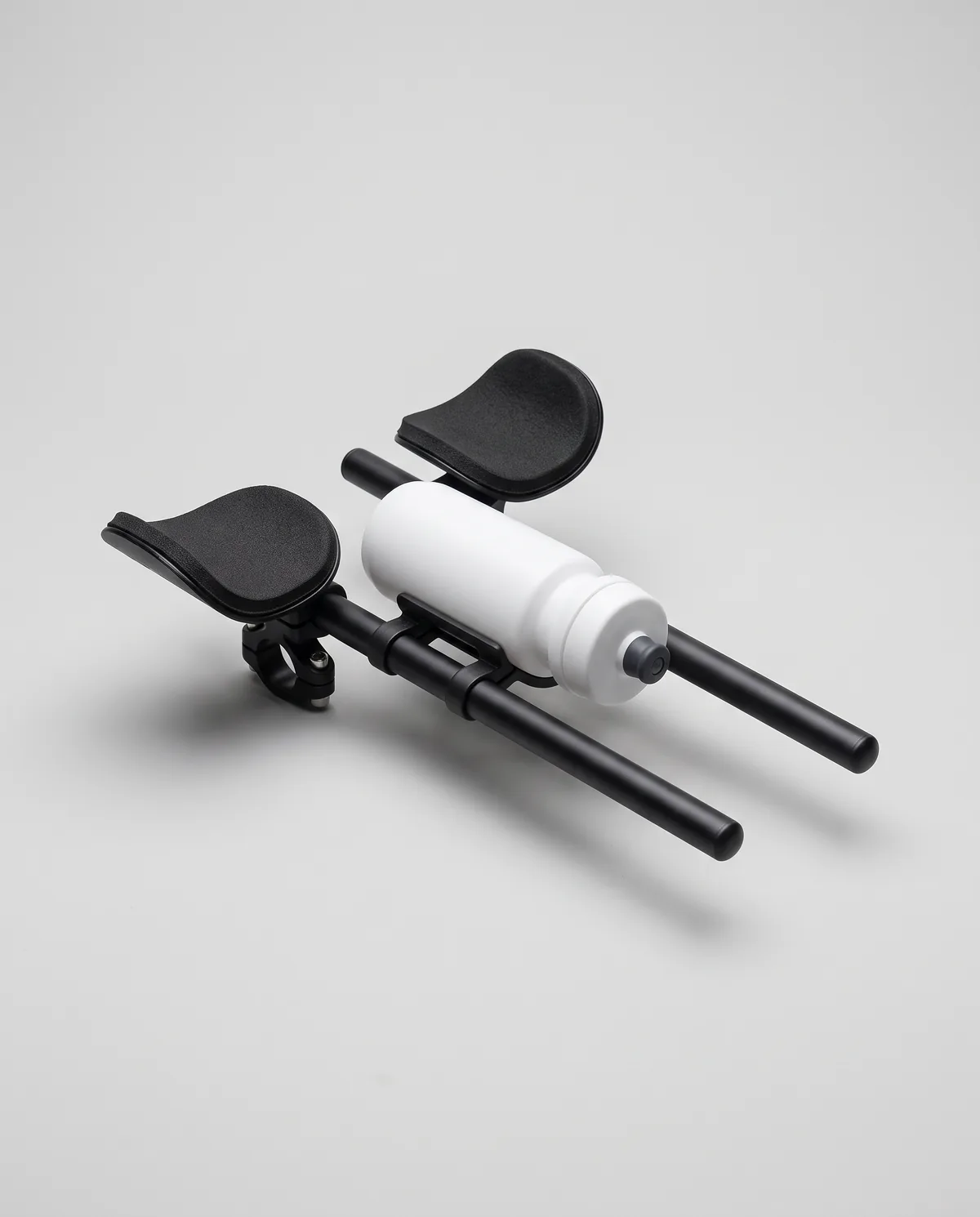
A bottle on the down tube adds air resistance. Between the aero bars, or behind the saddle close to your body, it adds much less. On the track, on a TT bike, moving it from the down tube to between the aero bars was worth about 4 W at 40 km/h (25 mph). It’s cheap, and it ranks fourth on the time trial ladder for seconds per euro. It is banned in UCI time trials, though.
−0'45"
What it’s worth on the example time trial, 90 km (56 mi) with 600 m (1,970 ft) of climbing at 32 km/h (20 mph), for about €45.
5.0 W
What a round half-liter bottle on the down tube cost at 40 km/h (25 mph) on the track, compared with no bottle.
1.2 W
The same bottle between the aero bars. Behind the saddle it cost even less, at 0.7 W.
2 L
The most water you can carry on the handlebar and aero bars combined in non-drafting World Triathlon races.
Where it costs the least
A bottle on the down tube adds drag. Between your arms, or behind the saddle close to your body, it adds much less. In the track test we cite, it cost between a quarter and a seventh as much1. Up front you can also drink without coming out of position2.
The people who ran the tests say the best spot depends a lot on the rider. Between the aero bars works best if you ride with your arms close together. Behind the saddle usually costs less, and for some riders it was even faster than no bottle at all1.
What the tests say
Aerocoach, 2020. Time trialist Jessica Rhodes-Jones rode a TT bike on the track with a sensor that measures CdA on the move. The results are extra watts compared with no bottle. At 40 km/h (25 mph), a round half-liter bottle cost 5.0 W on the down tube, 3.6 W on the seat tube, 1.2 W between the aero bars and 0.7 W behind the saddle. At 30 km/h (19 mph) it was less than half that. A 900 ml bottle on the down tube cost 8.2 W, and a 750 ml hydration system between the aero bars 1.8 W1.
EXTRA WATTS AT 40 KM/H (25 MPH) COMPARED WITH NO BOTTLE
Round 500 ml bottle900 ml
Down tube
Seat tube
Between the aero bars
Behind the saddle
A computer simulation. Ingmar Jungnickel, a former head of aerodynamics at a bike maker, simulated a rider with bottles but without the bike or the cages. With a slightly higher torso, one or two bottles between the arms saved almost 2 minutes over 180 km (112 mi) compared with no bottle. In a very tucked position, though, a bottle between the arms was about 40 seconds slower over 180 km than no bottle. Behind the saddle, almost horizontal and close to the body, the bottles saved about a minute and a half over the Ironman distance2. That’s a simulation, not a measurement.
The straw. On hydration systems with a straw, a long exposed straw can cost a lot, up to 3.5 W at 40 km/h (25 mph) in tests on other riders1.
What it’s worth on your ride
In the calculator, the bottle between the aero bars replaces the one on the down tube. It lowers your CdA, the air resistance of you and the bike, by 0.0045 m², with a range of 0 to 0.0078. At 40 km/h (25 mph) that’s about 3.7 W, up to 6.4, and at 32 km/h (20 mph) about 1.9 W.
The central value comes from Aerocoach’s half-liter bottle: 5.0 W on the down tube minus 1.2 W between the aero bars, or 3.8 W at 40 km/h (25 mph). That’s about 0.0046 m², which we round down. The high value is the switch from the 900 ml bottle on the down tube to the 750 ml system between the aero bars, 6.4 W1. The low value is zero, to stay conservative. In the computer simulation, with a very tucked rider, a bottle between the arms was about 40 seconds slower over 180 km (112 mi) than no bottle, and the down tube wasn’t simulated2. Only one rider was measured, which is why the range is wide.
The example time trial is the bike leg of a half-distance triathlon: 90 km (56 mi) with 600 m (1,970 ft) of climbing, averaging 32 km/h (20 mph) on a stock TT bike, with no drafting. There, the bottle between the aero bars is worth about 0'45", up to 1'20". We don’t count weight. It’s the same water in a different spot, the mount is light, and bottle weight barely matters on the flat2.
What it costs. We count €45 for the mount and bottle. Each second costs €1.05, which makes it fourth of 21 on the time trial ladder for the example ride set to triathlon, after tires, tubeless and chain. The calculator only suggests it if you have aero bars and the race is a triathlon, because it’s banned in UCI time trials.
Behind the saddle it costs even less1,2, but the calculator doesn’t include that option yet.
NUMBERS FROM THE CALCULATOR
On the example time trial, with a 74 kg rider on a time trial bike. Each upgrade is counted on its own, without the others.
Updated from the calculator on NOVEMBER 18, 2026.
How to choose and install it
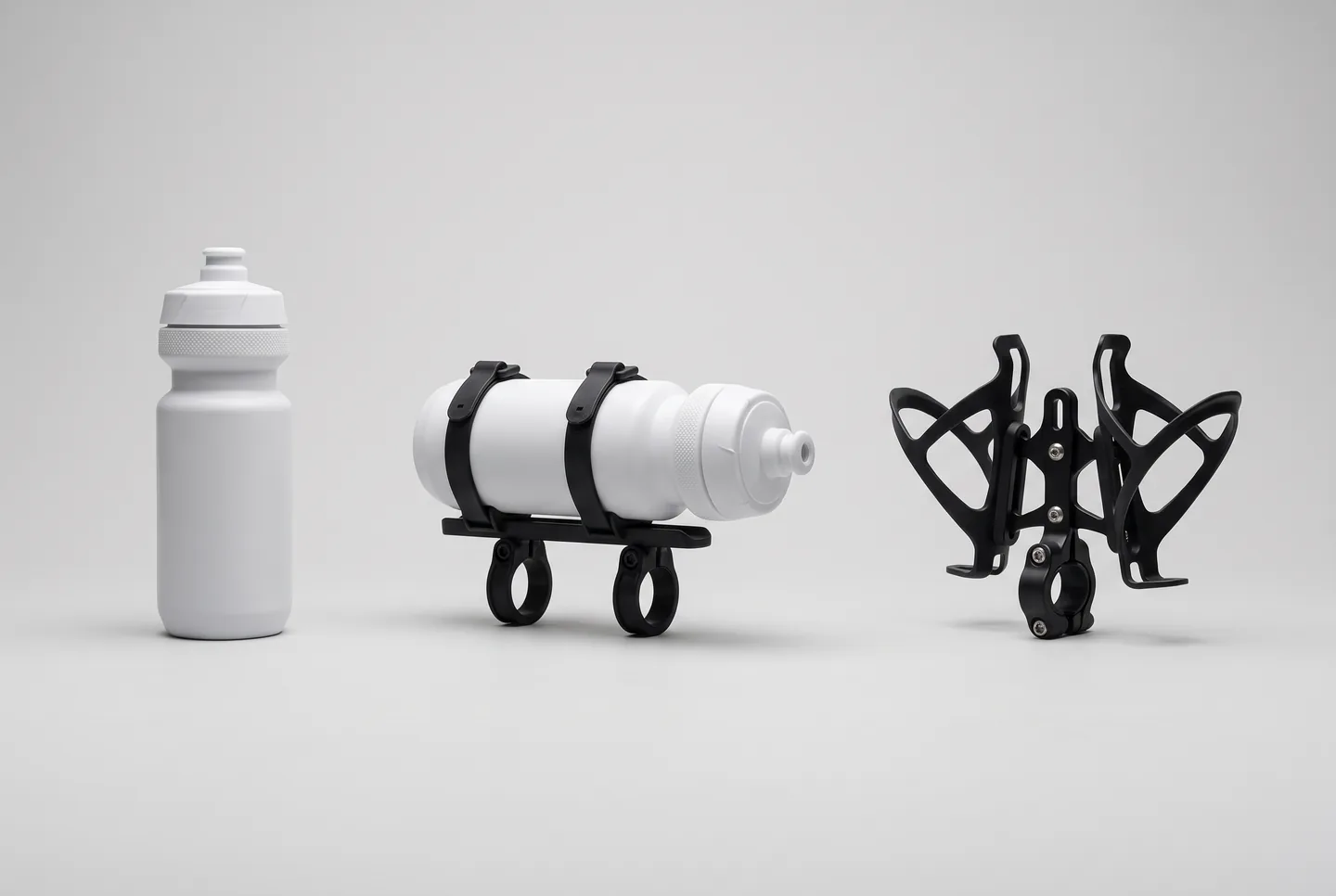
- Get it off the down tube. That’s the most expensive spot. A large bottle there cost more than 8 W at 40 km/h (25 mph)1.
- Between the aero bars if your arms are close together. If you ride with them wide, or very tucked, behind the saddle may work better1,2.
- Behind the saddle, keep it flat and close. In the computer simulation, the best bottles were almost horizontal and close to the body, at saddle height or a little above2.
- Keep the straw short. A long exposed straw can wipe out the gain1.
- Plan for aid stations. When the front bottle is empty, toss it at an aid station, or use an open one and refill it from the bottles they hand out. The cage has to hold those securely too3.
Race rules
- Non-drafting triathlon (World Triathlon): bottles and cages can go on the handlebar and aero bars, with no more than 2 liters in total on anything that turns with the steering. At the back, you can have up to two bottles of up to one liter each4.
- Draft-legal triathlon (World Triathlon): aero bars and bottles behind the saddle aren’t allowed. Elite, U23, junior and youth races also ban bottles on the handlebar4.
- Nothing in your suit (World Triathlon): bottles and hydration systems can’t be attached to or tucked into the tri suit or arm sleeves4.
- IRONMAN. TRI247 says 2 liters up front and 2 liters at the back, plus bottles inside the frame triangle3. Where the rules differ, IRONMAN races follow the IRONMAN rules5, so read them before the race.
- UCI races, time trials included: bottles can only go on the down tube or seat tube, inside the triangle, and must hold 400 to 800 ml. They’re banned behind the saddle, on the stem and anywhere else, which includes between the aero bars6.
The rules change often, so before race day read the current ones and your event’s own rules.
When it’s not worth it
If you race a UCI time trial, the bottle between the aero bars is banned6.
If you ride very tucked, a bottle between your arms can be slower than no bottle2. Try behind the saddle instead.
If you ride with your arms wide, a bottle between the aero bars helps less1.
If you don’t have a bottle on the down tube, there’s nothing to move.
Sources
We read every source ourselves. They’re all public pages you can read for free. Prices are approximate. We don’t link to stores, because the site doesn’t tell you where to buy.
- Aerocoach, 2020. Bottles on the track, with a sensor that measures CdA: one rider on a time trial bike, at 30 and 40 km/h (19 and 25 mph), bottles of various sizes on the down tube, on the seat tube, between the aero bars and behind the saddle. Aerocoach does aerodynamics testing and sells wheels and components, not the bottles tested. Article
- Triathlon Magazine Canada, 2025. Computer simulation by Ingmar Jungnickel, former head of aerodynamics at a bike maker: bottles between the arms and behind the saddle, with a high torso and in a very tucked position, without a bike and without bottle cages. Article
- TRI247. Where to carry bottles in triathlon: Aerocoach’s tests, the IRONMAN bottle rules, aid stations. Article
- World Triathlon, 2025. Competition rules, edition of December 13, 2025 with the March and April 2026 amendments: bottles on the handlebar (5.2 f), behind the saddle (5.2 j), how much water at the front and rear (5.2 m, n), items inside the suit (5.2 o). Rules (PDF)
- Triathlon Magazine Canada, 2026. The rules to know for the 2026 season: World Triathlon and IRONMAN, bottles at the front and rear. Article
- UCI, 2023. Guide to the technical regulations, edition of January 1, 2023: bottles (1.3.024 bis). Guide (PDF)