GUIDES · CLOTHING
Aero clothing: how many watts you save with a jersey, skinsuit, shoe covers and socks.
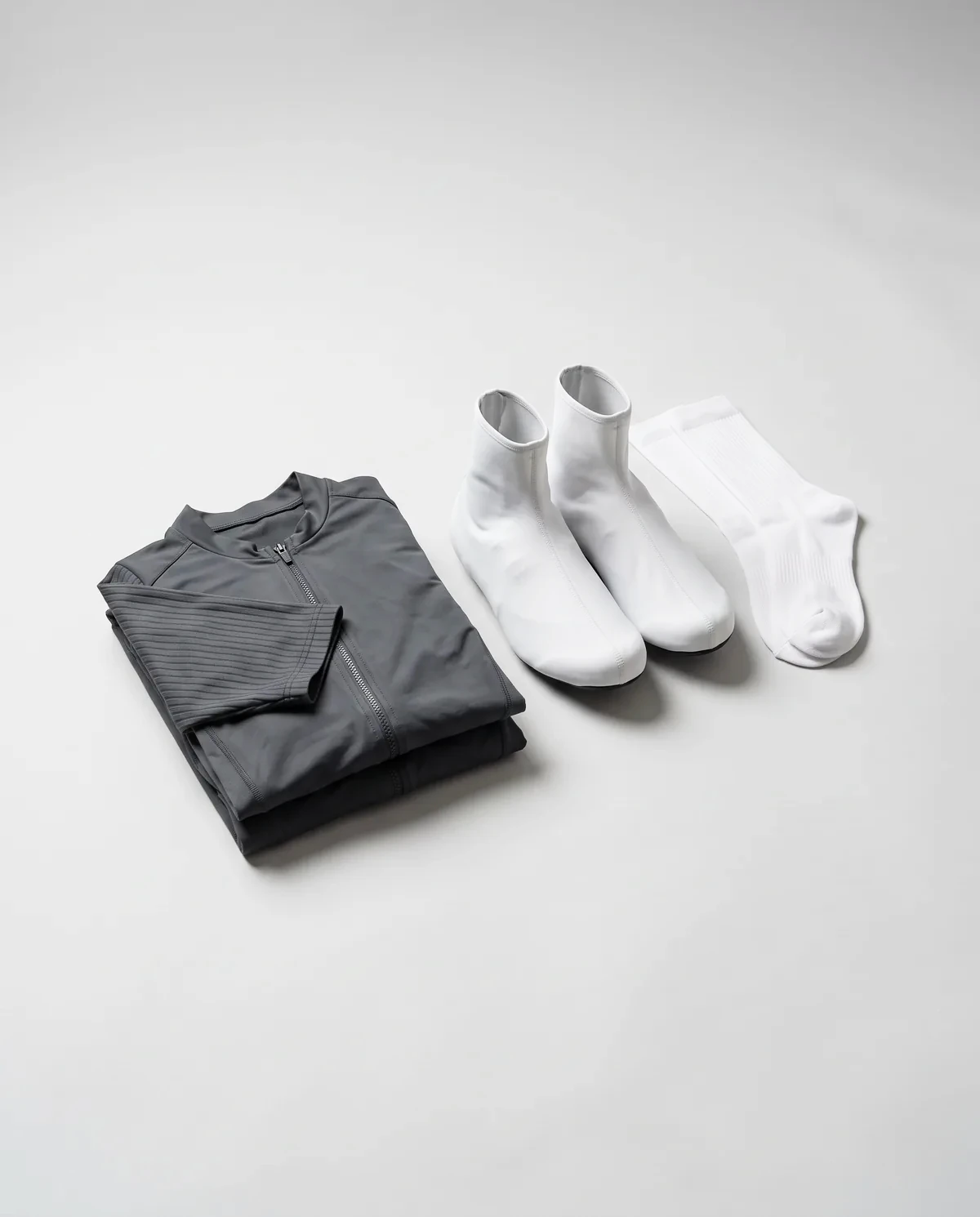
On the flats, almost all your effort goes into pushing air, and most of that air is pushed by you rather than the bike. A flapping jersey costs you watts, and a race skinsuit saves even more. Shoe covers and socks matter less. The catch is that the most aero clothing is tight, and when it’s hot a looser jersey is more comfortable.
10 W
What a race skinsuit saved over a budget jersey and bib shorts in the wind tunnel at 40 km/h (25 mph). With an aero base layer underneath, it was 18 W.
−1'00"
What a skinsuit is worth instead of a flapping jersey on the example gravel ride, 62 km (39 mi) with 780 m (2,560 ft) of climbing, for about €250.
14 W
What a jersey one size up cost at 50 km/h (31 mph). It still fit close, but bunched up more at the sides.
80%
Roughly how much of the air resistance comes from the rider. The bike accounts for the rest.
Where the watts go
On the flats, air makes up more than 90% of the resistance. Counting climbs too, it takes 56 to 96% of your power, depending on the grade. The power needed to overcome it grows with the cube of your speed1.
About 80% of the air resistance comes from the rider and about 20% from the bike1. That’s why clothing matters.
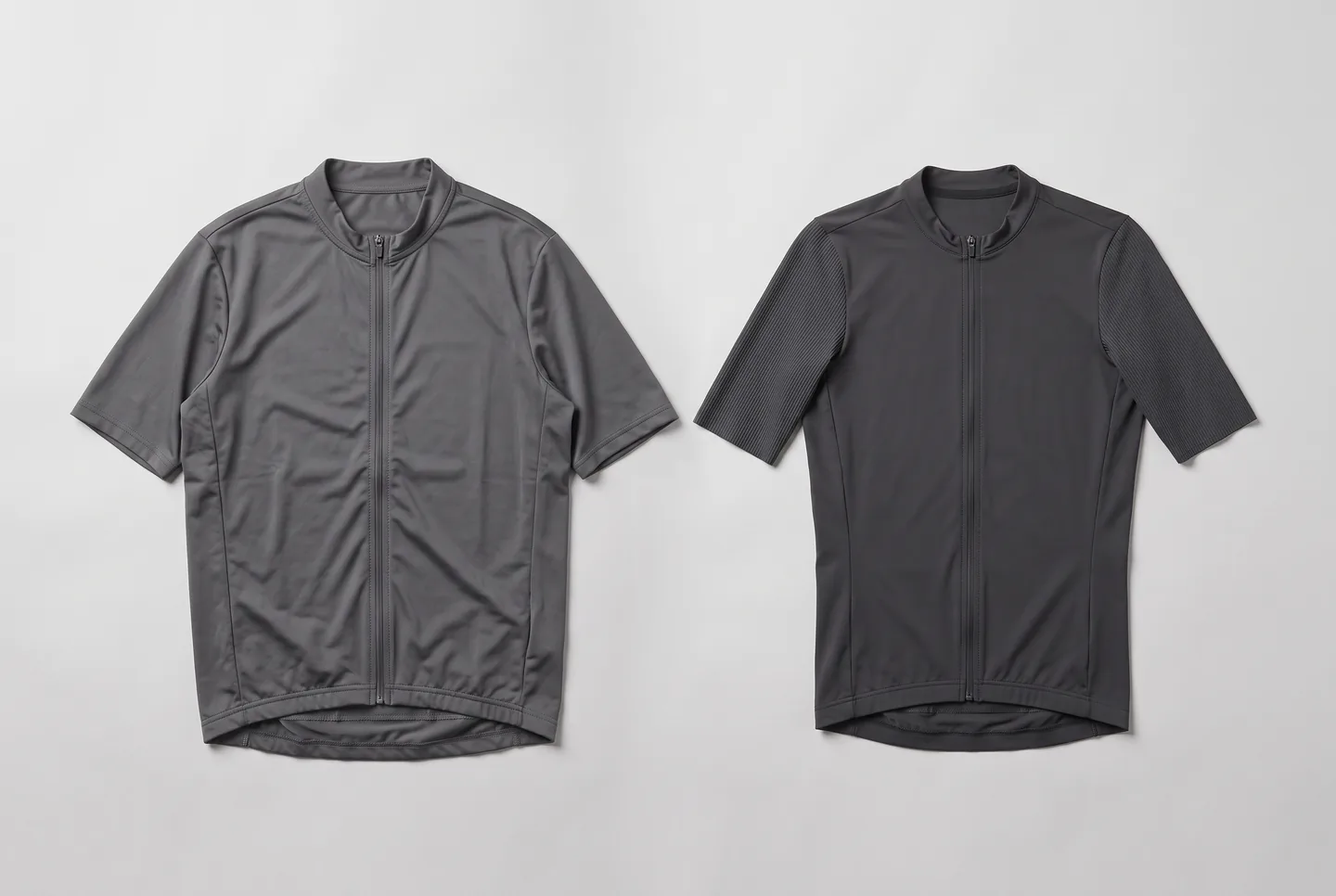
Clothing costs watts when it’s loose or bunches up. You gain with a close fit, few wrinkles and seams that line up with the airflow1. Fabric matters too. In the right places, a textured fabric shifts the point where the air breaks away from the body, and that lowers drag. Where the air has already broken away, like on the lower back, the fabric makes little difference1. In a university study, sleeves made of a textured fabric made a jersey clearly faster2.
What the tests say
Jersey and shorts. The Norwegian University of Science and Technology (NTNU) tested jerseys and bib shorts in a wind tunnel, on mannequins and on a rider pedaling on rollers with his hands low on the bars, at 35, 50 and 65 km/h (22, 31 and 40 mph)2. A jersey one size up, an M instead of an S, still fit close but bunched up more at the sides. At 50 km/h (31 mph) it added 104 g of drag, about 14 W. A jersey made with specially designed fabrics saved 8.2 W over the original one, and a pair of bib shorts saved 4.8 W, also at 50 km/h (31 mph)2.
One maker claims 91 seconds over 40 km (25 mi) between a relaxed-cut jersey and a close-fitting race jersey that was also a size smaller, measured in its own wind tunnel at a wind speed of about 50 km/h (31 mph). For a close-fitting winter kit it claims 83 seconds3.
Skinsuit. In 2025 Cyclingnews took a budget jersey and bib shorts to the wind tunnel at Silverstone and compared them with pricier jerseys and skinsuits. The tests used a real rider on a gravel bike at 40 km/h (25 mph), with a stated measurement error of ±2.55 W4. A more expensive, closer-fitting jersey was only 0.33 W better than the budget one, which is within the margin of error. The budget jersey was the only one the tester could feel flapping4.
The short-sleeve skinsuit saved 10.23 W. A two-year-old time trial skinsuit, designed for the track and time trials at speeds near 50 km/h (31 mph), was within the margin of error of the budget kit4. One maker claims its skinsuit is 96 seconds faster than its own jersey and bib shorts over a 40 km (25 mi) time trial, measured in its own tunnel5.
Aero base layer. This goes under the skinsuit. Its sleeves have raised ridges that press through the skinsuit and trip the air around your arm into turbulence, which leaves a smaller wake behind it6. In the Cyclingnews test, skinsuit and base layer together saved 18.06 W, or 12.79 to 23.33 W allowing for error. That’s about 8 W more than the skinsuit alone. The base layer tested wasn’t on sale yet4. Another maker claims 2.8 W at 45 km/h (28 mph) with no yaw and 7.5 W at 5° of yaw, in a test it commissioned. However, it compares its new skinsuit plus base layer with its previous time trial skinsuit, not the same skinsuit with and without the base layer6.
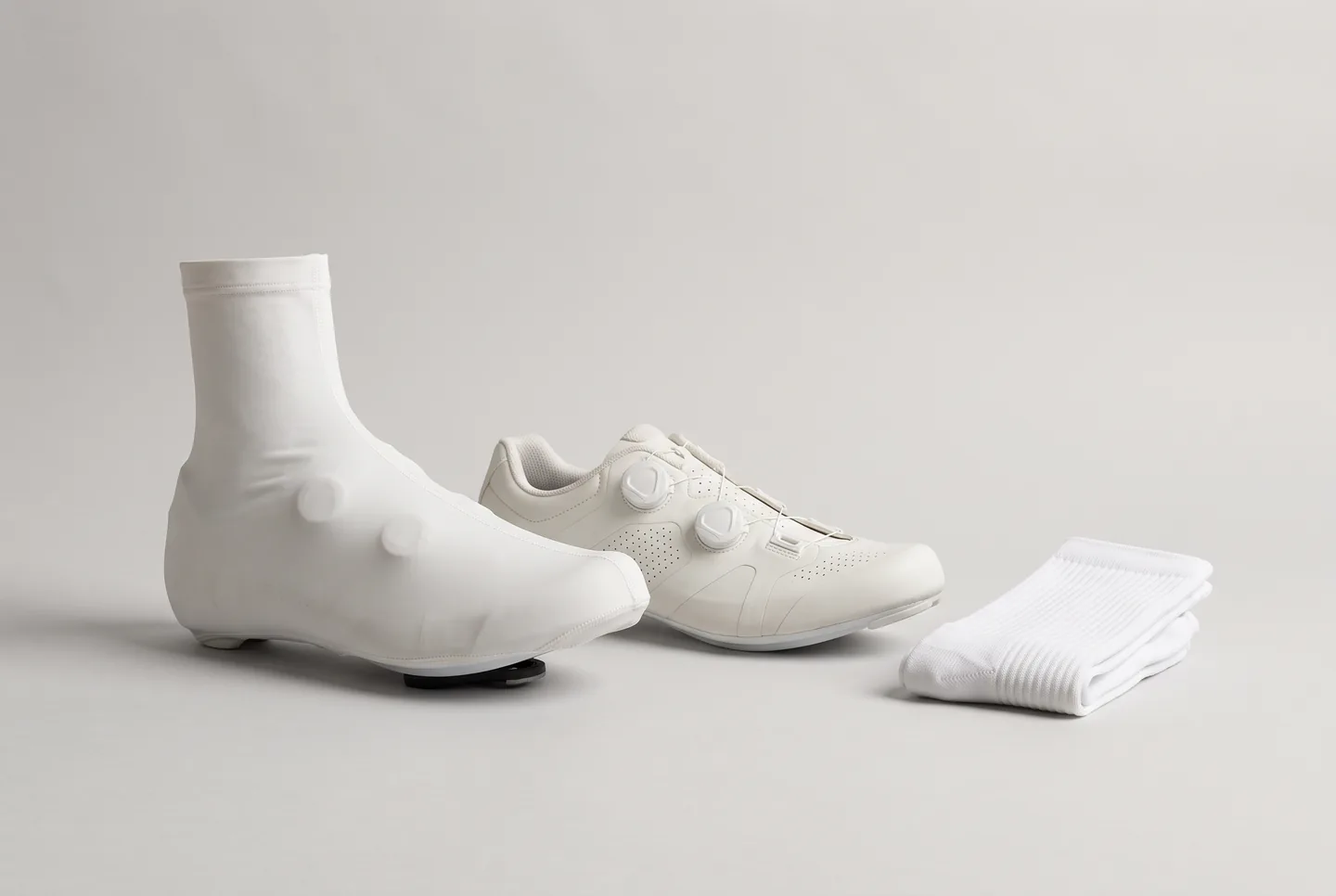
Shoe covers. In the same test, aero shoe covers over regular socks saved 6.27 W, or 1.00 to 11.54 W allowing for error. The people running the test said that with shoe covers on, the socks underneath hardly matter4. It’s the only measurement in favor of shoe covers we found, and the shoe cover maker had paid for product placement in that test.
Two unsponsored tests found no advantage, both in a time trial position. We haven’t found an unsponsored test in a road position. At the Politecnico di Milano, six riders were tested in the wind tunnel in a time trial position at 45 and 50 km/h (28 and 31 mph), with and without shoe covers. With shoe covers, drag went up by 0.003 m² on average, about the size of the test’s error, and the shoe covers didn’t help a single rider. The study is from 2011, with the shoe covers of that time13. In 2023 Cycling Weekly put a rider on a time trial bike in the wind tunnel, in a time trial position, at 45 km/h (28 mph). With aero shoe covers he needed about 1 W more than without14. An aerodynamics company that sells aero socks but not shoe covers says that in its tests below 45 km/h (28 mph), shoe covers are worth less than 1.5 W, if you can measure anything at all. It doesn’t say how it measured15.
WATTS SAVED AT 40 KM/H (25 MPH)
Measured in the wind tunnelWhat we count in the calculator, central value
Skinsuit
Skinsuit and base layer
Shoe covers
Keep one thing in mind with the Cyclingnews clothing test. The article says it includes paid product placement from the maker of the bike and from the maker of the aero base layer, shoe covers and socks tested. The magazine says it agreed to the deal on condition that it didn’t affect the tests. The magazine paid for the tunnel time, and the maker of the skinsuits and jerseys was there to observe4.
Socks. In June 2025 Cyclingnews tested 16 pairs of aero socks, two pairs of regular socks and the rider with no socks in the tunnel, at 45 km/h (28 mph) on a road bike. The measurement error was ±3.24 W, and this test wasn’t sponsored7. No aero sock beat the reference pair, ten-year-old regular socks, by more than the margin of error. The best was about 2.6 W faster. Eight aero socks were slower than no socks at all, and the gap between best and worst was about 10 W. The magazine notes that the tester is slight with small calves, and riders with bigger or differently shaped calves might gain more7. In the clothing test, though, the aero socks were about 3.4 W faster than regular socks, within the margin of error, and about the same as no socks. Going sockless was slightly faster than regular socks, also within the margin of error. The sock maker had paid for product placement in that test4. One sock maker claims just over 2 W at 40 km/h (25 mph) and 12.6 W at 60 km/h (37 mph), measured on a time trial bike with no yaw8.
What it’s worth on your ride
In the calculator, each piece of clothing lowers your CdA, meaning how much air you and the bike push. At 40 km/h (25 mph), 0.001 of CdA is worth about 0.8 W4. Here’s what we count:
- Close-fitting jersey and shorts, compared with a flapping jersey: 0.0046, from 0 to 0.023. The central value is the average of two independent measurements. One is the closest-fitting jersey in the Cyclingnews test, which barely beat the budget one that flapped4. The other is the jersey one size up in the Norwegian study2. The high value comes from the maker’s claimed 91 seconds3. The low value is zero, because the difference in the Cyclingnews test was within the margin of error. On the MTB we count 0 to 0.0088. There are no measurements at those speeds, so it’s an estimate.
- Skinsuit, compared with a jersey and shorts that already fit close: another 0.0095, from 0.0067 to 0.0156. The low value comes from a second wind tunnel test at 35 km/h (22 mph) with a pedaling rider, which found 3.69 W over a close-fitting jersey and bib shorts12. The high value is the Cyclingnews measurement against the flapping jersey, plus the error of a single run4. The central value sits in between, so that skinsuit and close-fitting jersey together come to 0.0141, inside the range of the Cyclingnews measurement. The skinsuit replaces the jersey and shorts. If you’re starting from a flapping jersey, you get both gains and only pay for the skinsuit.
- Aero base layer under the skinsuit: another 0.0031, from 0 to 0.0095. The high value is what it added to the skinsuit in the test, which had paid product placement from the base layer’s maker4. The central value is the least that test can back up, meaning the measurement minus its error of ±0.0064. It’s the difference between two runs, so the magazine adds the two errors together. The low value is zero, because the base layer works on the air around the arm, and at lower speeds than in the test the effect can disappear4. We only count it together with the skinsuit.
- Shoe covers: 0.002, from 0 to 0.0077. The high value is the measurement from the test with paid product placement4. The low value is zero, as in the two unsponsored tests in a time trial position13,14. The central value, about 1.6 W at 40 km/h (25 mph), is just above the aerodynamics company’s figure15. It’s an estimate.
- Aero socks: 0, from 0 to 0.0041. In the unsponsored test, none beat regular socks by more than the margin of error, so our middle value is zero. The high value is the aero sock from the clothing test, about 3.4 W at 40 km/h (25 mph)4,7. You pick shoe covers or socks, because under shoe covers the socks don’t count anymore4. We only count one of the two.
We work out the seconds on your ride. They depend on how fast you go and how much of the ride is flat or downhill, since air matters less on climbs1. If you draft for part of the ride, we only count the seconds on the part you ride alone. In a group you go at the group’s speed, so aero clothing makes it easier but doesn’t get you there sooner.
On the ladder, the skinsuit comes right after the close-fitting jersey and shorts as an extra step. It costs the difference, €50, and at checkout you only buy the skinsuit. The base layer always comes after the skinsuit. If you already own something, check it under “What you already have” and we’ll take it off the ladder. If you already own a close-fitting jersey and shorts, the skinsuit costs full price. If you already own the skinsuit, you only pay for the base layer. If you already own shoe covers, we don’t count aero socks.
On the example gravel ride, 62 km (39 mi) with 780 m (2,560 ft) of climbing, a close-fitting jersey and shorts are worth about 0'20", between 0" and 1'40". The skinsuit is worth another 0'40", between 0'30" and 1'10", so instead of a flapping jersey it’s worth 1'01". The base layer under the skinsuit adds 0'15", between 0" and 0'40". Shoe covers are worth 0'09", between 0" and 0'35". Aero socks have a middle value of zero, and 0'20" at most.
The example road ride, 80 km (50 mi) with 900 m (2,950 ft) of climbing, is longer and faster on pavement, so the air matters more and aero clothing is worth more. A close-fitting jersey and shorts are worth 0'30", the skinsuit another 1'00" (1'30" instead of a flapping jersey) and the base layer another 0'20". Shoe covers are worth 0'13", between 0" and 0'50". Aero socks have a middle value of zero, and 0'25" at most. On the MTB we only count a close-fitting jersey and shorts. On your ride it could be more or less, depending on how fast you go and how much climbing there is.
What it costs. The calculator counts €200 for a close-fitting jersey and shorts, €250 for the skinsuit, €150 more for the base layer, €60 for shoe covers and €35 for aero socks. In online stores, a road skinsuit usually costs about €190 to €350 at full price, less on sale. An aero base layer starts at about €120, aero shoe covers run about €50 to €63, and aero socks €25 to €55. A close-fitting jersey and bib shorts start at about €165 at full price for the cheapest models, and mid-range ones go up to about €245, less on sale. If you find a different price, enter it under “Your prices”.
NUMBERS FROM THE CALCULATOR
On the example ride for each discipline, with a 74 kg rider. Each upgrade is counted on its own, without the others. The “on top of” rows only count what they add, and only cost the difference.
| Seconds · cost · rank | ROAD | GRAVEL | MTB |
|---|---|---|---|
| Aero shoe covers | −0'15"€605th | −0'09"€605th | — |
| Close-fitting jersey and shorts | −0'30"€2007th | −0'20"€2006th | −0'04"€20010th |
| Race skinsuiton top of the close-fitting jersey and shorts | −1'00"+€508th | −0'40"+€507th | — |
| Skinsuit with aero base layeron top of the skinsuit | −0'20"+€1509th | −0'15"+€1508th | — |
—: not counted in that discipline. Updated from the calculator on NOVEMBER 18, 2026.
How to choose
- The right size. Snug, with no wrinkles and no fabric flapping. In the Norwegian study, the bigger size still fit close but bunched up more at the sides, and that cost 14 W at 50 km/h (31 mph). The authors say getting the right jersey size is extremely important2. A jersey that’s too big also has pockets that sag when they’re full10.
- Don’t size down. The skinsuit maker that was at the test advises against going a size smaller, because aero fabric that’s stretched too far may not work as intended4. Fit makes a big difference to how fast a skinsuit is, while the differences between skinsuits can be small. The only way to know which one is fastest on you is to test it on you11.
- Choose for your speed. Some skinsuits are designed for higher speeds. In the test, the time trial skinsuit designed for speeds near 50 km/h (31 mph) was no faster than the budget kit at 40 km/h (25 mph)4.
- Look at the sleeves. In the Norwegian study, the authors think the jersey’s gain on the mannequin came mostly from the sleeves2. The maker says the aero base layer works best under thin sleeves, and sleeves that already have aero ridges can get in its way. Under a thick winter jacket it’s unlikely to help6. If you race, UCI rules have banned fabric ridges taller than 1 mm (0.04 in) since 20196.
- Shoe covers or socks. Pick one, because with shoe covers on, the socks underneath barely matter4. Choose aero socks that stay up and feel comfortable7. In UCI races they can’t come up higher than halfway between the ankle bone and the head of the fibula8.
What order makes sense
The calculator ranks upgrades by euros spent per second gained. On the example gravel ride, shoe covers come first at €6.7 per second. Aero socks aren’t in the ranking, because their middle value is zero. Next is a close-fitting jersey and shorts at €10. Right after that comes the skinsuit, which as an extra only costs €50, or €1.2 per second. Then the base layer at €12 per second.
On the example road ride the order is the same. Shoe covers cost €4.6 per second, a close-fitting jersey and shorts €6.7, the skinsuit as an extra €0.8 and the base layer €7.5.
So if you’re starting from a flapping jersey, it makes sense to go straight to a skinsuit. It’s €250 instead of €200 for a jersey and shorts, for about three times the seconds. If you don’t want a skinsuit, a close-fitting jersey in the right size is the first step.
When it’s not worth it
If you climb a lot or ride slow terrain. Air matters less on climbs1, and on loose dirt the terrain is what slows you down. On the example MTB ride, 35 km (22 mi) with 900 m (2,950 ft) of climbing, a close-fitting jersey and shorts are worth about 4 seconds, and that’s an estimate. On the MTB we don’t count a skinsuit, base layer, shoe covers or socks.
If it’s hot. A light, slightly looser jersey can be more comfortable and let a bit more air through10. The Cyclingnews test didn’t measure comfort or body temperature, and the magazine says those matter too4.
If you’re almost always on a wheel. Behind another rider you push 30 to 41% less air9, so aero clothing matters less. And in a group you go at the group’s speed, so the calculator only counts seconds on the part you ride alone.
If your kit already fits close, a new jersey isn’t worth much. In the test, a pricier, closer-fitting jersey was no faster than the budget one, even though that one flapped a little4. The next step is a skinsuit.
If you already wear shoe covers, or your socks aren’t worn out, aero socks aren’t worth much. In the test, none beat regular socks by more than the margin of error7.
Sources
We read every source ourselves. They’re all public pages you can read for free. Prices are approximate, from online stores in November 2026. We don’t link to the stores, because the site doesn’t tell you where to buy.
- Crouch, Burton, LaBry and Blair, Sports Engineering, 2017. Review of studies on aerodynamics in cycling: how much of the resistance is air, how much comes from the rider, how clothing, folds, seams and fabrics work. Study
- NTNU, 2015. Spurkland, Bardal, Sætran and Oggiano, of the Norwegian University of Science and Technology, test fabrics, jerseys and bib shorts in a wind tunnel, on mannequins and on a rider on rollers, from 35 to 72.5 km/h (22 to 45 mph). Including the comparison between two sizes of the same jersey. Study
- road.cc, 2014. A maker tests a relaxed-cut jersey against a close-fitting race one, and a winter kit, in its own wind tunnel at a wind speed of about 50 km/h (31 mph). Maker’s data. Article
- Cyclingnews, 2025. Jerseys, skinsuits, aero base layer, shoe covers and socks in the wind tunnel at Silverstone, at 40 km/h (25 mph), with a rider on a gravel bike. The article contains product placement paid for by the maker of the bike used and by the maker of the base layer, shoe covers and socks. Article
- BikeRadar, 2016. A maker claims its skinsuit is 96 seconds faster over a 40 km (25 mi) time trial than its jersey and bib shorts, measured in its own tunnel. Maker’s data. Article
- BikeRadar, 2023. How an aero base layer is made and how it works, with data from a test the maker commissioned at 45 km/h (28 mph). UCI rules on fabric ridges. Article
- Cyclingnews, 2025. 16 pairs of aero socks, two of regular socks and no socks, in the wind tunnel at Silverstone at 45 km/h (28 mph). Test with no paid products. Article
- BikeRadar, 2020. A maker claims its aero socks save just over 2 W at 40 km/h (25 mph) and 12.6 W at 60 km/h (37 mph), on a time trial bike. With the UCI rule on sock height in races. Maker’s data. Article
- Politecnico di Milano, 2016. Belloli, Giappino, Robustelli and Somaschini measure how much air resistance drops for a drafting rider in the wind tunnel at 50 km/h (31 mph), at different distances and with air coming from the side. Study
- BikeRadar, 2024. How to choose a jersey: close-fitting versus loose, heat, pockets. Article
- Cycling Weekly, 2022. How to choose a skinsuit: how much fit matters and how small the differences between one skinsuit and another are. Article
- BikeRadar, 2023. Wind tunnel test at Silverstone, at 35 km/h (22 mph), with the rider pedaling on rollers: skinsuit against jersey and bib shorts, helmet, wheels, socks. Article
- Politecnico di Milano, 2011. Gibertini, Campanardi, Grassi and Guercilena test shoes with and without shoe covers in the wind tunnel, on a leg model and on six riders in a time trial position at 45 and 50 km/h (28 and 31 mph). Chapter of the book Wind Tunnels and Experimental Fluid Dynamics Research. Study
- Cycling Weekly, 2023. The magazine’s editor tests his time trial position, skinsuits, helmets and aero shoe covers in the wind tunnel at Silverstone, at 45 km/h (28 mph), with a bike and kit on loan. The article discloses no sponsor. Article
- Swiss Side. Aerodynamics company that sells wheels and clothing, including aero socks, but not shoe covers. It writes that in its tests, below 45 km/h (28 mph), shoe covers are worth less than 1.5 W, without describing the tests. Article