GUIDES · TIME TRIAL AND TRIATHLON
Disc wheel and deep front wheel: what they’re worth in time trials.
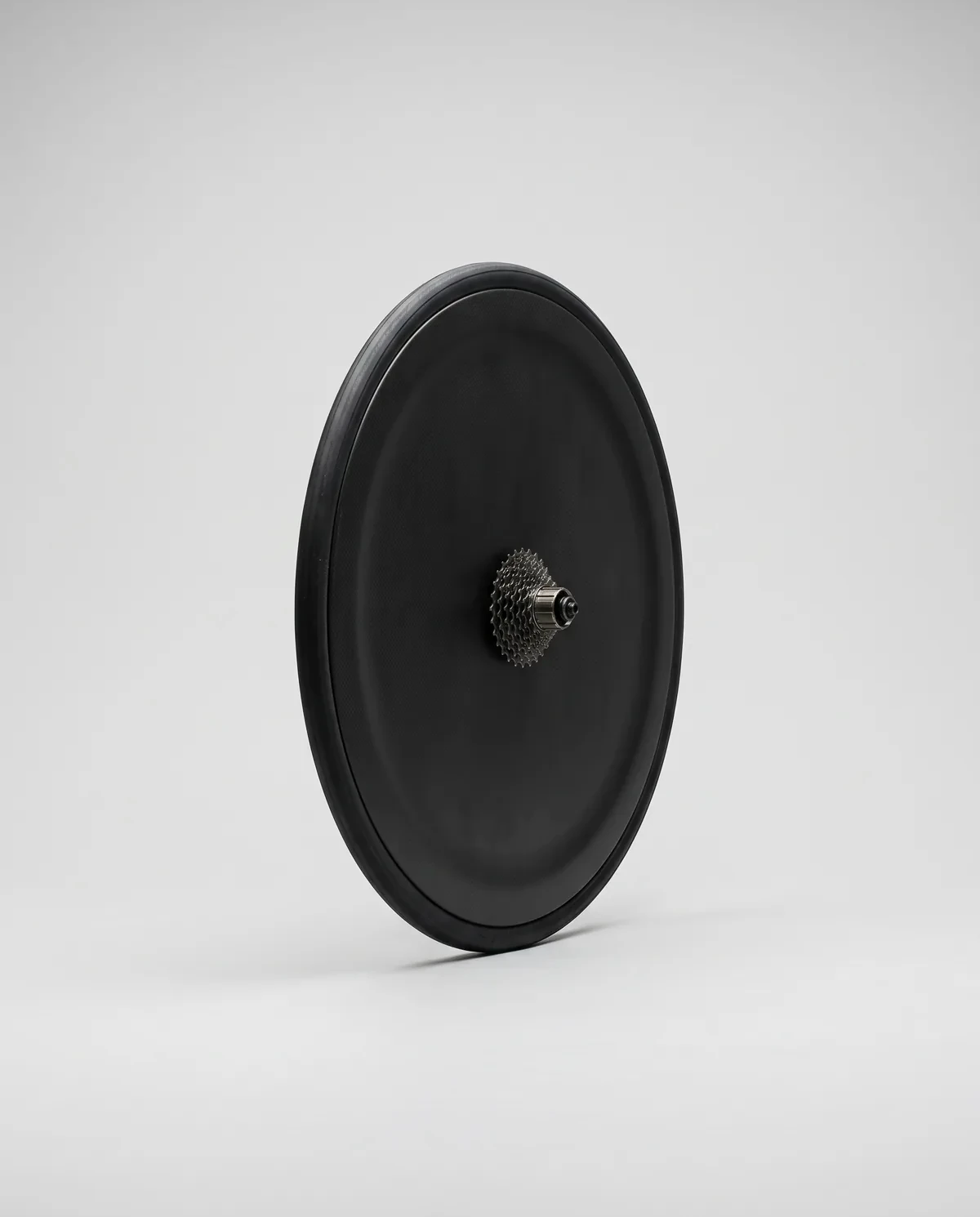
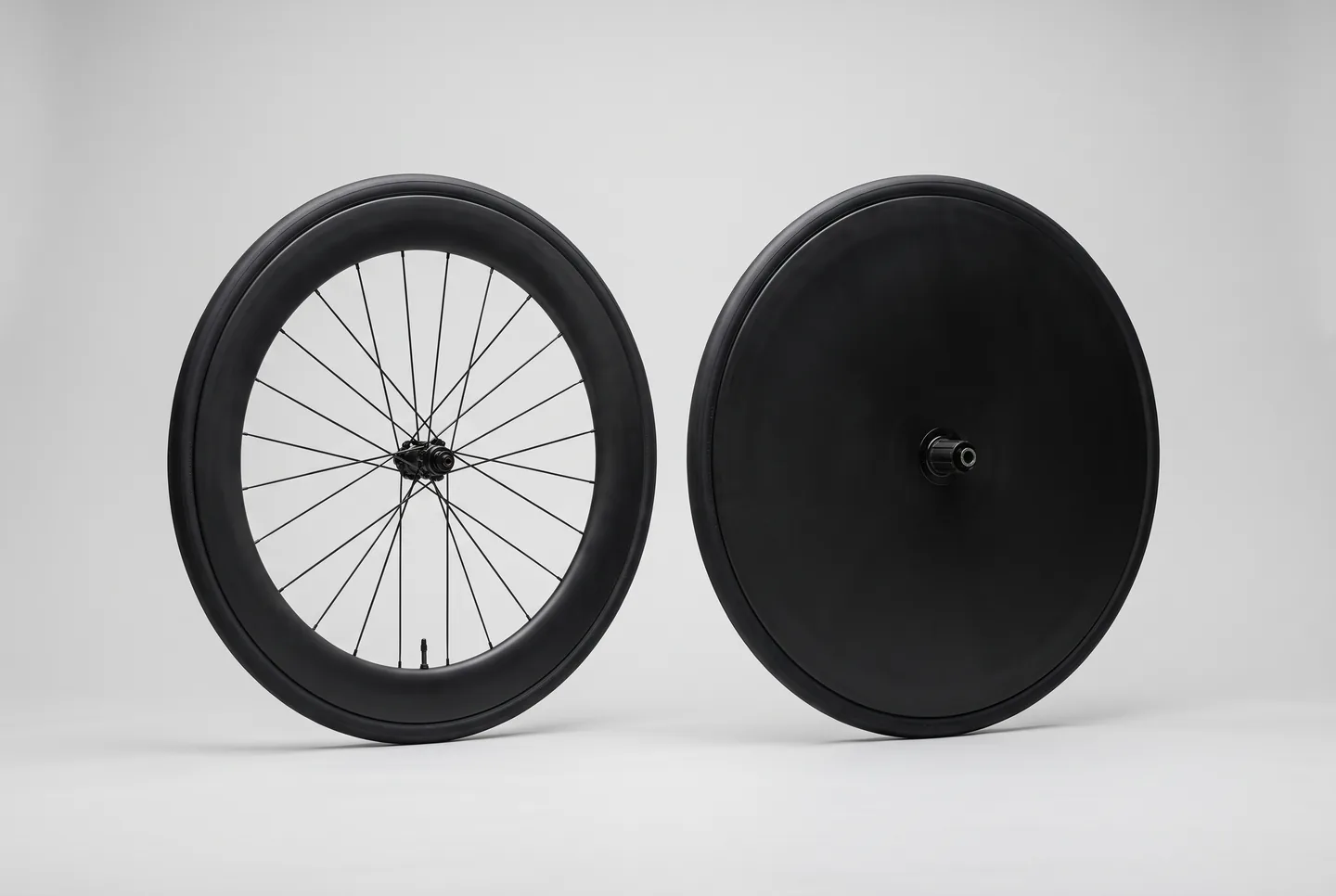
A disc wheel is a solid rear wheel. Up front you run a deep carbon wheel, 60 mm or more. That’s the usual setup for time trials and triathlon. We couldn’t find an independent measurement of just these two wheels with a rider on the bike, so the calculator’s numbers are a cautious estimate, well below what you usually read. They also take some skill to handle in a crosswind.
−2'10"
What they’re worth together on the example time trial, 90 km (56 mi) with 600 m (1,970 ft) of climbing at 32 km/h (20 mph), for about €1,900.
−1'20"
The disc wheel on its own, on the same ride, for €1,500. The deep front wheel is worth −0'50" for €400.
40%
How much less drag a wheel has at the back than at the front in a 1990 test, because it sits partly in the bike’s wake.
0
The number of independent tests we found of a disc wheel alone with a rider on the bike. That’s why the calculator marks it ESTIMATED.
A disc at the rear, a deep rim at the front
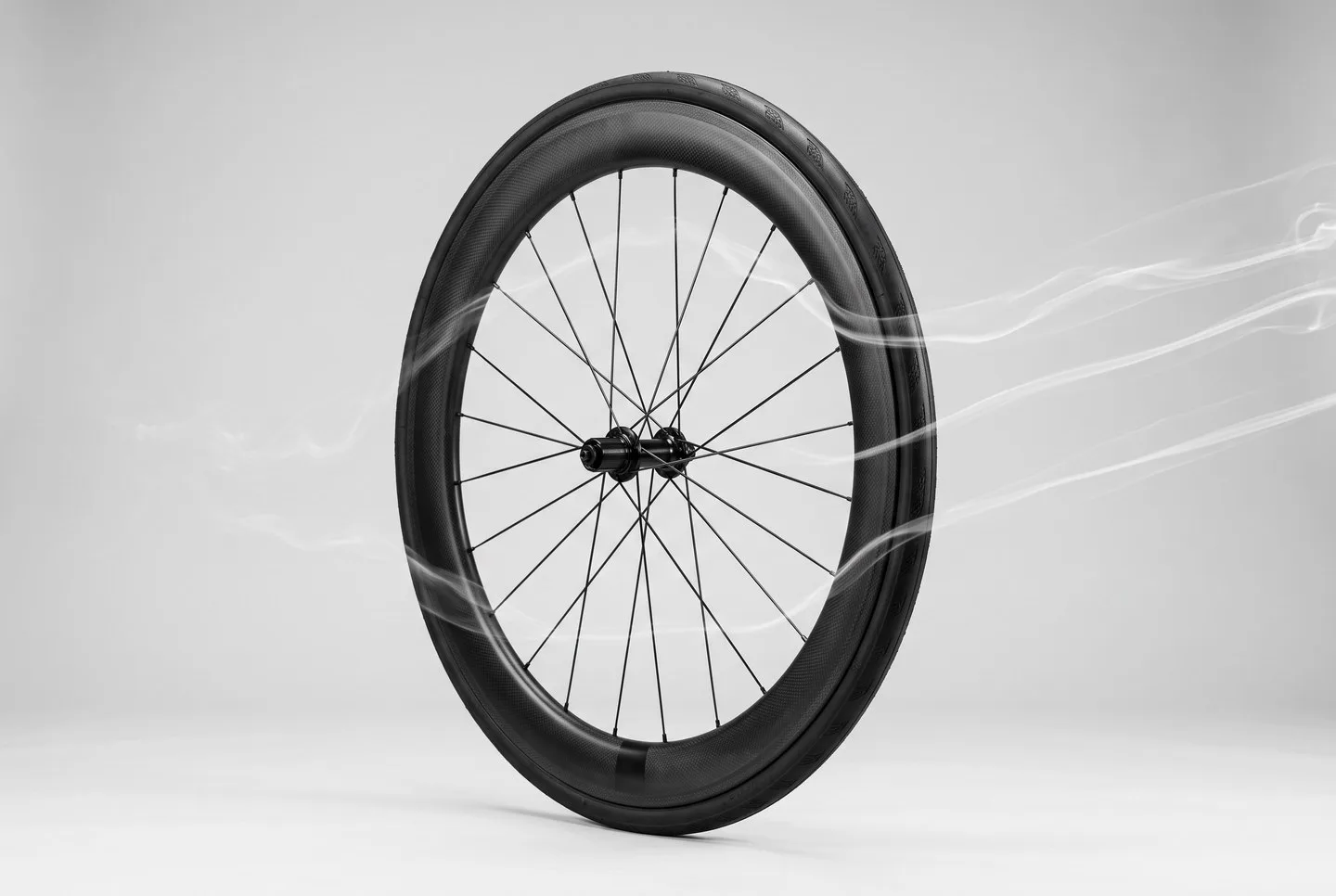
A spoked wheel churns up a lot of air, because the spokes are spinning through the wind. A disc wheel covers all of that with a solid disc. A deep rim covers part of the spokes and gives the rim a longer profile.
The two wheels don’t count the same. The rear wheel sits partly in the wake of the rest of the bike, and in a 1990 test rear wheels had about 40% less drag than front wheels. Together the wheels make up as much as 10–15% of the air resistance of bike and rider1. Most of the rest is your body. Computer simulations put the rider at about 80% of the drag in a time trial position, and the bike and wheels at 17–20%2.
Nobody runs a disc up front. In a crosswind it would push the steering around, and many races ban it3,7.
What the tests say
Wheels on their own. In a wind tunnel test cited in a scientific review, six wheels were tested without a bike. With no crosswind, the disc had 70% less drag than a traditional spoked wheel, and the deep wheels about 60% less. With a crosswind at low speeds, the disc’s drag jumped suddenly at certain angles2. Those are wheels on their own, and the numbers change on a bike with a rider.
With a mannequin. Monash University in Australia tested five front wheels on a TT bike with a rear disc at 50 km/h (31 mph), first without a mannequin and then with one on the bike. With the mannequin and an almost head-on wind, a front disc was only slightly faster than the deep wheels, and at around 15° of yaw the deep wheels caught up. The mannequin changed the results, and the authors say wheels should be tested with a rider rather than on their own3.
With a real rider. In 2024 Cyclingnews swapped low-profile wheels for a pair of 50 mm wheels on a road bike, with the journalist riding, at 40 km/h (25 mph). They saved 5.89 W, with a margin of error of 3.91 W. In a head-on wind the deep wheels were a bit slower, and in a crosswind they were faster. The author says that with that margin of error, the two pairs could even be equal4. It’s a pair of road wheels, not a disc, but it’s the closest measurement we found.
Disc and front wheel together. A book by Jim Martin and John Cobb, cited by a training magazine, gives 60–90 seconds saved over 40 km (25 mi) with a rear disc and a three-spoke front wheel, without saying what wheels they’re compared with. The book presents its numbers as calculations5.
The numbers you see quoted. An article on the website of Challenge Family, a triathlon race organizer, which looks like it was written by a bike maker, says their wind tunnel tests found the disc saved up to 25 W at 40 km/h (25 mph) over a stock low-profile wheel, and less over a deep carbon wheel. It doesn’t say who ran the tests or how6. The calculator stays well below that.
DISC WHEEL: WATTS SAVED AT 40 KM/H (25 MPH) COMPARED WITH A SHALLOW ALUMINUM REAR WHEEL
Claimed
High estimate
Central estimate
Low estimate
Crosswinds
A crosswind pushes a deep or solid wheel sideways. In the Monash test, at 15° of yaw the side force was about double the drag for every wheel. With two discs at 10°, the rider would have had to lean about 15° to stay upright. The forces on the front wheel are probably what upsets the handling most3.
That’s why discs usually only go on the back, and not at all in strong wind7. Up front, the deeper the rim, the more you feel it in the steering. In a test by the German magazine TOUR, taking 15 mm off the rim depth on one of the tested pairs halved the steering torque. For time trials and triathlon, TOUR says 60 mm rims pay off more than 45 mm ones8.
A steady wind is fairly manageable, but strong gusty crosswinds aren’t6. Lighter riders feel it more, because they have less mass to resist a gust9.
What they’re worth on your ride
The calculator treats the two wheels as separate items. The disc replaces a shallow aluminum rear wheel and lowers your CdA, the air resistance of you and the bike, by 0.008 m², with a range of 0.004 to 0.015. At 40 km/h (25 mph) that’s about 6.5 W, between 3 and 12, and at 32 km/h (20 mph) about 3.4 W. The deep front wheel replaces a shallow aluminum front wheel and lowers it by 0.005 m², between 0.002 and 0.009, or about 4 W at 40 km/h.
These are our own estimates. At the central value, the two wheels together lower your CdA by 0.013 m². Over a flat 40 km (25 mi) at 40 km/h (25 mph), that’s about 52 seconds, just under Martin and Cobb’s 60–90 seconds5. It’s about double what Cyclingnews measured for the 50 mm pair4, but here you have a solid disc at the back and a deeper rim up front. Even the disc’s high value is half the claimed figure6. We give the front wheel more than half the gain of a 50 mm pair because it sits in clean air. That’s an assumption, since nobody has measured it.
We also count weight, using our own estimate. A stock aluminum rear wheel weighs about 1,000–1,100 g, and a disc can weigh anywhere from 150 g more to 100 g less. At the central value it’s 50 g more, just over a second on the example ride. We count the deep front wheel at the same weight as a shallow one, give or take 100 g. In a 2026 TOUR article on a high-end TT pair, the 85 mm front wheel has a claimed weight of 820 g and the disc 965 g10.
The example time trial is the bike leg of a half-distance triathlon: 90 km (56 mi) with 600 m (1,970 ft) of climbing, averaging 32 km/h (20 mph) on a stock TT bike, with no drafting. There the disc is worth about 1'20", between 0'35" and 2'30", and the deep front wheel about 0'50", between 0'15" and 1'30". Together that’s about 2'10". They’re worth more on a longer ride with less climbing. Going faster saves more watts, but the gain in seconds drops a little because you spend less time on the bike.
If you already have mid-depth carbon wheels, the calculator counts about a quarter of the gain, between zero and just under half. If you already have deep wheels, it doesn’t suggest them.
What they cost. We count €1,500 for a mid-range disc and €400 for the front wheel, about half the price of a mid-range carbon wheelset. High-end wheels cost a lot more. In the TOUR article the disc was €2,599 and the 85 mm front wheel €1,14910. Each second costs about €8 with the front wheel and €19 with the disc. On the time trial ladder, the front wheel is seventh out of 20 and the disc ninth. Tires, tubeless, chain, the bottle between the aero bars, the TT helmet and the tri suit all come first.
NUMBERS FROM THE CALCULATOR
On the example time trial, with a 74 kg rider on a time trial bike. Each upgrade is counted on its own, without the others.
| Seconds · cost · rank | TT AND TRIATHLON |
|---|---|
| Deep-section carbon front wheel | −0'50"€4007th |
| Rear disc wheel | −1'20"€1,5009th |
Updated from the calculator on NOVEMBER 18, 2026.
See what a disc wheel and a deep front wheel are worth on your ride
How to choose them
- Check the rules first. Some races ban disc wheels11,12. IRONMAN requires a spoked front wheel12. The rules are further down the page.
- Don’t go too deep up front. TOUR recommends 60 mm rims for time trials and triathlon8. If you’re light or your races are often gusty, go shallower9.
- Disc on the back only. That’s where it affects handling the least3,7.
- Go by independent tests. Sellers pick their own comparisons. Wheels should be tested on the bike, with a rider3.
- Train on them in the wind. Ride them before race day, crosswinds included. Challenge Family says riders who aren’t used to a disc find it hard to control6.
Race rules
- Draft-legal age-group triathlon (World Triathlon): wheels need at least 12 spokes, and discs are banned11.
- Non-drafting triathlon (World Triathlon): rear wheel covers are allowed, but the technical delegate can change that for safety, in strong wind for example11.
- IRONMAN. The front wheel must be spoked, though a deep rim is fine. A rear disc is allowed, but some races ban it for safety, including the World Championship in Kona. Each race lists its rules in the athlete guide12.
- UCI races. From 2026, rims in mass-start road races can’t be deeper than 65 mm. Deeper wheels and discs are still allowed in individual and team time trials13.
The rules change often, so before race day read the current ones and your event’s own rules.
When they’re not worth it
If the wind is strong or gusty, a disc gets hard to control and you feel a deep front rim in the steering6,8.
If the course has a lot of climbing, weight matters more, and a disc usually weighs 150–250 g more than a deep spoked carbon wheel6.
If you average under 30 km/h (19 mph) on a hilly course, Challenge Family says a lighter wheel pays off more6. Check it for your ride in the calculator.
If you’re light or not yet confident on the bike, a disc will give you trouble in crosswinds6,9.
If you race draft-legal triathlons, discs are banned11.
If you already have deep carbon wheels, the gain is small or zero.
See what a disc wheel and a deep front wheel are worth on your ride
Sources
We read every source ourselves. They’re all public pages you can read for free. Prices are approximate. We don’t link to stores, because the site doesn’t tell you where to buy.
- Malizia, van Druenen and Blocken, 2021. Computer study of the front wheel of a time trial bike with a mannequin, with a review of earlier studies: rear wheels have about 40% less drag than front wheels (Kyle, 1990), wheels account for up to 10–15% of total drag (Greenwell and colleagues). Sports Engineering. Article
- Crouch and colleagues, 2017. Review of aerodynamics in cycling: wheels in the wind tunnel (Tew and Sayers), how much of the total drag comes from the rider and the bike. Sports Engineering. Article (PDF)
- Barry and colleagues, Monash University, 2012. Five front wheels in the wind tunnel on a time trial bike with a disc wheel at the rear, alone and with a mannequin, at 50 km/h (31 mph) and up to 30° of yaw: drag, side force and moments. Procedia Engineering. Article (PDF)
- Cyclingnews, 2024. 50 mm wheels against low-profile wheels, in the wind tunnel with the rider on the bike, at 40 km/h (25 mph) and with wind from different directions. Article
- Sports Performance Bulletin. Training magazine: an article by Joe Beer on the aerodynamics of equipment, citing Martin and Cobb’s calculations (High Performance Cycling, 2002) on a disc wheel and a three-spoke wheel. Article
- Challenge Family, 2026. When to choose a disc wheel: claimed figure of up to 25 W at 40 km/h (25 mph), with wind tunnel tests that aren’t described; wind, climbs, average speed, weight. Challenge Family organizes triathlon races; the article seems to be written by a bike maker. Article
- TOUR, 2005. Aero wheels: the disc wheel in crosswinds, why it’s only used at the rear and not in strong wind. In German. Article
- TOUR, 2022. Aero wheels in the wind tunnel, with a pedaling mannequin: rim depth, crosswinds, steering torque, recommended depths for time trials and triathlon. Article
- Cyclingnews, 2020. Wheel depth: crosswinds, light riders, which depth for which use. Article
- TOUR, 2026. An 85 mm front wheel and a high-end disc wheel for triathlon and time trials: claimed weights and list prices. Article
- World Triathlon, 2025. Competition rules, edition of December 13, 2025 with the March and April 2026 amendments: wheels (5.2 e). Rules (PDF)
- Slowtwitch, 2026. The IRONMAN wheel rule (2026 rules, 5.02 a) and the disc wheel ban in Kona. Article
- Cyclingnews, 2026. The UCI rules changed for 2026: maximum rim depth in mass-start road races, deep wheels and the disc wheel in time trials. Article