GUIDES · TIME TRIAL AND TRIATHLON
Tri suit with sleeves: what it’s worth and when it pays off.
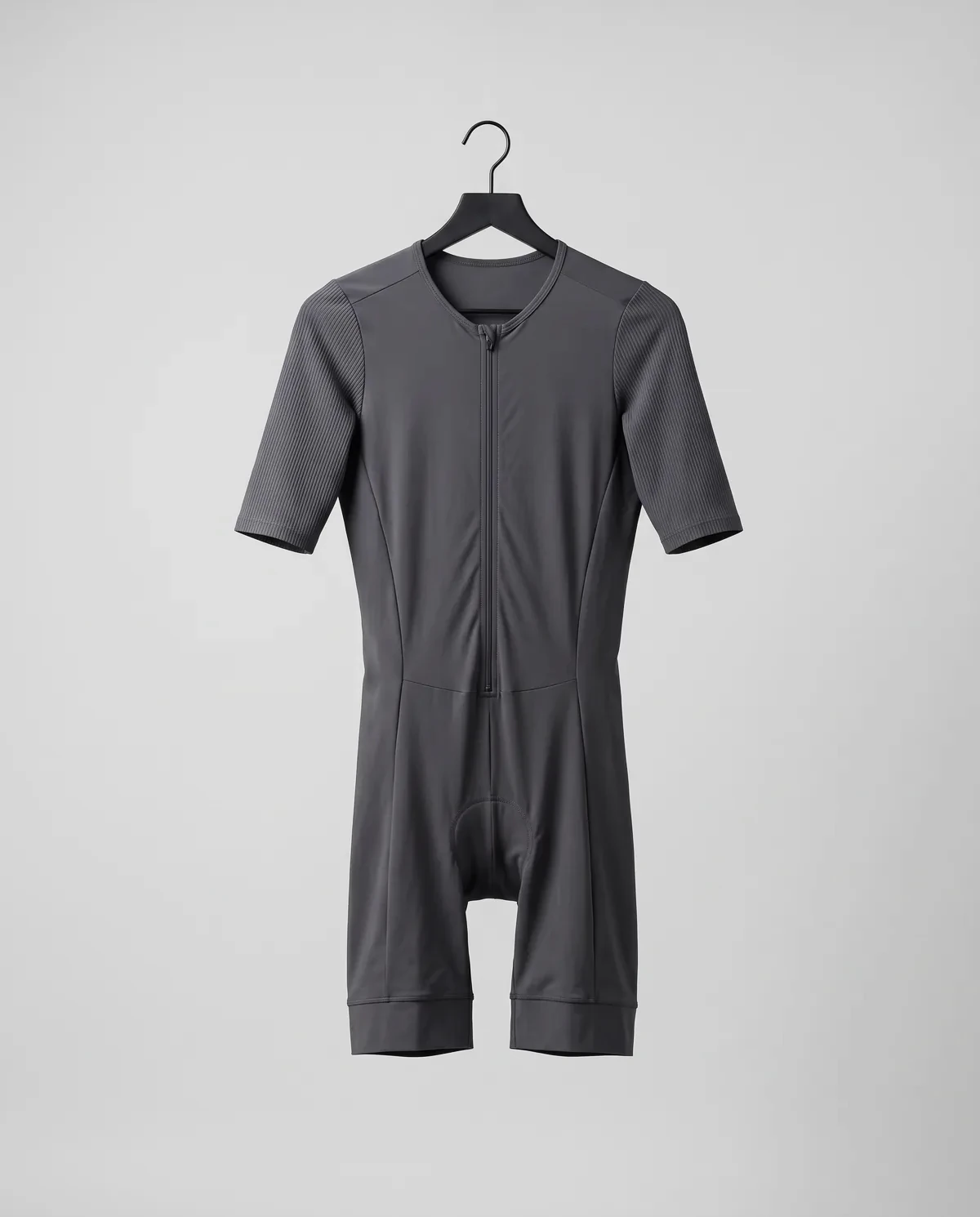
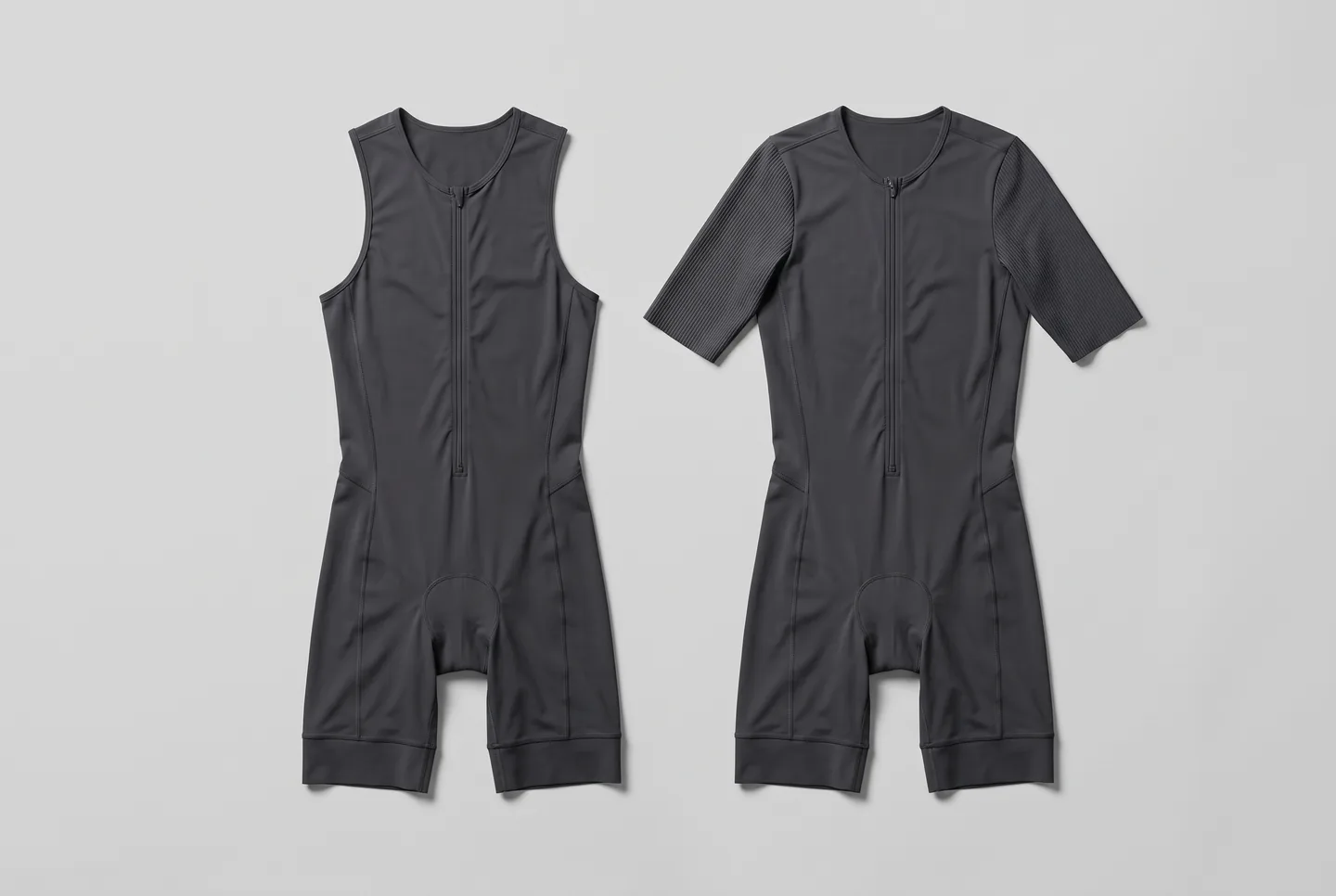
You wear a tri suit for the whole race, from the swim through the bike to the run. Aero suits have short sleeves, textured fabrics and a tight cut, and in the wind tunnel the best ones save more than a minute over 40 km (25 mi). No one has directly compared a basic sleeveless suit with an aero suit with sleeves, though, so the calculator uses an estimate. Getting the size wrong can cost you as much as you gain.
−1'10"
What it’s worth on the example time trial, 90 km (56 mi) with 600 m (1,970 ft) of climbing at 32 km/h (20 mph), for about €250.
2–97 s
What 12 tri suits saved over 40 km (25 mi) at 40 km/h (25 mph) in the wind tunnel, compared with a baseline suit.
14 W
What a jersey one size too big cost at 50 km/h (31 mph), in a test at the Norwegian university in Trondheim.
Elbow
The limit for sleeves in World Triathlon races. They have to end above the elbow without covering it.
Why sleeves
About 80% of the drag comes from the rider and the rest from the bike1, so what you wear matters. Sleeves cover your shoulders and upper arms, which are right out front in a time trial position. 220 Triathlon says going sleeveless costs you a little aero3.
The Norwegian University of Science and Technology (NTNU) tested sleeves on a mannequin. At 19 m/s, about 68 km/h (42 mph), two rough fabrics on short sleeves had 26 and 43 g less drag than the original fabric. With longer sleeves down to the elbow, the gap doubled to 54 and 87 g. Below 50 km/h (31 mph), though, the sleeves made hardly any difference2.
Sleeves also keep the sun off and keep you warmer. Sleeveless suits leave your arms free for the swim, spare you riding in wet sleeves and usually cost less3.
What the tests say
220 Triathlon, 2024. The magazine tested 13 tri suits in the wind tunnel at Silverstone, England, with a rider in an aero position at 30 and 40 km/h (19 and 25 mph) and 7.5° of yaw. The results are seconds saved over 40 km (25 mi) against a baseline suit the magazine doesn’t describe. At 40 km/h, 12 suits saved 2 to 97 seconds, and about half of them saved 47 seconds or more. At 30 km/h they saved 3 to 125 seconds. The thirteenth, the slowest, has a number you can’t read in the table. The only sleeveless suit saved 38 seconds at 40 km/h, more than five of the suits with sleeves. Some suits saved much more at 30 than at 40 km/h, so treat these numbers with caution3. The magazine says a well-fitting suit with taped seams, textured fabric and longer sleeves and legs is worth about a minute over 40 km3.
Cyclingnews, 2025. This one tested cycling skinsuits, not tri suits, with a rider on a gravel bike in a moderate race position rather than a time trial one, at 40 km/h (25 mph), with a measurement error of ±2.55 W. Compared with a budget jersey and shorts, a short-sleeve aero skinsuit saved 10.2 W and a high-end skinsuit 13.5 W. A long-sleeve time trial skinsuit saved 1.8 W in that position, which is within the measurement error, so there was no clear difference4. The article includes paid product placement from the bike maker and from a maker of socks, shoe covers and base layers. The skinsuit maker wasn’t one of the sponsors4.
WATTS SAVED AT 40 KM/H (25 MPH) COMPARED WITH A BUDGET JERSEY AND SHORTS
High-end jersey
Long-sleeve skinsuit
Aero skinsuit
High-end skinsuit
What’s missing. We couldn’t find a direct, independent comparison between a basic sleeveless suit and an aero suit with sleeves. In the 220 Triathlon test we don’t know what the suits were measured against. In the Cyclingnews test the baseline is a jersey and shorts, and the position isn’t a time trial one.
Size matters as much as the model
A suit that wrinkles loses a lot of its advantage. At NTNU, the same jersey in a size M, on a rider who fit snugly into a size S, had 104 g more drag. That’s about 14 W at 50 km/h (31 mph) and about 7 W at 40 km/h (25 mph). The authors say the right size is essential2. The wrong size costs about as much as you’d gain by switching to a faster model.
220 Triathlon also says fit matters for aero. If a suit doesn’t fit well, try another size, because sizing varies between brands3,5. What counts is how snug it is down on the aero bars, not standing in front of the mirror.
What it’s worth on your ride
In the calculator, the aero tri suit with sleeves replaces a basic sleeveless tri suit. It lowers your CdA, the air resistance of you and the bike, by 0.007 m², with a range of 0.002 to 0.015. That’s about 6 W at 40 km/h (25 mph), between 1.6 and 12, and about 3 W at 32 km/h (20 mph).
It’s our own estimate, which is why the calculator labels it ESTIMATED. The high value is close to the Cyclingnews high-end skinsuit against a budget kit4, and it falls between the middle of the 220 Triathlon suits and the best ones3. The central value is lower, because you’re already starting from a close-fitting tri suit, not a jersey and shorts. The low value covers riders who end up with a size that wrinkles or a fabric that doesn’t do much2.
The example time trial is the bike leg of a half-distance triathlon: 90 km (56 mi) with 600 m (1,970 ft) of climbing, averaging 32 km/h (20 mph), with no drafting, on a stock time trial bike. There, the tri suit with sleeves is worth about 1'10", between 0'20" and 2'20". It’s worth more on a longer ride with less climbing.
What it costs. The calculator counts €250. The suits 220 Triathlon tested in the wind tunnel cost about £180 to £400, and one cost €6505. Each second costs about €3.6, which puts the tri suit sixth of 20 on the time trial ladder, after tires, tubeless, chain, the bottle between the aero bars and the time trial helmet. The calculator uses the full price. If your suit was due for replacement anyway, you can enter the difference as your price in the calculator.
NUMBERS FROM THE CALCULATOR
On the example time trial, with a 74 kg rider on a time trial bike. Each upgrade is counted on its own, without the others.
Updated from the calculator on NOVEMBER 18, 2026.
Heat and sun
Sleeves keep the sun off your shoulders and arms, which matters in long races. Perforated fabrics help you stay cool but block less sun, and your sunscreen may have washed off in the swim3,5.
If you really struggle in the heat, 220 Triathlon suggests going sleeveless3. As far as we could find, no one has measured how much hotter sleeves make you over a two- or three-hour bike leg in the sun.
How to choose one
- Size first. Try it in your aero position. There shouldn’t be any wrinkles on the shoulders, back or hips2.
- Sleeves down to just above the elbow. Longer sleeves test faster in the wind tunnel2,3, but the rules say they have to stop above the elbow6.
- Swim in it. The sleeves shouldn’t restrict your stroke, and the underarm seams shouldn’t rub5.
- Check the inside seams. In a long race, a seam that chafes turns into a real problem3.
- Pockets. 220 Triathlon says rear pockets can add a little drag, but it didn’t measure how much. Some are so shallow that a gel won’t stay put3,5.
- Get it wet before race day. Some fabrics go see-through when wet, and the zipper needs a flap behind it that doesn’t chafe3.
Race rules
- Sleeves (World Triathlon): allowed at every distance, as long as they end above the elbow without covering it. Long sleeves or arm sleeves need the technical delegate’s approval6.
- Torso (World Triathlon): the suit has to cover the whole front of the torso and sit on both shoulders, but the back can be open above the waist. In middle- and long-distance races, a two-piece can leave the stomach bare6.
- Zipper. You can unzip on the bike and the run, as long as it stays fastened at the bottom and your shoulders stay covered. In World Triathlon races it has to be zipped up for the last 100 m (330 ft)6, and in IRONMAN races at the finish line7.
- Nothing inside the suit (World Triathlon): on the bike you can’t carry anything inside the suit except food, and that includes bottles. The same goes for arm sleeves6,7.
- Non-wetsuit swim (World Triathlon): when wetsuits aren’t allowed, nothing can cover your arms below the elbow or your legs below the knee6.
IRONMAN races have their own rules, which take precedence over World Triathlon’s where the two differ7. The rules change often, so check the current ones and your race’s own rules before you race.
When it’s not worth it
If your suit is already snug and the right size, you’ll gain less than the central value.
If the size isn’t right, the wrinkles can cost you more than you gain2.
If you really struggle in the heat, a sleeveless suit may be the better pick3.
Sources
We read every source ourselves. They’re all public pages you can read for free. Prices are approximate. We don’t link to stores, because the site doesn’t tell you where to buy.
- Crouch and colleagues, 2017. Review of aerodynamics in cycling: how much of the total drag comes from the rider and the bike. Sports Engineering. Article (PDF)
- NTNU, 2015. Spurkland, Bardal, Sætran and Oggiano, Norwegian University of Science and Technology: fabrics, sleeves, jerseys and bib shorts in the wind tunnel, on mannequins and on a rider, from 35 to 72.5 km/h (22 to 45 mph). Including the comparison between two sizes of the same jersey. Article (PDF)
- 220 Triathlon, 2024. Tri suits in the wind tunnel at Silverstone, at 30 and 40 km/h (19 and 25 mph): seconds over 40 km (25 mi) compared with a baseline suit that isn’t described. Also covers sleeves versus sleeveless, sizing, heat and pockets. The magazine earns a commission on purchases made through its links. Article
- Cyclingnews, 2025. Jerseys and skinsuits in the wind tunnel at Silverstone, at 40 km/h (25 mph), with a rider on a gravel bike. The article contains product placement paid for by the maker of the bike used and by a maker of socks, shoe covers and base layers. Article
- 220 Triathlon, 2025. Tests from 2024. The tri suit test, with list prices and notes on sizing, sleeves, heat and pockets. The magazine earns a commission on purchases made through its links. Article
- World Triathlon, 2025. Competition rules, edition of December 13, 2025 with the March and April 2026 amendments: clothing (2.8 c), wetsuits (4.11 b) and items inside the suit (5.2 o). Rules (PDF)
- Triathlon Magazine Canada, 2026. The rules to know for the 2026 season: World Triathlon and IRONMAN, clothing, zipper, items inside the suit. Article