GUIDES · TIRES
Fast-rolling tires: how many watts they save and how to choose them.
Rolling resistance costs you on every mile you ride. A puncture-resistant tire can lose as much as 10 W more per tire than a race tire. In another test, seven of eight race tires were within 2.5 W of each other. The catch is that on the road, faster tires are usually more fragile.
−10.8 W
Per road tire, on a test drum at 29 km/h (18 mph), going from a puncture-resistant tire to a race tire: 22.9 W versus 12.1 W.
−3'20"
What they’re worth on the example gravel ride, 62 km (39 mi) with 780 m (2,560 ft) of climbing, starting from normal tires, for about €95 a pair.
< 2.5 W
How close seven of the eight race tires were, per tire, in another lab test.
2×
The puncture-resistant tire scored almost twice as high as the race tire in the puncture test, 95 points versus 49.
Where the watts go
As a tire rolls, it flattens under load and springs back on every turn of the wheel. That flexing wastes energy as heat, and that’s rolling resistance. How much you lose depends on the tire (casing, compound, width), the pressure and the inner tube, if there is one1. We have a separate guide on Crr and one on 28 vs 32 mm tires.
That’s why two tires of the same size can roll very differently. A race tire has a thin casing and a thin tread1. A puncture-resistant tire is thicker and heavier. In Bicycle Rolling Resistance’s tests it measured 4.8 mm at the center of the tread versus 2.8 mm, and weighed 400 g versus 221 g2,3.
What the tests say
Bicycle Rolling Resistance runs every tire on a drum at 29 km/h (18 mph), with 42.5 kg (94 lb) on the wheel, and reports how many watts it loses2. The lab has changed its method several times over the years and recalculated older results. Until 2022, gravel and MTB tires were tested with a butyl tube, and their tubeless numbers were worked out afterward9. In each comparison below, both tires were tested the same way.
Road. With the same 100 g butyl tube, a 25 mm race tire lost 12.1 W and a puncture-resistant tire of the same size lost 22.9 W. That’s 10.8 W more per tire2,3.
Gravel. Two 40 mm gravel tires, with tubeless values for 30 ml of sealant recalculated by the lab9. The one with low knobs, 0.4 mm at the center, lost 16.2 W. The one with tall knobs, 2.3 mm at the center, lost 26.0 W, or 9.8 W more per tire4,5.
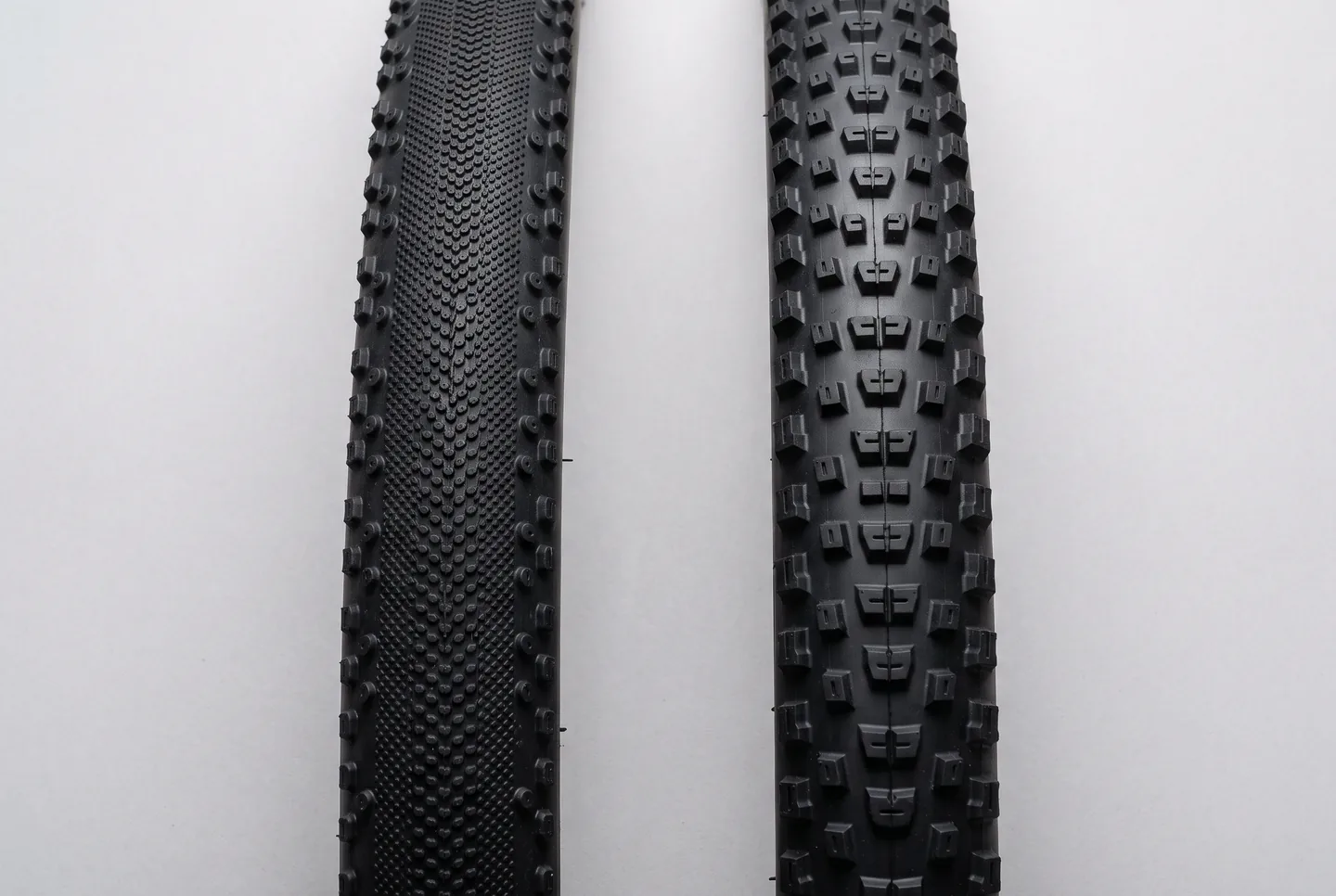
MTB. Three 29" XC tires, set up tubeless with 40 ml of sealant, with center knobs from 1.4 to 2.1 mm. Two lost 17.3 and 19.0 W, and the third lost 26.1 W. The third was tested in 2019 with a tube, and the lab recalculated it for tubeless and for its current method, so that number is less precise6,7,9. Two of them had almost the same center knobs, 2.0 and 2.1 mm, and were still 7.1 W apart6,7.
WATTS LOST BY EACH TIRE ON THE DRUM
Slower tire in the comparisonFaster-rolling tire
Road
Gravel
MTB
Among race tires. BikeRadar tested eight race tires, all 28 mm except one 27 mm. Seven were within 2.5 W per tire of each other, and the gap from first to last was 4.82 W. That lab uses a different speed, load and tube, so you can’t compare its watts with the ones above8.
The trade-off
A faster tire is usually more fragile. In the tread puncture test, the road race tire scored 49 points and the puncture-resistant one 952,3. BikeRadar says race tires put speed, grip and comfort ahead of protection, and that thinner, lighter materials usually wear out sooner. If you ride a lot of miles in rough conditions, it suggests a tougher, all-season tire8.
Gravel and MTB tires don’t always follow that rule. The two gravel tires scored 33 and 36 points and the three XC tires between 28 and 31, even though they rolled very differently4,5,6,7.
What they’re worth on your ride
In the calculator you pick the tires you have now: fast race tires, normal stock tires, or tough puncture-resistant ones. The gain varies a lot. If you’re on fast tires, Crr usually drops by no more than 0.0008 on the road and 0.0010 on gravel and MTB. From normal tires, it drops by 0.0010 to 0.0025 on the road, 0.0008 to 0.0025 on gravel and 0.0008 to 0.0030 on MTB. From tough tires, it drops by 0.0021 to 0.0032 on the road, 0.0020 to 0.0045 on gravel and 0.0020 to 0.0040 on MTB.
On the road, the numbers for fast and tough tires come from the drum tests2,3,8. For gravel we only have measurements comparing low and tall knobs4,5, and for MTB only comparisons between XC tires6,7. The other cases are estimates, and the calculator labels them that way. Off pavement we use the same differences. That’s an assumption, because the tests are all done on a drum.
On pavement we don’t let Crr go below 0.003, because the fastest race tire we cite got down to 0.0030 set up tubeless10. If you also go tubeless, we only count the margin that’s left.
On the example gravel ride, 62 km (39 mi) with 780 m (2,560 ft) of climbing, going from normal tires is worth about 3'20", between 1'50" and 5'40". On your ride it could be more or less, depending on the tires you have, your power, your speed and how much of the ride is unpaved.
What they cost. The calculator counts a pair: €110 for road, €95 for gravel and €110 for MTB. If your tires needed replacing anyway, only the difference counts. We take off €60 (€70 for MTB), which you would have spent regardless.
NUMBERS FROM THE CALCULATOR
On the example ride for each discipline, with a 74 kg rider. Each upgrade is counted on its own, without the others.
ROAD
−4'20"
- Cost
- €110
- Per second
- €0.42
- Rank
- 1st of 27
GRAVEL
−3'20"
- Cost
- €95
- Per second
- €0.47
- Rank
- 2nd of 26
MTB
−3'10"
- Cost
- €110
- Per second
- €0.58
- Rank
- 2nd of 23
Updated from the calculator on NOVEMBER 18, 2026.
How to choose them
- Look at the measured watts. Only compare tires tested by the same lab, at the same speed, load and pressure, and with the same tube or sealant. You can’t mix numbers from different labs2,8.
- Look at protection too. The puncture test score and the thickness at the center tell you how fragile a tire is2,3.
- Choose for where you ride. If you put in a lot of miles in rough conditions, a tougher all-season tire is a better pick than a race tire8. On gravel, low knobs rolled much faster than tall ones on the drum4,5.
- Think about tubeless. Without a tube there’s no friction between tube and tire1. It has its own guide.
When it’s not worth it
If you already run race tires, the gain is small. Seven of eight race tires were within 2.5 W of each other, per tire8.
If your roads are full of glass, thorns or rocks, put protection first. The puncture-resistant tire scored 95 points versus 49 in the puncture test, but it lost 10.8 W more2,3.
If your tires are almost new, you’d be paying for the whole pair. Wait until they’re worn out, when the price difference is small.
Sources
We read every source ourselves. They’re all public pages you can read for free. Prices are approximate, from online stores in November 2026. We don’t link to the stores, because the site doesn’t tell you where to buy.
- BikeRadar, 2025. What rolling resistance is and what it depends on. Article
- Bicycle Rolling Resistance, 2018. A 25 mm road race tire with a butyl tube: watts, puncture test score, center thickness, weight. Test
- Bicycle Rolling Resistance, 2017. A 25 mm puncture-resistant road tire, with the same tube. Test
- Bicycle Rolling Resistance, 2022. A 40 mm gravel tire with low knobs, tubeless. Test
- Bicycle Rolling Resistance, 2020. A 40 mm gravel tire with tall knobs, tubeless. Test
- Bicycle Rolling Resistance, 2024 and 2026. Two 29" XC tires, tubeless. Comparison
- Bicycle Rolling Resistance, 2019. A third 29" XC tire, tubeless. Test
- BikeRadar, 2023. Eight road race tires tested in a lab at Silverstone, with watts and notes on protection and durability. Article
- Bicycle Rolling Resistance. The test method and how it has changed over the years, with the older tests recalculated. Method page
- Bicycle Rolling Resistance, 2021. A 25 mm road race tire, tubeless with 20 ml of sealant: Crr 0.00303. Test