GUIDES · TIRES
Crr: what rolling resistance is.
Crr tells you how much a tire holds you back as it rolls. It’s the force needed to roll the tire divided by the weight on it. With 84 kg (185 lb) of rider, bike and clothing at 25 km/h (16 mph), rolling costs about 32 W on stock tires (Crr 0.0055) and about 21 W on race tires with tubes (0.0036). The slower you go and the rougher the surface, the more it matters compared with air. This guide covers where it comes from, how to read the tests and what it’s worth in seconds.
2'20"
What lowering Crr by 0.001 is worth on the calculator’s example road ride, 80 km (50 mi) with 900 m (2,950 ft) of climbing.
16 km/h
On the road with stock tires, rolling resistance holds you back more than air below this speed. On a mountain bike on loose dirt, that’s true up to about 28 km/h (17 mph).
0.0036
The Crr of a race tire with a tube, worked out from the watts measured on the drum. A puncture-resistant tire of the same size comes out at about 0.0069.
0.022
The Crr measured on a cross-country course. On asphalt with stock tires, it’s about a quarter of that.
What it is
As a tire rolls, it flattens under load and springs back on every turn of the wheel. That flexing wastes energy as heat, and that’s rolling resistance2. Crr sums it up in one number, the rolling force divided by the weight on the wheel2.
In the power model, the rolling force is Crr times the weight of rider and bike, and the watts are that force times speed1. So rolling watts go up in proportion to weight and speed, while air watts go up with the cube of speed1. That’s why rolling resistance matters more when you’re going slowly, like uphill, off pavement or on a mountain bike2.
Typical values
WATTS FOR ROLLING RESISTANCE, 84 KG (185 LB)
| CRR | 25 km/h (16 mph) | 15 km/h (9 mph) |
|---|---|---|
| 0.0030 Race tire, tubeless | 18 W | 11 W |
| 0.0036 Race tire, with a tube | 21 W | 13 W |
| 0.0055 Stock tire | 32 W | 19 W |
| 0.0069 Puncture-resistant tire | 41 W | 24 W |
| 0.010 Hardpack (estimate) | 59 W | 35 W |
| 0.022 Cross-country trail | 129 W | 78 W |
| 0.030 Technical terrain | 176 W | 106 W |
Crr almost doubles going from a race tire to a puncture-resistant one. Off pavement it goes up much more. It was measured at about 0.022 on a cross-country course7, and about 0.030 on a more technical course with roots and rocks8. We couldn’t find solid measurements for hardpack, so the calculator uses an estimate of 0.010.
Rolling resistance vs. air
The calculator’s model shows the speed below which rolling resistance holds you back more than air on the flat. On the road with stock tires and the medium position, that’s about 16 km/h (10 mph), and about 13 km/h (8 mph) with race tires. On a gravel bike on hardpack, using our estimate, it’s about 21 km/h (13 mph). On a mountain bike on loose dirt it’s about 28 km/h (17 mph), so almost always.
Above those speeds, air matters more, and so does your CdA. It has its own guide.
How to read the tests
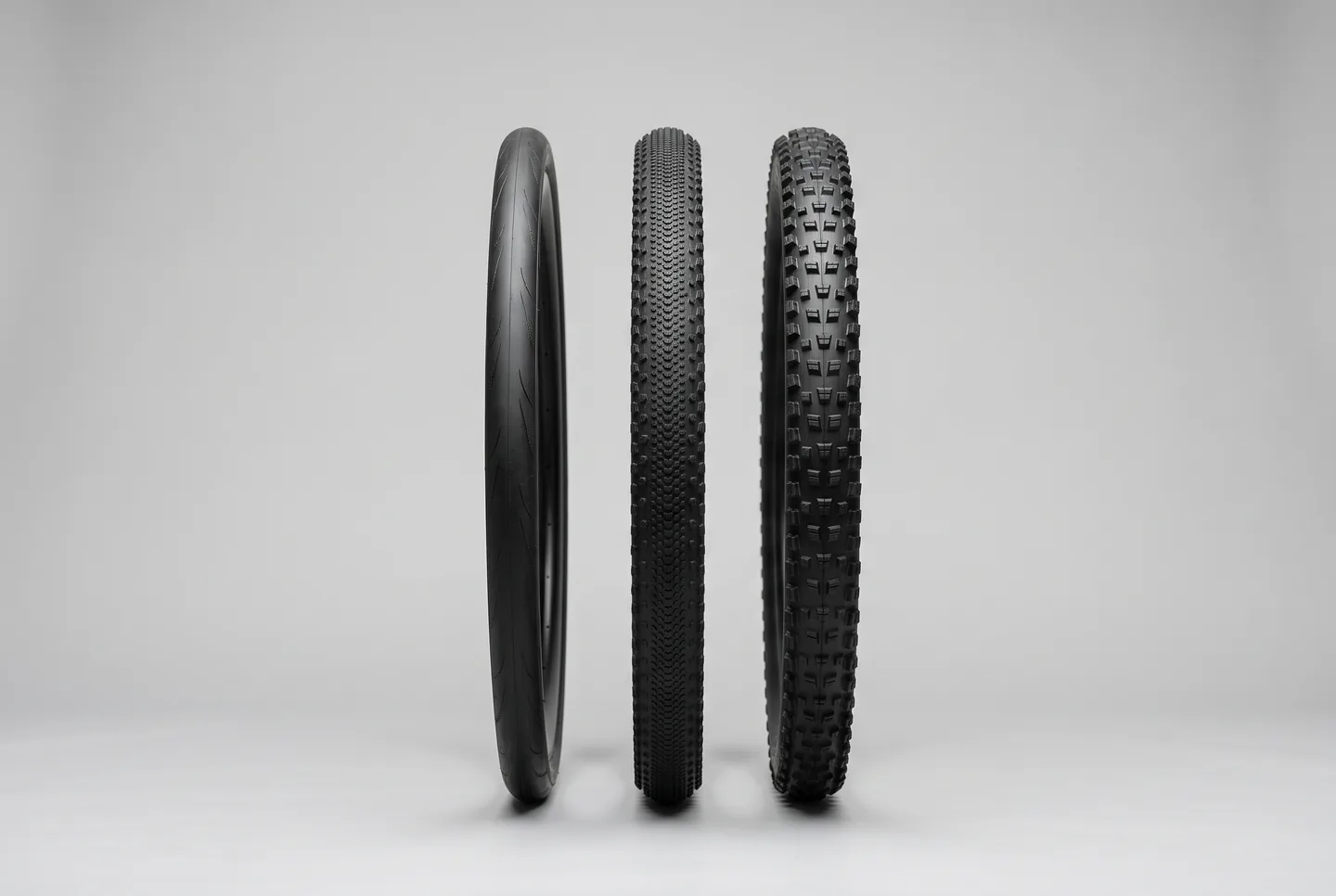
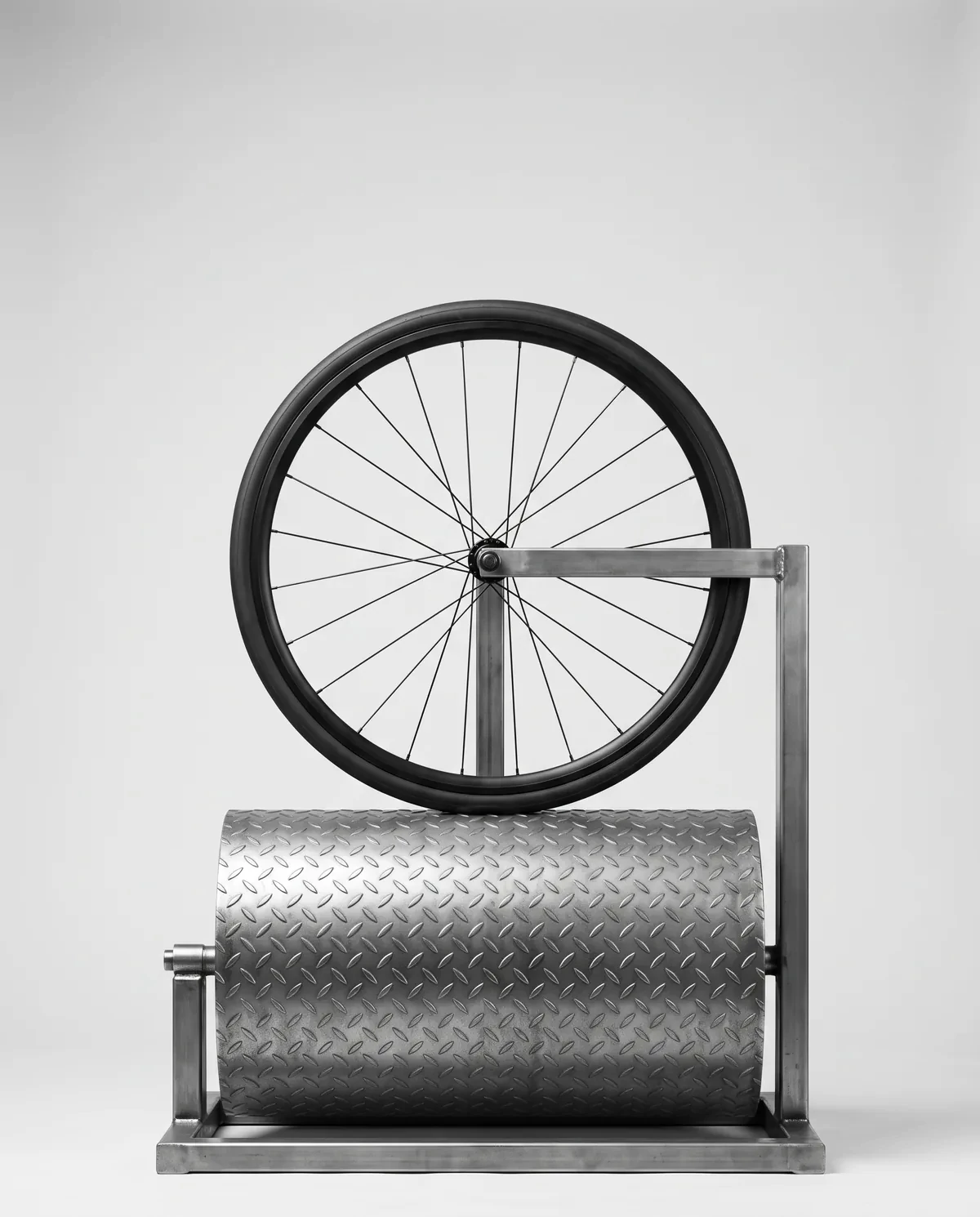
Bicycle Rolling Resistance tests every tire on a 77 cm (30 in) drum covered in diamond plate to simulate average asphalt. It runs at 28.8 km/h (18 mph) with 42.5 kg (94 lb) on the wheel and reports the watts lost by one tire3. To get Crr, divide the watts by the load on the wheel in newtons (42.5 kg × 9.81) and by the speed in meters per second (8), which comes to dividing by about 3,340. That math is ours, since the lab only reports watts.
So a 25 mm race tire with a butyl tube that lost 12.1 W has a Crr of about 0.0036, and a puncture-resistant tire of the same size at 22.9 W comes out at about 0.00694,5. For some tires the lab also lists the Crr, and one tubeless race tire came in at 0.003036.
The test watts are for one tire, at that speed and that load. The lab says that with 85 kg (187 lb) of rider and bike on two tires, the watts at the same speed are about double3. A drum isn’t a road, and on rough surfaces, cobbles and dirt the losses go up2.
What it depends on
- The tire. A thinner, more supple casing and a compound with more silica lose less, but lighter, thinner casings usually puncture more easily2.
- Width and pressure. Both change how much the tire flattens. On the drum at the same pressure, a wider tire lost less. At the pressures people actually run, which differ by width, the narrower one lost a little less. On smooth asphalt wide tires aren’t slower, and on rough asphalt they can be faster2. We have a guide on where to start with pressure, and a guide on 28 vs 32 mm tires that covers it too.
- The inner tube. In one test, running a tube instead of tubeless cost about 0.2 to 3.8 W. The gap was smaller with latex, TPU usually loses less than butyl, and tubeless is the most efficient2. We have a guide on inner tubes.
- The surface. Smooth asphalt loses the least, and rough asphalt, cobbles and dirt all add to it2.
- Weight. Rolling watts go up in proportion to the weight of rider and bike1.
What it’s worth in seconds
In the calculator, lowering Crr by 0.001 is worth about 2'20" on the example road ride, 2'20" on the gravel ride and 1'40" on the shorter MTB ride. Going from stock tires to race tires with tubes drops it by about 0.002 on the road.
In the calculator you pick the tires you have: fast, normal or tough. We start from 0.004, 0.0055 and 0.007 on asphalt (0.008 on a mountain bike), and from 0.010, 0.020 and 0.030 on hardpack, loose dirt and technical terrain. For fast tires we use 0.004, a little above the drum values. If you know your Crr, you can enter it yourself. Tires also have their own guide.
Sources
We read every source ourselves. They’re all public pages you can read for free.
- Crouch, Burton, LaBry and Blair, 2017. Scientific review of cycling aerodynamics, in Sports Engineering: the power model, with rolling resistance in proportion to weight and air resistance with the cube of speed. Study (PDF)
- BikeRadar, 2025. What rolling resistance is and what it depends on: deformation, casing, compound, width and pressure, inner tubes, surface. Article
- Bicycle Rolling Resistance. The test method: drum, speed, weight on the wheel, how to convert the watts to a real rider. Method page
- Bicycle Rolling Resistance, 2018. A 25 mm road race tire with a butyl tube: 12.1 W. Test
- Bicycle Rolling Resistance, 2017. A 25 mm puncture-resistant road tire, with the same tube: 22.9 W. Test
- Bicycle Rolling Resistance, 2021. A 25 mm road race tire, tubeless with 20 ml of sealant: Crr 0.00303. Test
- Maier and colleagues, 2018. Journal of Sports Sciences. Power and resistance measured on a cross-country course: Crr 0.022. Study
- Maier and colleagues, 2019. Journal of Sports Sciences. Resistance measured on a more technical cross-country course, comparing rims of different widths: Crr about 0.030. Study