GUIDES · TIRES
25, 28, 30 or 32 mm tires: which rolls faster.
At the same pressure, a 32 mm tire rolls slightly faster than a 28. But people usually run a 32 at lower pressure, and when you pump them up for the same comfort the two roll almost the same. On the drum, the biggest gap between 23 and 32 mm was 0.2 W per wheel. In another test, with tubeless tires from 25 to 32 mm, at the pressures the test picked, the 32 rolled 0.6 W per wheel faster than the 25. What really makes the difference is comfort, weight, drag, the surface you ride on and the rim you mount the tire on.
0.2 W
The biggest gap per wheel between 23, 25, 28 and 32 mm versions of the same tire, inflated for the same comfort.
−0.5 W
How much faster the 32 rolls than the 28 per wheel at the same 80 psi, with a butyl tube. With a latex tube it’s 0.2 W.
75 psi
The 32’s pressure on the drum with 42.5 kg (94 lb) on the wheel, versus 81–90 psi for the 28. In bar, that’s 5.2 versus 5.6–6.2.
+43 g
How much heavier the 32 was than the 28, per tire. On a 100 km (62 mi) ride with 1,000 m (3,280 ft) of climbing, that’s about 4 seconds.
At the same pressure, the wider tire is faster
SAME TIRE, SAME PRESSURE, PER WHEEL
| PRESSURE | 25 MM | 28 MM | 32 MM |
|---|---|---|---|
| 120 psi 8.3 bar | 8.4 W | 8.0 W | 7.8 W |
| 100 psi 6.9 bar | 8.9 W | 8.4 W | 8.2 W |
| 80 psi 5.5 bar | 10.0 W | 9.2 W | 9.0 W |
| 60 psi 4.1 bar | 11.8 W | 10.9 W | 10.3 W |
At the same pressure, a wider tire flattens less along its length, so the contact patch is shorter and the tire flexes less2. On the drum at 80 psi, the 32 lost 9.0 W and the 28 lost 9.2 W. Down to 80 psi the gap stays at 0.2 W. At 60 psi it grows to 0.6 W, 10.3 W versus 10.91.
On a rim with a 17 mm internal width at 100 psi, the 28 measured 28.5 mm and the 32 measured 31.8 mm. On a wider rim they’d measure a little wider1.
At the same comfort, they roll almost the same
PRESSURE AND WATTS PER WHEEL
| WIDTH | SAME TIRE DROP | SAME COMFORT |
|---|---|---|
| 23 mm | 108 psi 7.4 bar 10.3 W | 92 psi 6.3 bar 11.3 W |
| 25 mm | 100 psi 6.9 bar 10.7 W | 87 psi 6.0 bar 11.5 W |
| 28 mm | 90 psi 6.2 bar 10.8 W | 81 psi 5.6 bar 11.4 W |
| 32 mm | 75 psi 5.2 bar 11.4 W | 75 psi 5.2 bar 11.4 W |
People usually run a 32 at lower pressure than a 28. Inflate them so they compress by the same percentage and the 32 goes to 75 psi and the 28 to 90, with the 32 losing 0.6 W more per wheel. Inflate them for the same comfort and the 32 still goes to 75 psi but the 28 drops to 81, and both lose the same 11.4 W1.
Across all four widths at the same comfort, the gap was 0.2 W at most. The tester recommends the narrowest tire that gives you the comfort you want, since a tire that’s too narrow and too soft can bottom out on the rim and pinch the tube1.
BikeRadar also tested the same tire in 26 and 30 mm. On the drum at the same pressure, the wider one was faster, but at the pressures people actually run, the narrower one was. It doesn’t give the watts2.
The tube matters more than the width. At 80 psi the 28 lost 9.2 W with a latex tube and 11.5 W with a butyl one. That’s 2.3 W per wheel, more than any difference in width. These tests used inner tubes; tubeless is in the next section1. We have a guide on inner tubes.
The 30 and tubeless
In 2022 the same kind of drum test was repeated with another tire, a tubeless one, in 25, 28, 30 and 32 mm. At the same pressure, 73 psi (5 bar), the 25 lost 11.0 W per wheel, the 28 10.3 W, the 30 9.8 W and the 32 9.4 W6.
At the pressures picked for the test, lower for the wider tires, the differences get small: from the 25 to the 32 it’s 0.6 W per wheel6.
TUBELESS, AT THE TEST PRESSURE, PER WHEEL
| WIDTH | PRESSURE | WATTS | ON THE RIDE |
|---|---|---|---|
| 25 mm | 80 psi 5.5 bar | 10.4 W | — |
| 28 mm | 72 psi 5.0 bar | 10.2 W | −11" |
| 30 mm | 69 psi 4.8 bar | 10.0 W | −22" |
| 32 mm | 65 psi 4.5 bar | 9.8 W | −33" |
The 30 sits in the middle, as you’d expect. The tester thinks the 28 is better than the 25, and going wider than the 28 is a personal choice. Wider tires weigh more and push more air, and that can eat up the small advantage6.
The weights: 255 g for the 25, 266 g for the 28, 292 g for the 30 and 310 g for the 326. In the calculator’s model, on the same ride, a pair of 32s instead of a pair of 25s costs about 5 seconds, and a pair of 30s about 3.
For the tester, the real advantage of wide tubeless tires is something else: at lower pressure the sealant plugs holes better, and with more air inside you have more time before the tire gets too soft to ride on6. We have a guide on tubeless.
On real roads and on dirt
The drum is smooth and roads aren’t. On a rough road the tire also has to soak up vibration, and that’s where a wider, softer tire can be faster23.
In a test on a real road, on smooth asphalt at 15 km/h (9 mph), 28, 32, 35 and 44 mm tires with the same casing rolled almost the same, with differences too small to be significant. The tester says a supple casing matters most3. Zinn, writing in Velo, doubts this kind of test, because outdoors the air has too much effect to measure differences this small4.
On a drum that simulates cobbles, at 35 km/h (22 mph), the results were mixed. For the three road tire models tested in two widths, the wider one was faster every time. For gravel tires, the narrower one was faster in four of six models4. We also have a guide on how much slower a gravel bike is on the road.
Weight and air
100 KM (62 MI) WITH 1,000 M (3,280 FT) OF CLIMBING, AT 200 W
| 32 MM INSTEAD OF 28 | ON THE RIDE |
|---|---|
| Same pressure, 80 psi | −27" |
| Pressure for the same tire drop | +33" |
| Pressure for the same comfort | 0" |
| 86 g more in tires | +4" |
| Every watt less at the pedals | +33" |
The 32 weighed 278 g and the 28 weighed 235 g, so 43 g more per tire and 86 g for the bike1. In the calculator’s model, that’s about 4 seconds over 100 km (62 mi) with 1,000 m (3,280 ft) of climbing.
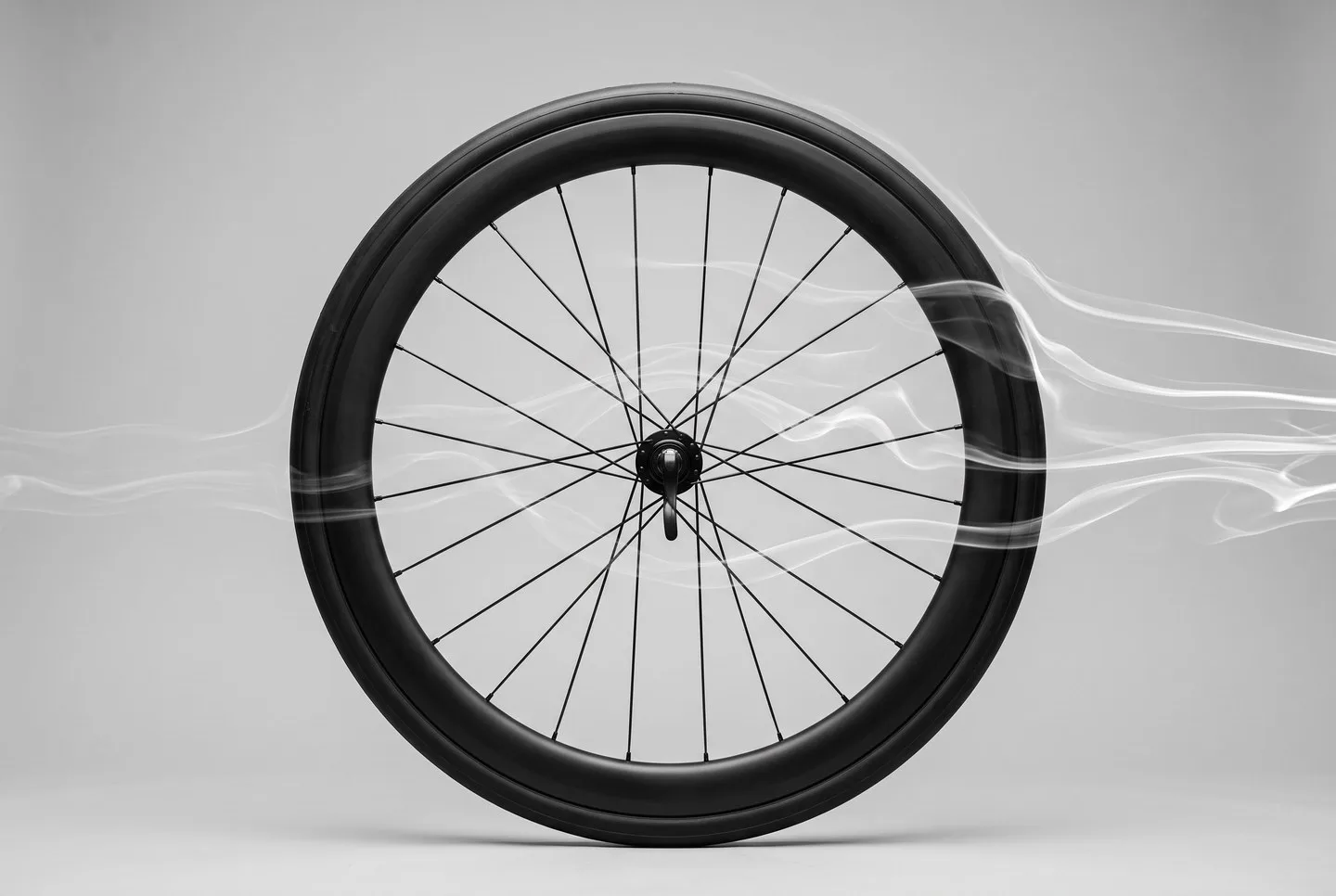
Drag matters too. A wider tire pushes more air, and with aero wheels the rim width matters. The usual rule is that the rim’s outer width should be at least 105% of the tire’s mounted width. If the rim is narrower, you lose some of what the wheel does for you5. With the widths measured on the drum, that means a rim at least 30 mm wide on the outside for the 28 and 33.4 mm for the 32. On a wider rim the tire gets wider, so the rim has to be wider still8.
The author of the wind tunnel tests estimates about 1 W for every 2 mm of extra tire width, with the wind almost head-on. He doesn’t say at what speed, or whether that’s per wheel or per bike, so we don’t turn it into seconds. In another example, pumping a tire from 7 to 8 bar took the rim from 102% to 98% of the tire’s width, which cost 1 to 9 W depending on the wind5.
Rim width
The same tire changes width depending on the rim. What counts is the internal width, where the tire’s bead sits8.
Road tires are usually designed to measure roughly their printed width on a rim with a 19 mm internal width. But it varies from tire to tire. On a 21 mm rim a 28 can come out at about 30 mm8.
THREE 25 MM TIRES ON THREE RIMS
| INTERNAL RIM WIDTH | ACTUAL WIDTH | WATTS |
|---|---|---|
| 18 mm | 26.4 mm | 9.65 W |
| 22 mm | 28.1 mm | 9.88 W |
| 26 mm | 29.8 mm | 9.70 W |
On the drum, three 25 mm tires went on average from 26.4 mm on a rim with an 18 mm internal width to 29.8 mm on a 26 mm one. At the same pressure they rolled a little faster on the wide rim. With the pressure adjusted for the width, the three rims were almost the same: less than a quarter of a watt per wheel7.
For rolling resistance, the tester finds the best results with an internal rim width of about 65–75% of the width printed on the tire; anywhere between 50 and 80% is almost as good. For a 25 he recommends a rim with a 17–18 mm internal width, and for a 28, 19–20 mm7. The outer width, on the other hand, matters for drag, as we saw above with the 105% rule5.
In practice: if you buy a 30 for a wide rim, you may end up with a tire wider than you think. Make sure it clears the frame and fork8.
Tire pressure
The wider the tire, the lower the pressure. On the drum, for the same comfort, the 28 needed 81 psi (5.6 bar) and the 32 needed 75 psi (5.2 bar)1. Those are the test pressures, with 42.5 kg (94 lb) on the wheel and a 17 mm internal rim width, so don’t copy them. Your weight, the bike’s weight and your rim width all change how the tire behaves2.
- Stay within the limits. For the tire in the 2019 test, the maximum is 115 psi (7.9 bar) for the 28 and 100 psi (6.9 bar) for the 321. A hookless wheel BikeRadar mentions has a 5 bar limit, or 72.5 psi, which is less than the 75 and 81 psi in the test2. Always go by whichever is lower, the tire limit or the rim limit.
- On rough roads, go lower. On a bumpy surface, higher pressure is slower, so it’s usually better to drop it as long as the tire stays stable3. With a tube, go too low and the tire bottoms out on the rim and pinches the tube1. Stay within the limits printed on the tire and rim.
- A 42 mm knobby tire on asphalt. In a test on very smooth asphalt, there was no real difference between 30 and 40 psi (2.1–2.8 bar). At 20 psi (1.4 bar) the tire squirmed but wasn’t much slower. At 10 psi (0.7 bar) it was a lot slower3. The rider’s weight isn’t given, so these aren’t pressures to copy.
Which to choose
- On smooth asphalt, a 28 and a 32 roll almost the same if you pump them up for the same comfort. Pick the narrowest one that gives you the comfort you want1. Zinn thinks the narrower one probably wins on smooth asphalt, because it weighs less and pushes less air4.
- On rough roads, the 32 at lower pressure is more comfortable and can be faster123.
- 25, 28, 30 or 32. Among the four, at the pressures the test recommends, there’s little difference: the tester thinks the 28 is better than the 25, and past the 28 it’s up to you6.
- Look at the rim. On a wide rim the tire comes out wider than what’s printed on it: a 28 on a rim with a 21 mm internal width can come out at about 30 mm. Make sure it clears the frame8.
- With deep-section wheels, check the rim width. If it isn’t at least 105% of the tire, you lose some of the wheels’ advantage5.
- Casing and tube matter more. The road tester says a supple casing matters more than almost anything else3, and on the drum the tube was worth more than the width1. We have a guide on fast-rolling tires.
The calculator doesn’t distinguish between tire widths. It goes by the type of tire and the surface.
Sources
We read every source ourselves. They’re all public pages you can read for free. Two of the eight sources are published by companies that sell tires or accessories, and four others make money from affiliate links. We note this next to each one. The ride times come from the calculator’s model.
- Bierman, Bicycle Rolling Resistance, 2019. The same road tire in 23, 25, 28 and 32 mm on the drum: at 120, 100, 80 and 60 psi with latex and butyl tubes, at the same tire drop and the same comfort, with measured weights and widths. The page has affiliate links to the tested tire. Test
- Norman, BikeRadar, 2025. What rolling resistance is and how width, pressure, rim, weight and surface affect it, with a comparison of two widths of the same tire. The publication uses affiliate links. Article
- Heine, 2021. Tests on a real road, on a timed 132 m (433 ft) descent, with tires from 28 to 44 mm and different pressures. Published on the blog of the author’s tire company; he tests only his company’s tires and says so. Article
- Zinn, Velo, 2021. Tests on a drum that simulates cobbles, at 35 km/h (22 mph), with road and gravel tires in several widths of the same model, and the limits of outdoor testing. Article
- Tire pressure and aerodynamics, no author or date. The author worked for a wheel maker from 1999 to 2013 and describes wind tunnel tests on tires and rims and the 105% rule. Published on the blog of a company that sells pumps and accessories. Article
- Bierman, Bicycle Rolling Resistance, 2022. Another road tire, tubeless, in 25, 28, 30 and 32 mm on the drum: watts at the same pressure and at the pressures picked for the test, with measured weights and widths. The page has affiliate links. Test
- Bierman, Bicycle Rolling Resistance, 2021. Road, gravel and MTB tires on rims with 18, 22 and 26 mm internal widths: actual width and watts at the same pressure and at an adjusted pressure. Test
- Norman, BikeRadar, 2026. Rim width: internal and external, how much the mounted tire changes, hookless rims. The publication uses affiliate links. Article