GUIDES · MTB
MTB tire pressure: where to start.
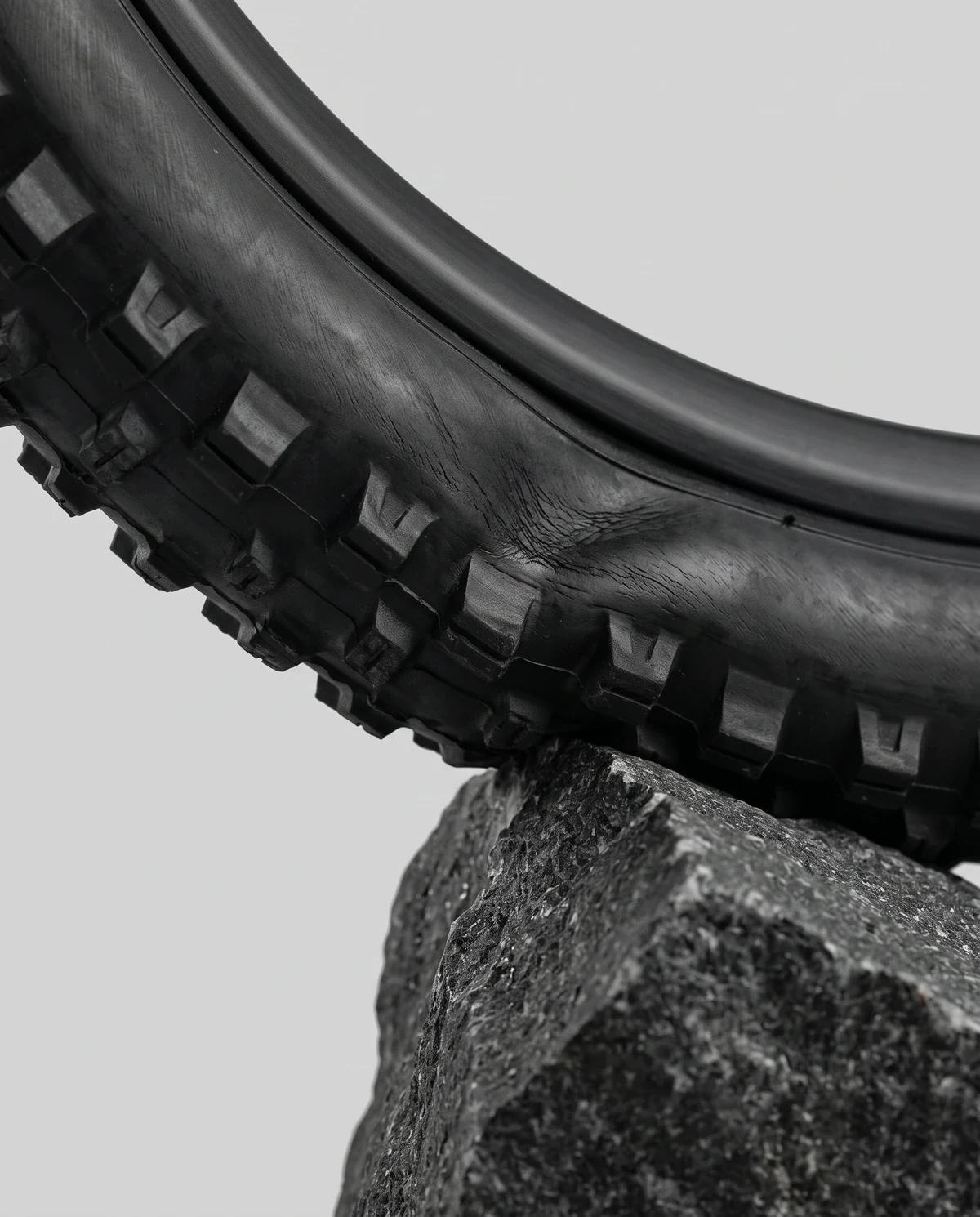
For a rider of about 75 kg (165 lb) running 2.25 to 2.5 inch tubeless tires, TOUR and BIKE suggest 1.5 to 1.8 bar (22–26 psi)1. The rougher the terrain, the lower you want to go. Run too little air, though, and you get flats, rim strikes and a tire that folds in corners. This guide gives you a starting point for your kind of riding, shows how to adjust it for your weight and how to dial in your own pressure.
1.5 / 1.7 bar
The starting point, 22 / 25 psi, for XC on 2.25 inch tubeless tires with a rider of about 75 kg (165 lb).
0.2 bar
How much air to let out at a time, 3 psi, on a test ride, until the bike feels “spongy”.
+0.3–0.5 bar
How much to add, 4–7 psi, if you run an inner tube instead of tubeless.
2.5 bar
The maximum pressure, 36.3 psi, with hookless rims and 55 to 64 mm tires, or about 2.25 to 2.5 inches.
A starting point
Before you pump up. These numbers are a starting point, not the right pressure for your bike. Never go over the maximum pressure printed on the tire or the rim, and if they differ, go by the lower one. With hookless rims and 55 to 64 mm tires (about 2.25–2.5 inches), the maximum is 2.5 bar (36.3 psi)56. Check the minimum printed on the tire too. If it’s higher than the number in the table, use the minimum. If you feel the rim bottom out on hits, add air.
Josh Welz gives these starting values for mountain bikes in the German magazines TOUR and BIKE (same publisher, same article)1:
STARTING POINT, TUBELESS
| RIDING/TIRE | PRESSURE |
|---|---|
| XC, 2.25" | 1.5 / 1.7 bar |
| Recreational and trail, 2.4" | 1.6 / 1.8 bar |
| Enduro and downhill, 2.5" | 1.5 / 1.7 bar |
XC pros on 2.25–2.4 inch tires and rims with a 28–30 mm internal width often run 1.4 to 1.7 bar (20–25 psi)1. In enduro and downhill you don’t want to go too low, because you risk flats and rim damage2.
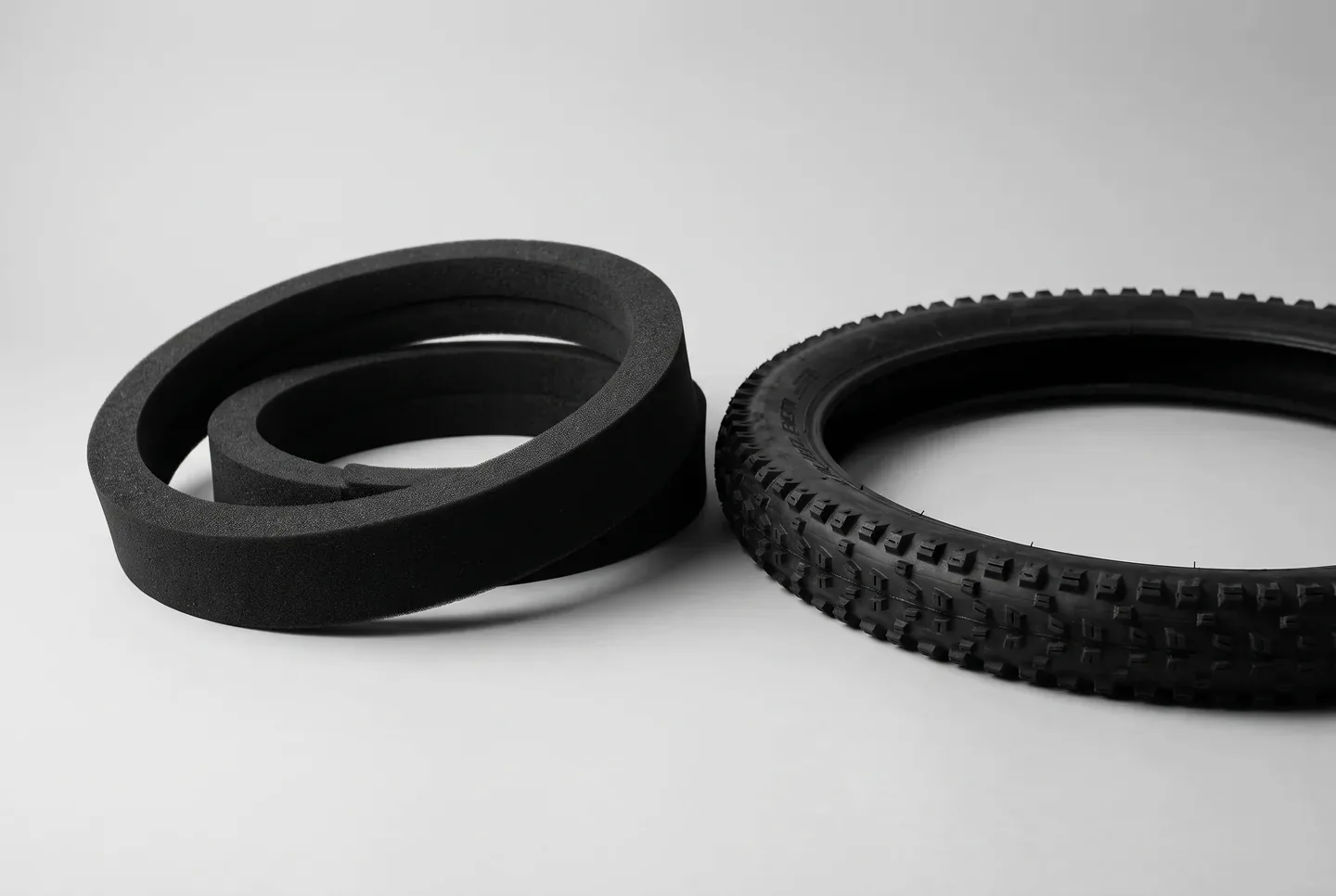
The rougher the terrain, the lower you want to go1. Wide rims support the tire better and often let you drop a little more1. Downhill riders often use inserts, which let you go lower still1, but the magazines don’t give numbers for them.
For your weight
Those values are for a rider of about 75 kg (165 lb). Heavier riders need more air and lighter riders need less. BIKE says pressure should change in proportion to the combined weight of rider, bike and gear2. Find the row for your weight, and if you ride with a heavy pack, water included, add that to your weight.
XC AND TRAIL, BY WEIGHT
| RIDER | XC 2.25" | TRAIL 2.4" |
|---|---|---|
| 65 kg | 1.3 / 1.5 bar | 1.4 / 1.6 bar |
| 75 kg | 1.5 / 1.7 bar | 1.6 / 1.8 bar |
| 85 kg | 1.7 / 1.9 bar | 1.8 / 2.0 bar |
| 95 kg | 1.9 / 2.1 bar | 2.0 / 2.2 bar |
We didn’t run the numbers for enduro and downhill, because the magazines warn against going too low there2.
Always stay under the maximum for the tire and the rim. If you weigh 85 kg (187 lb) or more and run a tube on a hookless rim, you can end up at 2.5 bar (36.3 psi), the maximum for 55 to 64 mm tires5. In that case, stay a few tenths of a bar below it.
Too little air
- Cornering. With too little air the tire can fold in corners3. In enduro and downhill, the bike gets unstable in fast corners and compressions2.
- Flats and rims. If the tire bottoms out and you’re running a tube, you risk a pinch flat3. Flatting at low pressure can also damage the rim2.
- Casing. A zigzag line on the sidewall means a casing thread has broken. Add a little air3.
The right minimum pressure depends on your weight, how grippy the surface is, how the tire is built and how you ride3. Mountain bikes don’t have a simple rule like the one for road bikes. Frank Berto, who used that rule for road tires, didn’t think it worked for mountain bikes4.
How to find your pressure
- Start high. Pump up to the highest value in the table for your weight and riding, without going over the maximum for the tire and the rim1.
- Go down a little at a time. On a trail you know, let out 0.2 bar (3 psi) at a time until the bike feels “spongy”, then put back 0.1–0.2 bar (1.5–3 psi)1.
- A bit more in the rear. For enduro and downhill, the magazines suggest about 0.2 bar (3 psi) more in the rear, because the rear wheel flats more easily2.
- Always use the same gauge. Two gauges can read up to 15% apart3. At pressures this low, you can feel a few tenths of a bar.
For other bikes, see the guide on gravel tire pressure and the one for road bikes.
In the calculator, pick MTB and enter your ride to see which upgrades are worth the most.
Sources
We read every source ourselves. They’re all public pages you can read for free. Rene Herse and Schwalbe make tires. TOUR and BIKE share a publisher and the article is by the same author, so for the values they count as one source.
- TOUR, 2026. The right pressure for road, gravel and MTB: starting values by type of riding and width, tubeless and inner tube, how to go down 0.2 bar at a time. Article
- BIKE, 2026. The same topic for MTB, with the rule for changing the pressure in proportion to weight and the risks of too low a pressure in enduro and downhill. Article
- Rene Herse / Jan Heine. Minimum pressure: what happens with too little air, what it depends on, how far off gauges can be. Article
- Frank Berto. “All About Tire Inflation”: the 15% tire drop rule for road tires, which according to the author doesn’t apply to mountain bikes. The PDF is a reprint. Article (PDF)
- Schwalbe. Hookless rims: maximum pressure by tire width under ETRTO; if the rim’s maximum is lower, that one applies. Page
- BikeRadar. Hookless rim safety: ETRTO and ISO limits by tire width. Article