GUIDES · WEIGHT
How much a road bike weighs: the real weights and how much they matter.
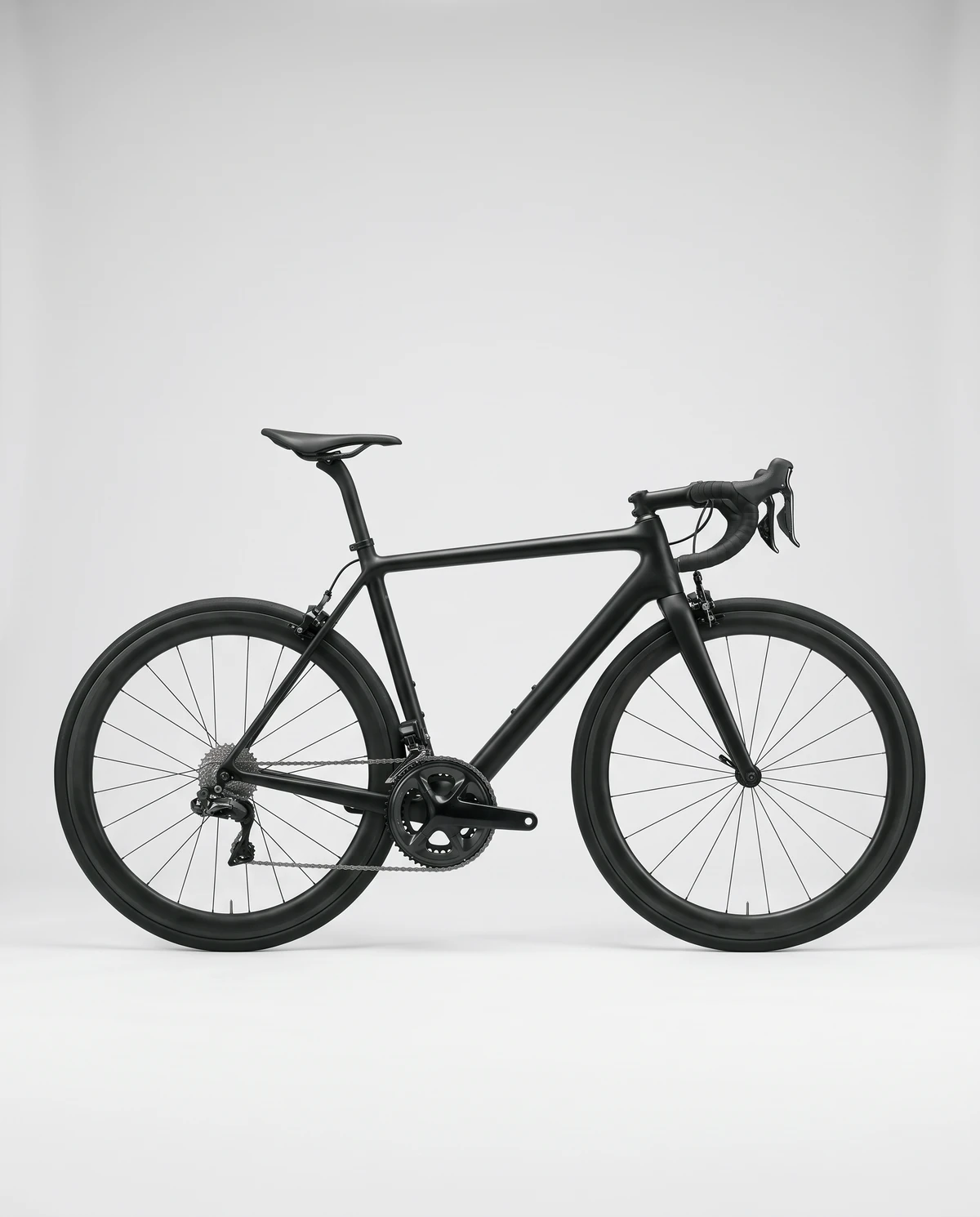
A road bike weighs from about 6.8 kg (15 lb) to more than 10 kg (22 lb). Pro bikes sit just above the 6.8 kg limit, road bikes up to €7,000 are around 7.5 kg (16.5 lb), and aluminum bikes around €1,000 are over 9 kg (20 lb). On the example ride, going from 10.2 to 7.5 kg is worth about a minute and a half.
6.8 kg
The minimum weight to race in UCI events. It still applies, but at the end of September 2026 the UCI announced it will review its bike rules.
7.06 kg
The average of eight pro bikes weighed at the 2026 Tour de France, ready to race.
7.5 kg
What most of the 17 road bikes up to €7,000 tested in 2025 weighed. The differences come mostly from the wheels and components.
+9 kg
The six aluminum bikes around €1,000 tested in 2022 all weighed more than 9 kg (20 lb).
The real weights
Claimed weights usually leave out pedals, bottle cages and mounts. Here we only use weights measured on a scale2.
WHAT THEY WEIGH IN TESTS
| BIKE | WEIGHT |
|---|---|
| Minimum for UCI races | 6.8 kg |
| Pro bikes at the 2026 Tour | 6.8–7.4 kg |
| Road bikes up to €7,000 | about 7.5 kg |
| Aluminum bikes around €1,000 | 9.0–10.2 kg |
Pro bikes. At the 2026 Tour de France, eight bikes were weighed ready to race: from 6.8 to 7.4 kg (15 to 16.3 lb), 7.06 kg (15.6 lb) on average. That’s almost half a kilo less than the year before, because fewer of the heavier aero bikes were weighed in 20262.
Road bikes up to €7,000. In 2025, 17 road bikes up to €7,000 were tested. Most weighed around 7.5 kg (16.5 lb). The lightest was 7.25 kg (16 lb), and only one was over 8 kg (17.6 lb). The biggest differences came from the wheels and components3.
Bikes around €1,000. In 2022, six aluminum bikes priced from €1,049 to €1,199 weighed between 9.0 and 10.2 kg (19.8 and 22.5 lb). The lightest had better wheels and components4.
The 6.8 kg limit
To race in UCI events, a bike must weigh at least 6.8 kg (15 lb). The rule has been in place since 20005,7.
As early as 2023, several road bikes could be built up close to 6.8 kg or even below it5. People have been calling for the rule to change for years, partly because it penalizes light riders. For a 50 kg (110 lb) rider, the bike makes up a bigger share of the total weight than for an 80 kg (176 lb) rider7.
At the end of September 2026, the UCI announced it will review its bike rules. According to TOUR, the weight limit is one of the rules most likely to change, but for now it still applies and nothing concrete has changed6.
The limit applies in races run under UCI rules. For a regular ride, there’s no minimum weight.
How much it matters on a ride
We ran the numbers with the calculator’s model, at the same power, changing only the bike’s weight.
COMPARED WITH AN 8.6 KG (19 LB) BIKE
| BIKE WEIGHT | EXAMPLE RIDE | 10 KM AT 7% |
|---|---|---|
| 6.8 kg (15 lb) | −1'03" | −0'50" |
| 7.5 kg (16.5 lb) | −0'38" | −0'30" |
| 8.6 kg (19 lb) | — | — |
| 9.5 kg (21 lb) | +0'32" | +0'25" |
| 10.2 kg (22.5 lb) | +0'56" | +0'44" |
On the example ride, each kilo is worth about 35 seconds. On a climb it matters more in proportion, but even there, going from 10.2 to 6.8 kg is worth just over a minute and a half on 10 km (6.2 mi) at 7%.
The rider’s weight counts just like the bike’s: a kilo is a kilo. There’s a guide on rider weight or bike weight, and a calculator to run the numbers on your ride: what 1 kg less is worth.
Where to save weight
Between bikes of the same type, the weight differences come mostly from the wheels and components3,4. Among the 17 road bikes up to €7,000, the lightest one saved about 600 g (1.3 lb) in the wheels alone3.
Before you change your frame, look at the wheels. But remember that on the example ride, 600 g is worth about 20 seconds. There’s a guide on how to lighten your bike.
What the numbers don’t tell you
The calculation holds at the same power, with no wind and no surges. It doesn’t account for momentum, so on short rollers it can make the kilos count a bit too much. A lighter bike isn’t necessarily faster: on the flat, the air matters more. There’s a guide on aero or endurance bikes.
Sources
We read every source ourselves. They’re all public pages you can read for free. The ride times come from the calculator’s model.
- The MARGINE LAB calculator. The model used for the times: power, weight, air, rolling resistance, example road ride. Calculator
- von Bromley, BikeRadar, 2026. Eight pro bikes weighed ready to race at the 2026 Tour de France: weights, average, and why they’re lighter than in 2025. The publication uses affiliate links. Article
- Klötzer and Schultz, TOUR, 2025. 17 road bikes up to €7,000 weighed in size 56–57: weights, and where the differences come from. Article
- Schultz, TOUR, 2022. Six aluminum bikes at about €1,000: measured weights from 9.0 to 10.2 kg. Article
- von Bromley, BikeRadar, 2023. The UCI’s 6.8 kg limit: introduced in 2000, rule 1.3.019, and the bikes that could already reach the limit or go under it in 2023. The publication uses affiliate links. Article
- Norman, BikeRadar, 2025. The UCI rules the publication thinks should change, including the 6.8 kg limit, which penalizes light riders. The publication uses affiliate links. Article
- Weidner, TOUR, 2026. The UCI announces a review of its bike rules: the 6.8 kg limit still applies and, according to the magazine, is among the rules most likely to change. Article