GUIDES · DRIVETRAIN
Oversized pulleys: how many watts they’re really worth.
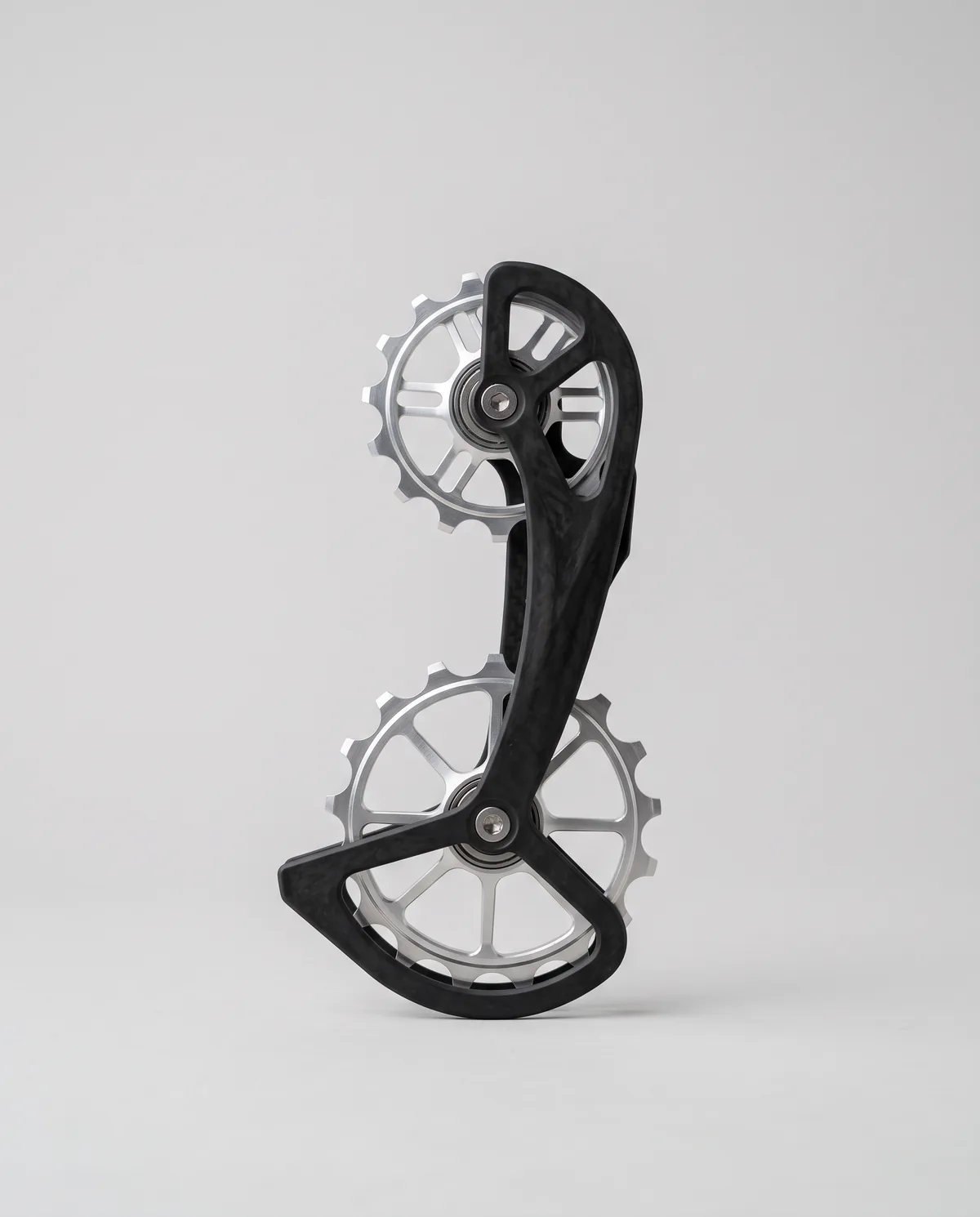
In the rear derailleur, the chain runs over two pulleys. The bigger they are, the less the chain bends and the fewer watts you lose. Size on its own is only worth a few tenths of a watt, though. The cage spring and the bearings matter more. The only independent test we found measured 1.76 W, and a complete system costs about €200 to €600.
1.76 W
How much less the oversized system lost than a stock cage with 11-tooth pulleys, in the independent 2013 test.
−0'30"
What they’re worth on the example gravel ride, 62 km (39 mi) with 780 m (2,560 ft) of climbing, for about €450 of cage and pulleys.
0.25 W
What size alone is worth going from 11 to 15 teeth, with the same bearings and the same chain tension.
21×
How much more each second costs than with a waxed chain on the example gravel ride, €16.07 versus €0.76.
Where the watts go
In the rear derailleur, the chain runs over two pulleys, one above the other. Down here your pedaling isn’t what pulls it tight. The derailleur spring keeps it taut1.
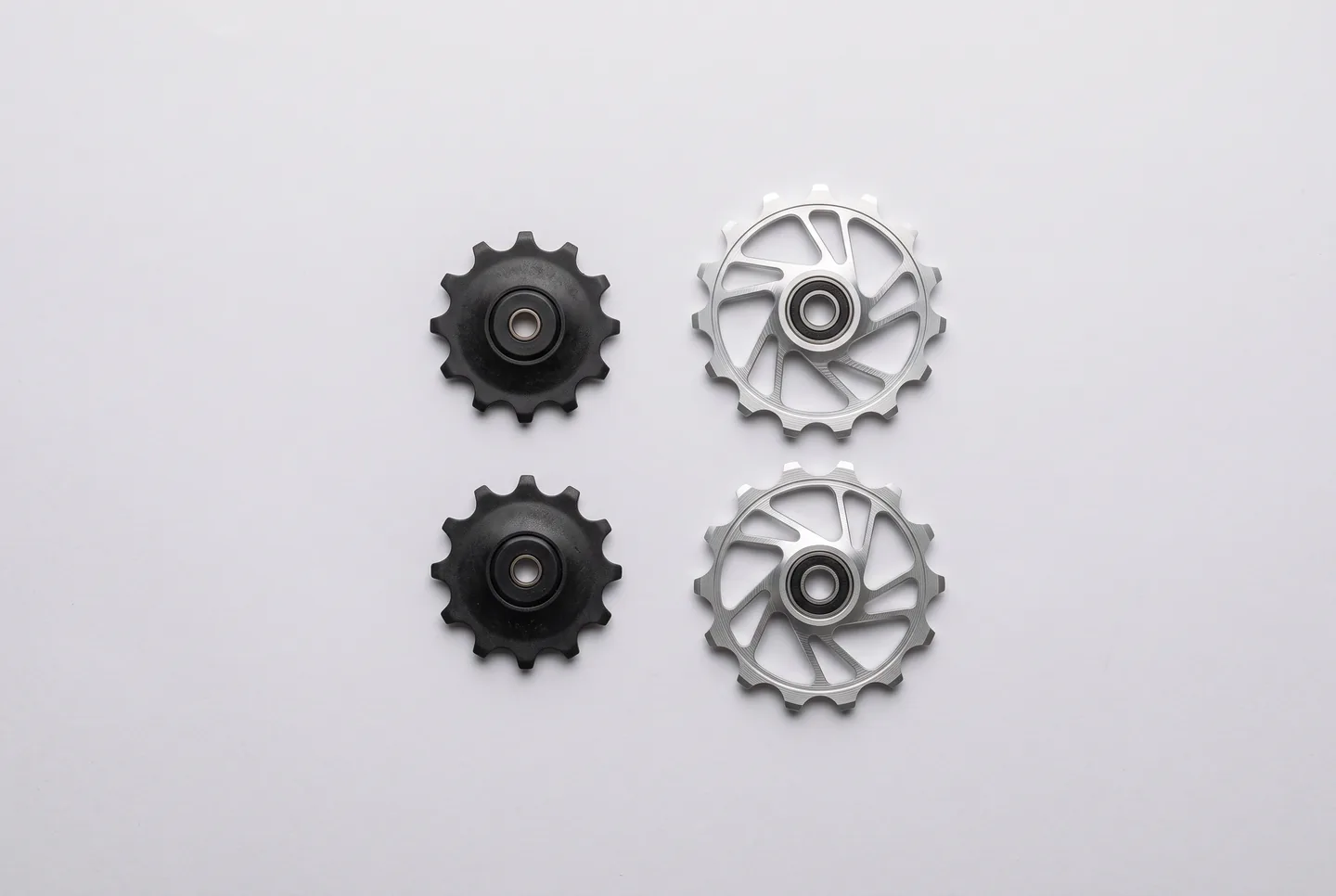
Each link bends as it goes onto a pulley and straightens as it comes off. The smaller the pulley, the more it bends. With 11 teeth it’s about 33° going on and the same coming off, and with 15 teeth it’s 24°. More bending means more friction. A bigger pulley also spins more slowly, so its bearing drags less1.
Two other things matter as well. One is chain tension, meaning how hard the cage spring pulls. The other is how freely the bearings turn. The tighter the chain, the more friction1. That’s why oversized systems change more than the pulleys. They come with their own longer cage and run the chain with less tension1,2.
What the tests say
The independent test. In 2013 Friction Facts, an American lab, bench-tested the friction of pulleys and cages1,3. The lab was independent then. Today the report is republished, unchanged, by the company that bought the lab in 20161,4. The bench ran at 95 rpm in the 53-tooth chainring and 12-tooth cog, with a straight, clean chain and a stated accuracy of ±0.02 W. Each result was the average of three 10-speed chains1. The test had three parts:
- Size only. Same bearings and the same chain tension throughout. Going from 10 to 15 teeth cut friction by 0.49 W, and going from 11 to 15 teeth, a very common size on derailleurs back then, cut it by 0.25 W1,3.
- The bearings. Each pair of pulleys with its own bearings, again with the same chain tension. More on this below1.
- The whole system. Pulleys, bearings and cage together. The stock system with 11-tooth pulleys lost 3.50 W, and the oversized system with 13- and 15-tooth pulleys and its own cage lost 1.74 W. That’s 1.76 W less1,3.
Most of the advantage comes from the cage, which puts less tension on the chain. It’s longer, and the spring hooks on at a different point. At the same chain tension, the pulleys from the two systems were 0.59 W apart. With their own cages, the gap was 1.76 W. The stock cage put 14.19 N of tension on the chain and the oversized one 6.85 N, less than half1,3.
The authors thought that outside the lab, where chains are dirtier, the saving would be even bigger, possibly over 2 W in road racing with a clean chain. That’s a hypothesis they didn’t measure1.
The maker’s own tests. In 2014 Friction Facts tested one maker’s oversized system before it was released. The maker publishes these results itself, alongside the 2013 report. Depending on the spring setting, the stock cage with 11-tooth pulleys lost 3.25 to 3.80 W and the oversized system with 17-tooth pulleys 0.83 to 1.43 W, about 2.4 W less5. When it went on sale in 2015, the maker claimed up to 3 W at 250 W. That’s almost 2.5 W over stock 11-tooth pulleys, plus half a watt more with a chain that isn’t perfectly clean6.
The maker calls these independent measurements6. They aren’t an independent test like the 2013 one, though. They’re tests of its own product, published by the company itself. In 2015 the maker also bought part of Friction Facts’ business, in 2016 it bought the whole lab, and the lab’s founder became its technical director4,7.
WATTS LOST BY PULLEYS AND CAGE, ON THE BENCH
11-tooth pulleysLarger pulleys
2013 · size only
2013 · whole system
2014 · clean chain
2014 · dirty chain
Two things nobody measured. The 2013 report mentions two possible downsides: the weight of a few extra chain links, and a bigger cage that catches more air. It also works out a third. When you’re cross-chained, the sideways load on the lower pulley adds about 0.07 W at most1. One maker says it found no losses in the wind tunnel8. What cross-chaining costs is covered in the guide on 1x vs 2x.
Dirty chain and clean chain
The 2014 tests also used a dirty chain. Friction went up by 1.3–1.4 W with the stock system and by about 0.7 W with the oversized one. The document says a dirty chain loses more where it bends more, which means on the small pulleys. With the dirty chain, the gap between the two came to about 3 W5. This is data published by the maker.
A dirty chain costs you a lot more than that, though. In the Friction Facts lube tests, after an hour of dirt, sand and water, the waxed chain was almost 6 W better than the one with the worst lube9. Clean the chain first, and only then think about pulleys. The chain has its own guide.
The bearings
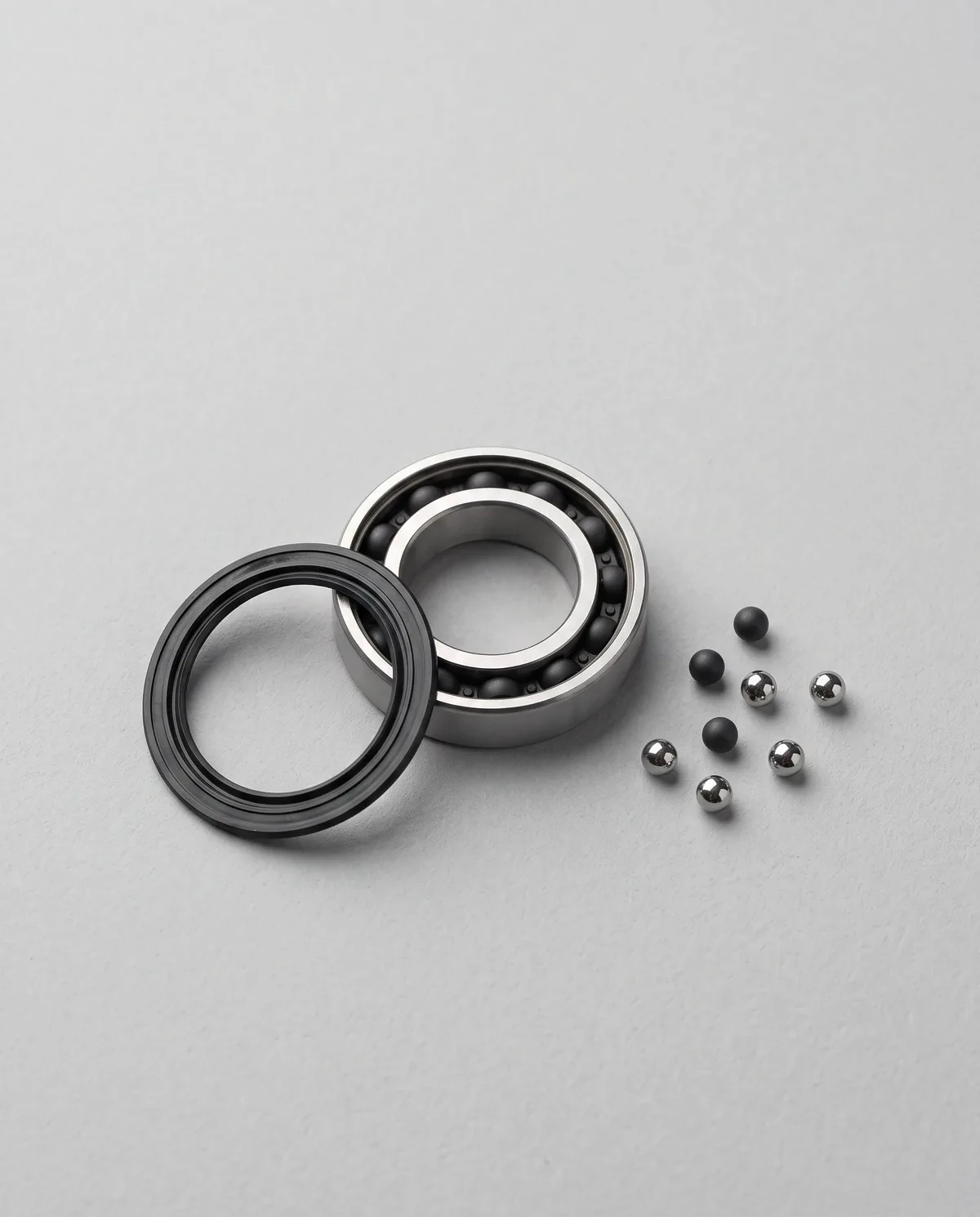
A rough bearing can wipe out the advantage of big pulleys. In the 2013 test, one 15-tooth pair lost 0.13 W more than same-size pulleys with ceramic bearings, and more than a 13/15-tooth pair. The authors thought its bearings were the most likely cause1.
It works the other way too. Two 11-tooth pairs with different bearings were 0.35 W apart. And keeping the stock cage but swapping in other 11-tooth pulleys with better bearings brought friction down from 3.50 to 2.72 W, which is 0.78 W less1.
A maker of oversized systems also says two good bearings lose less than 0.3 W together, and that better bearings gain about 0.1 W. It adds that flicking a pulley with your finger tells you nothing, because what matters is how it turns under chain load10.
What they’re worth on your ride
The calculator counts 1.2 W on the road, with a range of 0 to 2.4 W. On gravel it’s 0.9 W, from 0 to 2 W, and on the MTB 0.5 W, from 0 to 1.5 W. These are fixed watts. We don’t scale them to your power, because here the derailleur spring tensions the chain, not your pedaling1.
We start from 1.5 W, a bit under the 1.76 W from the independent test, because not everyone is starting from 11-tooth pulleys1,11. The test used road gearing and cadence, a 53-tooth chainring at 95 rpm1. On the example road ride the chain moves more slowly, at about 80% of that speed, which gives 1.2 W. The test didn’t try different speeds, so the idea that the gain drops with chain speed is our own calculation. On gravel the chain moves even more slowly, and several recent derailleurs already have pulleys bigger than 11 teeth11. On the MTB the chain moves at about half that speed, and 12-speed derailleurs already come with 12- to 16-tooth pulleys16,17. We didn’t find independent tests for gravel or MTB, so those values are estimates.
The high value starts from the maker’s 3 W, which was measured with a dirty chain. With a clean chain, its tests give 2.4 W at most5,6. We scale that down the same way, to 2.4 W on the road, 2 W on gravel and 1.5 W on the MTB. The 0 W is the worst case: a system whose bearings or spring are worse than stock, or a derailleur that already has big pulleys, where the gain can drop close to zero1,11.
On the example gravel ride, 62 km (39 mi) with 780 m (2,560 ft) of climbing, they’re worth about 0'30", between 0" and 1'00". On that ride, 1 W is worth 31 seconds. On the example road ride it’s about 0'30", between 0" and 1'00", and on the example MTB ride about 0'20", between 0" and 1'00". On your ride it could be more or less, depending on how much you pedal and how fast you go.
What it costs. The calculator counts €450 for a complete system with cage and pulleys, and €550 on the MTB, where they cost more. In online stores they run from about €200 to about €600, depending on the model and the bearings. If your pulleys were worn out and due for replacement anyway, the calculator takes off €20 (€50 on the MTB), the price of a pair of stock pulleys. The card also shows a cheaper option: just pulleys with better bearings in the original cage, for about €150. In the 2013 test that swap was worth 0.78 W1. We don’t calculate it separately.
NUMBERS FROM THE CALCULATOR
On the example ride for each discipline, with a 74 kg rider. Each upgrade is counted on its own, without the others.
ROAD
−0'30"
- Cost
- €450
- Per second
- €15
- Rank
- 10th of 27
GRAVEL
−0'30"
- Cost
- €450
- Per second
- €15
- Rank
- 9th of 26
MTB
−0'20"
- Cost
- €550
- Per second
- €28
- Rank
- 7th of 23
Updated from the calculator on NOVEMBER 18, 2026.
How to choose and how to install
How to choose.
- Count the teeth on your pulleys. The tests compare oversized systems with 11-tooth pulleys. Some recent derailleurs already have bigger ones. A high-end road derailleur released in 2024 has 12 teeth on top and 14 on the bottom11. In that case size alone is worth even less. In 2013, with everything else the same, going from 13 and 13 teeth to 15 and 15 gained 0.17 W1.
- Look at the whole system. Big pulleys with worse bearings, or with a spring that puts more tension on the chain, can give back everything they gain from size1. Look for friction data on the complete system, cage included, and check who did the testing.
- Check compatibility. Each system only fits certain derailleur models. One of the first, in 2015, only fit some 10- and 11-speed derailleurs from one brand6. A 12-speed system fit one model but not another 12-speed derailleur from the same brand2. Check the maker’s compatibility charts.
- Think about the warranty and shifting. Most makers say aftermarket pulleys can void the derailleur warranty12. A softer spring can make shifting worse, and even one pulley maker says to test it carefully8. Road Bike Action reports a rider who got less crisp shifts than with the stock derailleur, even on the setting meant for shifting13.
How to install. Always follow the instructions for the system and the derailleur. In general:
- Remove the wheel and chain. You’ll need the tools listed in the instructions, a torque wrench, a chain tool and a new chain. Set the derailleur where the cage can swing freely without hitting the frame14.
- Release the spring. The cage spring is under tension, so hold the cage with your hand and let it rotate slowly until the spring is unloaded. Then unbolt the stock cage. If the derailleur has a clutch, leave it in the derailleur body. Only the cage comes off14.
- Fit the new cage. Load the spring again by turning the cage in the direction of the arrow, and torque the bolts to spec. On one model the main bolt and the cage stop screw go to 4.5 N·m, and the bolts that clamp the cage around the pulleys to 1.5 N·m, so don’t mix them up. When you’re done, the cage should swing forward smoothly and snap back firmly14.
- Watch top, bottom and direction. The upper and lower pulleys are often different and shouldn’t be swapped, and many have an arrow for the direction of rotation12,15. Unless the instructions say otherwise, use a light threadlocker on the pulley bolts and torque them to the maker’s spec15.
- Fit a new chain. Bigger pulleys need a bit more chain1. One maker says to start with a new, uncut chain and size it following the derailleur maker’s guide, rather than adding links to your old chain8,14.
- Adjust and test. Check the derailleur adjustment and run through every gear before you head out8,14.
If you’re not sure, take it to a mechanic. It’s easy to get wrong, and putting it all back together isn’t simple13.
Maintenance
- Cleaning. One maker says to strip and clean the cage and pulleys every 5,000 km (3,100 mi), or once or twice a year. In harsh or extreme conditions, every 3,000 km (1,900 mi)14.
- Bearings. Wash the parts in degreaser and dry them. If you use compressed air, don’t let it spin the bearings15. Pop the seals off carefully, wash the bearing, add a few drops of oil and put the seals back. When you refit the pulleys, check the direction of rotation14.
- Wear. Replace the pulleys when the teeth get pointed, when they have side play, or when they turn stiffly and make noise. One groupset maker doesn’t give a fixed mileage interval. A worn chain also wears the pulleys, and the other way around12.
When it’s not worth it
If you go by what each second costs. On the example gravel ride, each second costs €16.07 with oversized pulleys. With a waxed chain it costs €0.76, and with tubeless €0.33.
If your derailleur already has big pulleys, size is worth even less, and we found no independent tests on current derailleurs1,11.
If your chain is dirty, clean it first. It costs less and gains you more9.
If you care about crisp shifting and your derailleur warranty, both can suffer8,12,13.
Back in 2013, BikeRadar wrote that under 2 W doesn’t make much difference for an everyday rider3.
Sources
We read every source ourselves. They’re all public pages you can read for free. Prices are approximate, from online stores in November 2026. We don’t link to the stores, because the site doesn’t tell you where to buy.
- Friction Facts, 2013. Independent test. Pulleys from 10 to 15 teeth with the same bearings, pairs of pulleys with their own bearings, and two complete systems with their own cage, on a bench. The original report is section 4 of a document published by CeramicSpeed, which bought Friction Facts in 2016. Document (PDF)
- Bikerumor. An oversized system for a 12-speed road derailleur: modified cage, less spring tension, compatibility with only one model. Article
- BikeRadar, 2013. Friction Facts’ independent test of oversized pulleys: size, bearings, cage tension. Article
- Bicycle Retailer, 2016. The maker of the 2014 tests buys the Friction Facts lab; the lab’s founder becomes its technical director. Article
- Friction Facts, 2014. Data published by the maker. Tests on CeramicSpeed’s oversized system before it came out, with clean and dirty chain and with the spring set in different ways. They’re in section 3 of the same document as the 2013 test. Document (PDF)
- BikeRadar, 2015. The system tested in 2014 goes on sale: watts claimed by the maker, pulleys, compatibility. Article
- Bicycle Retailer, 2015. The maker of the 2014 tests buys Friction Facts’ treated-chain business. Article
- CeramicSpeed. Maker of bearings and oversized systems, the same one as in the 2014 tests. FAQ: chain, spring tension and shifting, wind tunnel tests. Page
- Velo, 2013. Friction Facts tests of chain lubes at 250 W, with clean chains and after an hour of dirt and water. Article (PDF)
- Bikerumor. Three makers of pulleys and oversized systems explain where the saving comes from: size, bearings, spring. Article
- BikeRadar, 2024. Review of a high-end road groupset: the derailleur has 12-tooth pulleys on top and 14 on the bottom, before it had two 12s. Review
- Cycling Weekly, 2026. When to replace derailleur pulleys: signs of wear, warranty, direction of installation. Article
- Road Bike Action, 2022. Oversized pulleys: shifting, installation, warranty, prices. Article
- CeramicSpeed. Installation instructions for one of its oversized systems for a gravel derailleur: tools, spring, torque specs, chain, maintenance. They warn that the derailleur maker doesn’t intend for its cage to be replaced. Instructions (PDF)
- Park Tool. Rear derailleur overhaul: top and bottom pulleys, cleaning, threadlocker, tightening. Guide
- Shimano. Spec page of its top-of-the-range 12-speed MTB derailleur: 13-tooth pulleys. Spec page
- Blister, 2023. Another brand’s new 12-speed MTB groupset: 14- and 16-tooth pulleys, up from 12 and 14. Article