GUIDES · DRIVETRAIN
Ceramic bearings: how many watts they’re really worth.
Ceramic bearings are sold on watts, but independent tests find very few. In a test of 35 bottom brackets, the best ceramic one beat the best steel one by 0.03 W. For hubs we couldn’t find a single public independent measurement. Seals and grease matter more than what the balls are made of.
0.03 W
The gap between the best ceramic bottom bracket and the best steel one, out of 35 tested in the lab. For three of five brands, the steel version ran more freely than the ceramic one.
−0'04"
What ceramic hub bearings are worth on the example gravel ride, 62 km (39 mi) with 780 m (2,560 ft) of climbing, for about €450. A ceramic bottom bracket is worth −0'01" for €250.
0.66 W
The gap between the best and worst lube on the same ceramic bottom bracket bearings. The grease matters more than what the balls are made of.
0 tests
The number of public independent hub bearing measurements we found. The calculator’s high value is based on the 2.9 W claimed by a ceramic bearing seller, who doesn’t say what speed it was measured at.
Where the friction is in a bearing
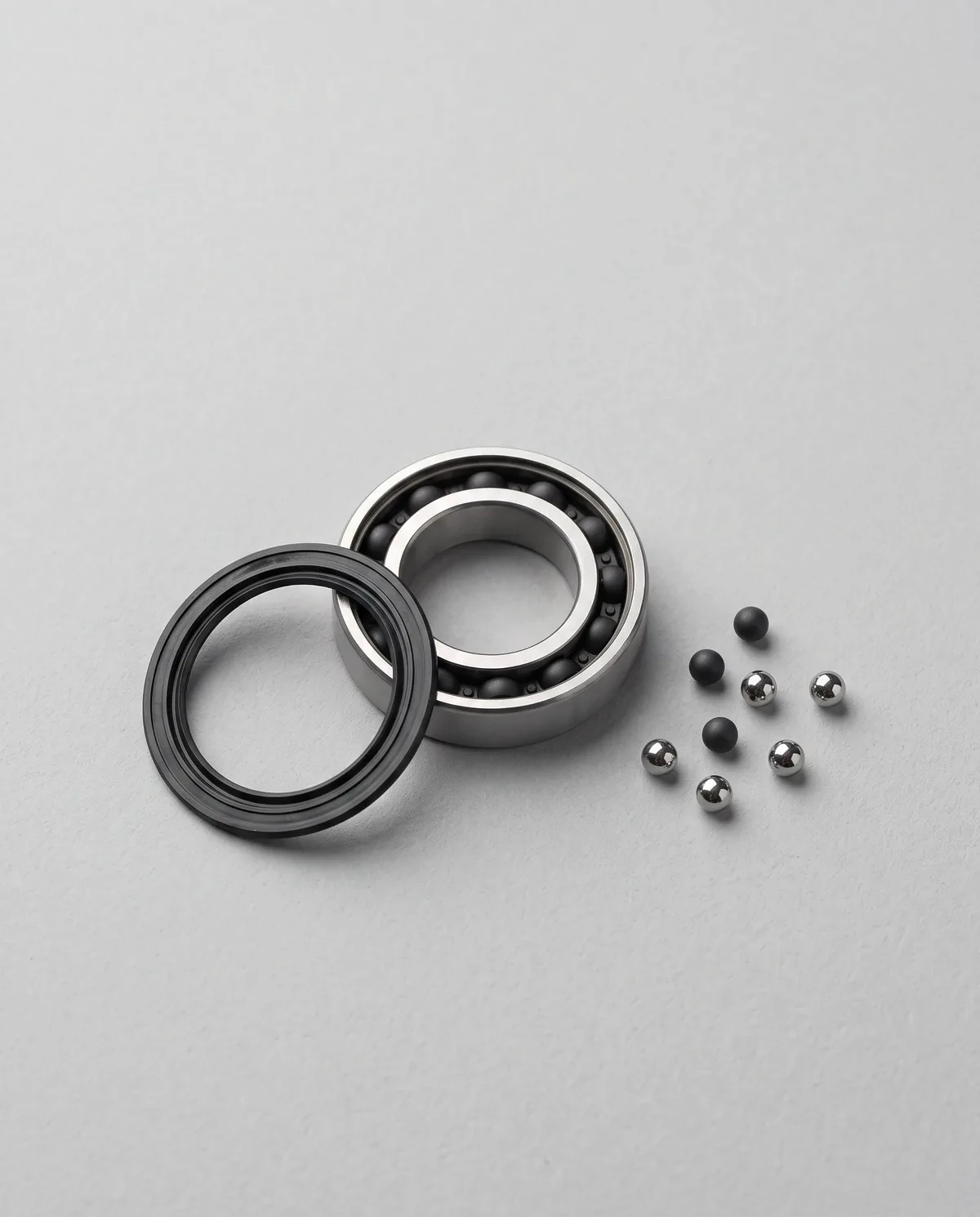
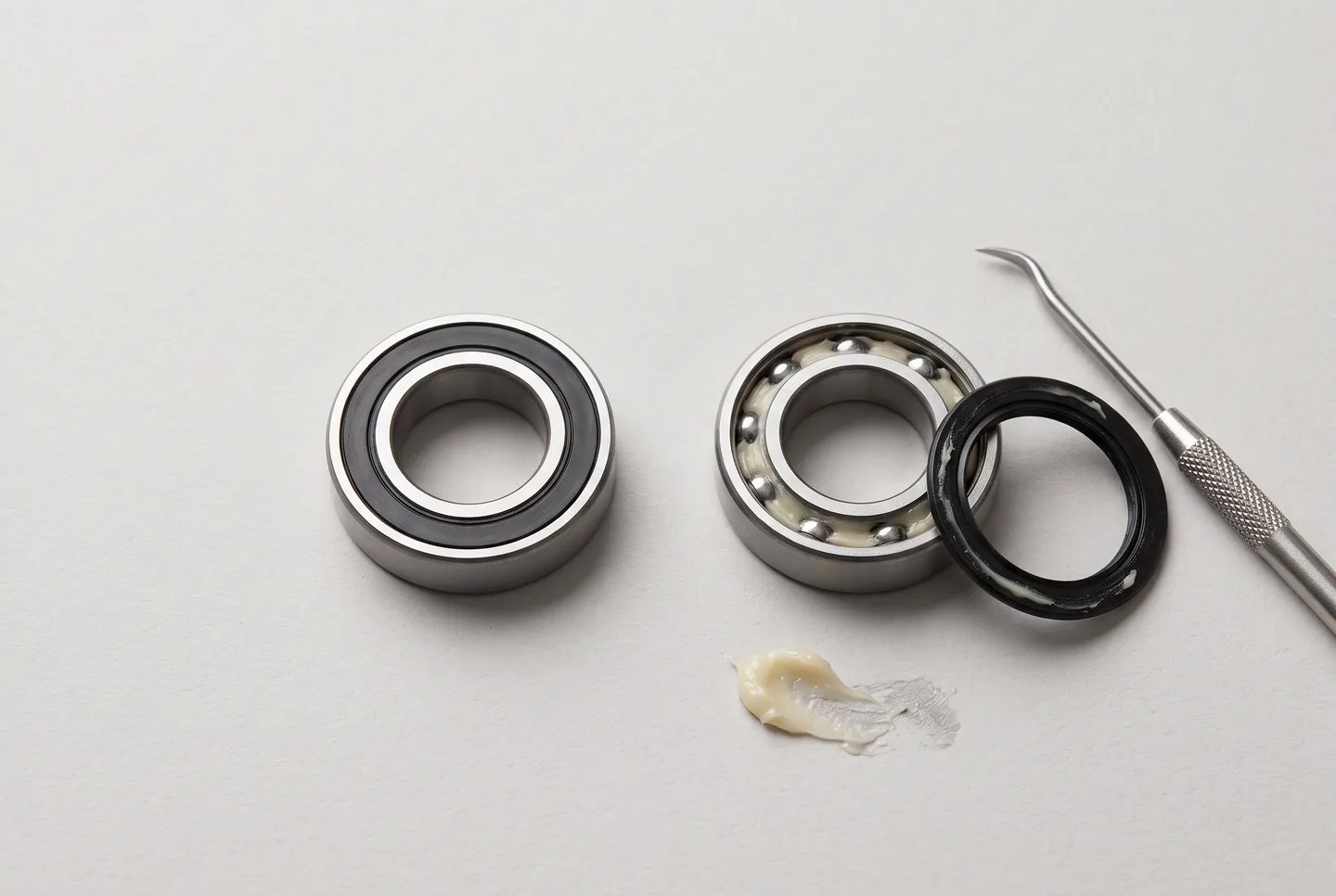
A cartridge bearing has two steel rings, called races, with a row of balls between them held apart by a cage. The seals sit on the sides and the grease is inside. Most “ceramic” bike bearings are actually hybrids, with silicon nitride balls and the same steel races as regular bearings1,2,3.
Friction comes from four places: the balls rolling on the races, a little sliding where they touch, the seals rubbing on the spinning ring, and the lubricant getting churned4,5. Ceramic balls only affect the first two. They’re more than twice as hard as steel and about one and a half times as stiff. A big bearing maker says hybrids have 5 to 8% less friction in its high-speed tests6.
In a sealed bearing, though, rolling is the small part. Hambini, an engineer who also sells bottom brackets and bearings, says the biggest loss is the seal, followed by the lubricant. Working from another bearing maker’s data, he calculates that ceramic balls can remove 3% of the friction at most, and more likely 0.3%1. The same big bearing maker also says contact seals account for a large share of total friction4.
Speed matters too. Ceramic bearings were developed for machines that spin at over 20,000 rpm, where a little less friction saves real energy. On a bike, a hub turns at a few hundred rpm and the bottom bracket turns at your cadence. A maker of hubs and bottom brackets says the difference there is negligible3,7.
Installation matters as well. Preload, meaning how hard the crank pushes on the bearings, should take out the play and nothing more. Overtighten the adjusting cap and the bottom bracket feels notchy, and an overtightened preload adjuster can ruin the bearings8. On cup-and-cone hubs, you want the loosest adjustment that still leaves no play9. We couldn’t find any public measurements of how many watts bad preload costs.
What the tests say
Bottom brackets: measured. In 2013 Friction Facts, an American lab, bench-tested 35 steel and ceramic bottom brackets from 12 brands. Friction ranged from 0.29 to 2.13 W, with an average of 0.77 W. The best ceramic one came in at 0.29 W and the best steel one at 0.32 W, a difference of 0.03 W. Five brands offered the same bottom bracket in steel and ceramic, and for three of them the steel one ran more freely10,11.
The freest-running of them all, that same 0.29 W ceramic, had no contact seals and no grease, and its maker only recommends it for the track and for rollers. Another bottom bracket with identical internals measured 0.31 W in the road version and 0.85 W in the MTB version, which has tougher seals and more, thicker grease. The lab concluded that seals and lubricant matter more than the material10.
Grease and seals: measured. Friction Facts then took three pairs of ceramic bearings from that test and changed only the lubricant and seals. The bench runs at 95 rpm with the average load of someone pedaling at 250 W, and measures to ±0.01 W. With the seals on, the lubricants came in between 0.13 and 0.79 W per pair of bearings. A regular grease measured 0.39 to 0.46 W depending on how much was used, and the best low-friction grease 0.13 W5.
Removing the seals saved 0.11 W with the regular grease and only 0.02 W with a light oil. The lab concluded that if you want a free-running bearing, you’re better off starting with a free-running lubricant and keeping the seals5. The PDF available today is republished by the ceramic bearing maker that bought the lab in 2016, and the lowest-friction grease in the test is that company’s own5,11.
WATTS LOST BY A BOTTOM BRACKET
Version with more frictionVersion with less friction
Best steel or best ceramic
MTB or road seals and grease
Regular or low-friction grease
Hubs: no independent measurements. Friction Facts said it had never run a full test on hubs. Based on its early tests, it estimated that a pair of hub bearings, the ones carrying the load, has about three times the drag of a bottom bracket pair. They’re smaller, but they spin about four times as fast. It put the freehub bearings at about half the bottom bracket. With a regular grease, it estimated about 3.5 W for the bottom bracket and hubs together5.
The number we use as the high value comes from a ceramic bearing seller. In 2016 it had Friction Facts test its bearings, and it paid for at least some of the tests. A pair of hubs lost 5.5 W with stock bearings and 2.6 W with the seller’s. It doesn’t say what speed or load was used, or whether the bearings were new or used12. Also, 5.5 W for the hubs alone is more than the lab’s own estimate for the bottom bracket and hubs together with a regular grease5.
Claimed, without public tests.
- A ceramic bearing maker claims up to 9 W for hubs, pulleys and bottom bracket combined3.
- A wheel brand that uses them says 6 to 9 W for the same parts, citing the bearing maker’s tests2.
- A wheel seller says 1 to 2 W for each hub or bottom bracket, mostly above 40 km/h (25 mph). It mentions “independent studies” but doesn’t say which ones13.
- Taking the other side, a product manager at a big wheel maker says a good steel bearing beats a poor ceramic one, and the gain isn’t worth the price2.
What they’re worth on your ride
In the calculator, a ceramic bottom bracket removes 0.03 W of friction, with a range of 0 to 1.0 W. The 0.03 W is the gap between the best ones in the 2013 test. The 1 W is the seller’s claimed difference between a stock bottom bracket and its ceramic one, 1.57 W versus 0.56 W. In the 2013 test, the worst ball-bearing unit hit 1.64 W and a roller-bearing one 2.13 W10,12. We label it “measured”.
For ceramic hub bearings, the central value is worked out from Friction Facts’ estimate. If each hub has three times the drag of the bottom bracket and the freehub has half, the 0.03 W between the best bottom brackets in 2013 turns into about 0.2 W at the hubs5,10. By the same estimate, hub friction goes up with how fast the wheel spins, and that 0.2 W applies at fast road speeds5. So we scale it to the speed of each discipline’s example ride: 0.15 W on the road, 0.12 W on gravel and 0.06 W on the MTB. The high value is the seller’s 2.9 W difference, scaled the same way because the seller doesn’t say what speed it was measured at: 2.2 W on the road, 1.7 W on gravel and 0.9 W on the MTB. With no independent measurement and a high value from a seller, the entry is labeled “claimed”.
We use these watts as they are, without scaling them to your power. That’s a simplification, because Friction Facts found bearing friction goes up a little when you push harder5.
On the example gravel ride, 62 km (39 mi) with 780 m (2,560 ft) of climbing, a ceramic bottom bracket is worth about 0'01", between 0" and 0'30". Ceramic hub bearings are worth about 0'04", between 0" and 0'50". On your ride it could be more or less, depending on how much you pedal and how fast you go. On the same ride, a waxed chain is worth 1'06" for €50.
What it costs. The calculator counts €250 for the bottom bracket and €450 for the hub bearings. If your bottom bracket needed replacing anyway, we take off €25, the price of a regular one. In online stores, a ceramic bottom bracket costs about €200 to €400 and a steel one about €12 to €57. Ceramic hub bearings cost about €25 to €140 each, and they’re also sold in wheel kits of four, five or six7. A full kit for both wheels runs about €400 to €500. On the example ride that works out to about €250 per second for the bottom bracket and €113 for the hubs. Both land in the bottom half of the ladder, with the hubs close to last.
NUMBERS FROM THE CALCULATOR
On the example ride for each discipline, with a 74 kg rider. Each upgrade is counted on its own, without the others.
| Seconds · cost · rank | ROAD | GRAVEL | MTB |
|---|---|---|---|
| Ceramic hub bearings | −0'04"€45020th | −0'04"€45021st | −0'03"€45021st |
| Ceramic bottom bracket | −0'01"€25024th | −0'01"€25024th | −0'01"€25023rd |
Updated from the calculator on NOVEMBER 18, 2026.
What matters most
- Seals that suit where you ride. Non-contact seals drag less but leave a gap where dust, dirt and water can get in. Light-contact seals add a few hundredths of a watt and keep things cleaner. For mud, MTB and cyclocross, double-lip seals protect better, but they drag more5.
- The right lubricant, in the right amount. A lighter lubricant drags less, but you’ll probably have to reapply it more often. Too much thick oil makes things worse. In the test, friction went up and jumped around, and the lab thought the oil was getting churned and the balls were sliding instead of rolling5.
- The right preload. The crankset’s adjusting cap only needs to be snugged up, between 0.7 and 1.5 Nm on some cranksets. The crank arm itself is held on by the pinch bolts, torqued to the maker’s spec, 12–15 Nm on those same cranksets. If there’s a preload adjuster, it’s only there to take out the play8. On cup-and-cone hubs with a quick release, adjust them with a hair of play while the wheel is off. Closing the quick release flexes the hollow axle and should take the play out. Check with the wheel in, and if there’s still play, tighten a little and try again9.
- Quality before material. In the 2013 test, friction came down mostly to design and quality, not to what the balls were made of10. A wheel maker and even a ceramic bearing maker agree that a good steel bearing beats a poor ceramic one2, and a wheel seller says the same13.
- Replace worn bearings. A cartridge bearing usually can’t be adjusted, so once it’s worn you replace it9.
Durability, dirt and water
One ceramic bearing maker claims its hub bearings last at least three times as long as steel ones, and in an interview it said up to 10 times3,7. We found no independent evidence on lifespan.
Others say the opposite. Ceramic balls are much harder than steel races6, and a hub maker says that pothole impacts make the balls dent the races until the bearing feels rough3. Hambini shows a chart where a ceramic bearing’s friction rises after about 600 km (370 mi), once the balls have worn a track into the races. He doesn’t publish the data or explain how he measured it1.
A company that sells both ceramic and steel bearings ran 10 bottom brackets on a bench for 18 months, with much higher loads than normal. Ceramic balls on chrome steel races, the kind most bearings use, cheap ones included, held up worse than on its own special stainless races. It tested two samples of each type, and the best ones were its own14.
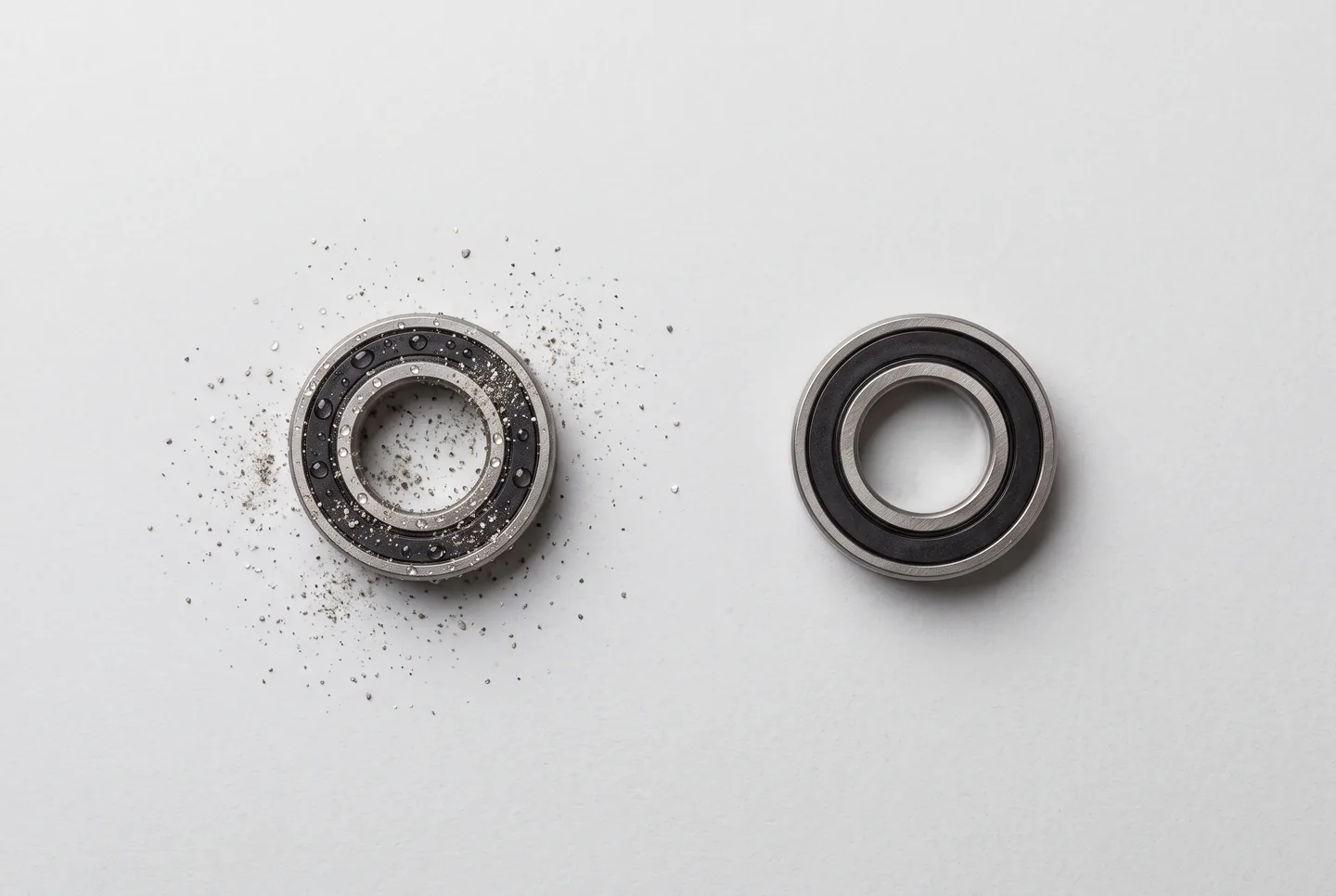
Ceramic balls don’t rust, but the races are still steel1,7. The company that ran the bench test says almost all bike bearings are killed by contamination, from water, salty sweat, dirt and sports drinks, long before load wears them out14.
The maker that claims three times the lifespan expects its bearings to be serviced once or twice a year. It says that’s what allows it to use light-contact seals and freer-running greases2. Lighter seals, though, keep out less dust, dirt and water5. One seller says they need cleaning and lubing more often than steel bearings, and that they’re a worse fit for wet and muddy riding unless they’re very well sealed13. We also have a guide on the maintenance that costs you watts.
Careful with the pressure washer. Don’t point it at the bottom bracket, hubs or headset. They’re packed with grease and they’re some of the most delicate parts of the bike. Start from a distance and move in slowly15.
When it’s not worth it
Almost always, if you go by seconds per euro. On the example gravel ride, a ceramic bottom bracket costs about €250 per second and ceramic hubs €113. On the same ride, new tires, tubeless and a waxed chain each cost less than €1 per second.
If you often ride in the wet or mud. You need tough seals and grease, and they add more drag on their own than ceramic balls can take away. In the 2013 test, the MTB version of one bottom bracket lost 0.54 W more than the road version5,10.
If your bearings spin smoothly, there’s no need to replace them. If they’re rough or have play, they do need replacing, but a good steel bearing costs much less and works better than a poor ceramic one2,9.
Where they can make sense: on dry, clean roads, with light seals and a low-friction grease, and with frequent servicing2,5. Even then, the measured gain at the bottom bracket is a few tenths of a watt, and it comes more from the grease and seals than from the balls5,10.
Sources
We read every source ourselves. They’re all public pages you can read for free. Prices are approximate, from online stores in November 2026. We don’t link to the stores, because the site doesn’t tell you where to buy.
- Hambini. Engineer who also sells bottom brackets and bearings. Where friction in a bearing comes from, hybrid bearings, race wear. The 600 km chart has no data or method. Analysis
- BikeRadar, 2021. Opinions from a maker of ceramic bearings, from a wheel brand that uses them and from a wheel maker that doesn’t use them: claimed watts, servicing, costs. Article
- road.cc, 2015, updated in 2019. Opinions from makers: claimed watts and lifespan, rotation speed on a bike, races marked by potholes. Article
- SKF, 2006. The bearing friction model: rolling, sliding, seals, lubricant. Article
- Friction Facts. Lubricants and seals on three pairs of ceramic bottom bracket bearings, at 95 rpm with the load of someone pedaling at 250 W. With an estimate of hub friction. The PDF is republished, with a 2018 copyright, by the bearing maker that bought the lab. Report (PDF)
- SKF, 2022. Bearing maker. Properties of silicon nitride and friction of hybrid bearings. Article
- Cyclingnews, 2021. Buyer’s guide: rotation speed, claimed lifespan, bearing kits for wheels. Article
- BikeRadar, 2023. How to install a crankset: adjusting cap and preload adjuster. Article
- Park Tool. Adjusting cup-and-cone hubs. Cartridge bearings can’t be adjusted, only replaced. Guide
- BikeRadar, 2013. The Friction Facts test of 35 bottom brackets from 12 brands, steel and ceramic: bench friction, seals and grease. Article
- Bicycle Retailer, 2016. Friction Facts is bought by a maker of ceramic bearings. Article
- CyclingCeramic, 2016. Seller of ceramic bearings. The tests it had Friction Facts run on bottom bracket and wheel bearings, without the test conditions; the hub figure is attributed to Friction Facts only in a table; it paid for at least the pulley test. Comparison · Tests
- Superteam Wheels. Wheel seller. Watts claimed without citing the studies, maintenance, wet and mud. Page
- Enduro Bearings, 2023. Maker of ceramic and steel bearings. Bench durability test on 10 bottom brackets, two samples per type, with amplified loads; the reviewer works for one of its suppliers. Report (PDF)
- BikeRadar, 2025. How to pressure wash a bike without ruining the bearings. Article