GUIDES · TIRES
Road bike tire pressure: where to start.
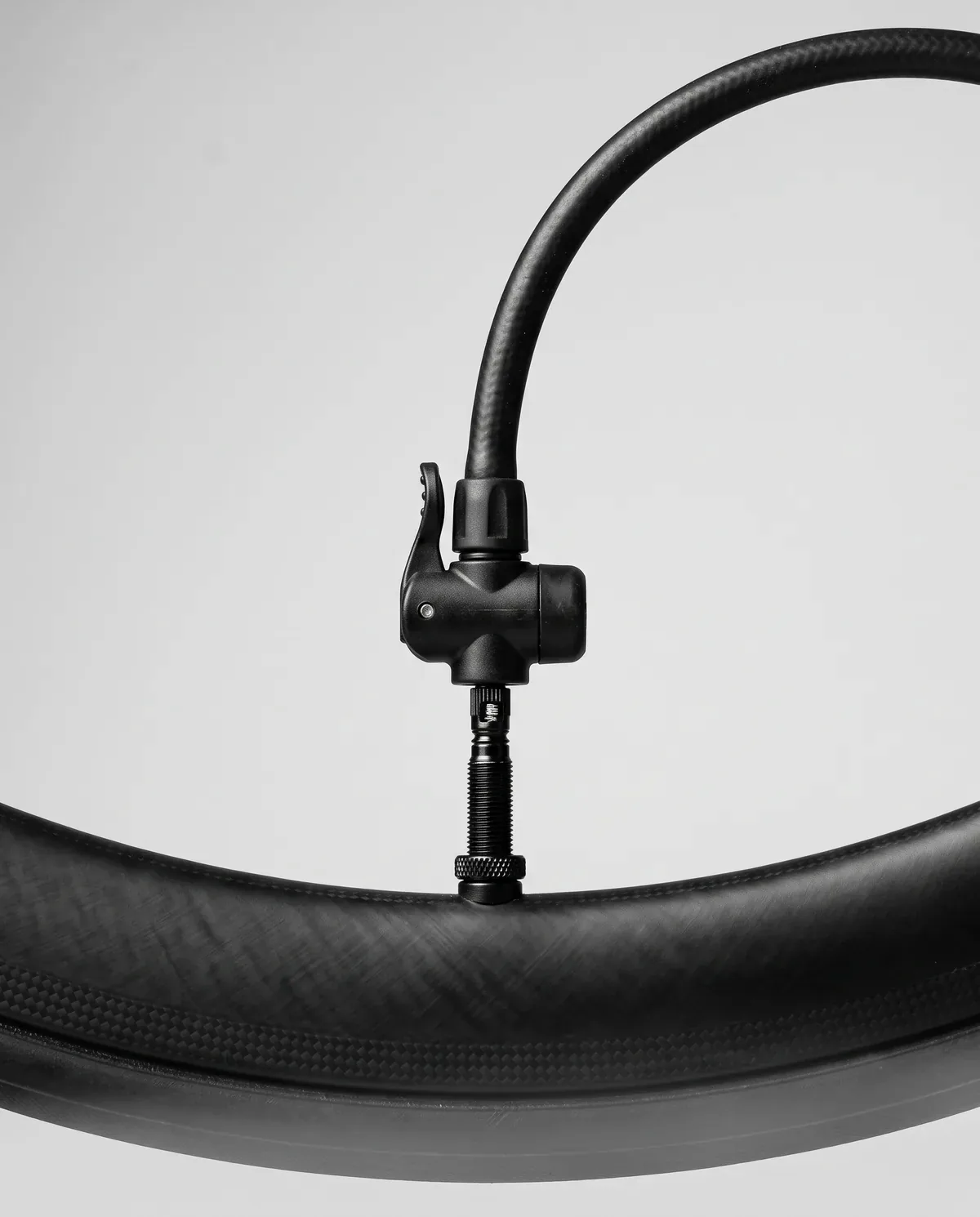
Pumping your tires up to the maximum printed on the sidewall won’t make you faster. In one test, fast-rolling 25 mm tires were as fast at about 5 bar (72.5 psi) as at 9 bar (131 psi), and on rough roads lower pressure is faster. This guide gives you a starting pressure, the limits to stay within, especially on hookless rims (the ones without a hook), and how to measure pressure accurately.
5 bar
The maximum pressure, 72.5 psi, on hookless rims with 25 to 29 mm tires. Wider tires have a lower maximum.
1 W or 9 W
What it cost in a test on fresh asphalt to run 10 psi below the breakpoint, and to run 10 psi above it.
15%
How much the tire compresses at the pressure Frank Berto recommended. It’s a starting point, not a rule.
±5%
How far off a regular floor pump gauge can be.
Why you shouldn’t inflate to the maximum
Before you pump up. These numbers are a starting point, not the right pressure for your bike. Never go over the maximum pressure printed on the tire and the rim, and if the two differ, go by the lower one. On hookless rims the maximum is 5 bar (72.5 psi) even if the tire says more, and it’s lower still with tires 30 mm and up (FIG. 04). Check the minimum too, and if you feel the rim bottom out in potholes, add air.
Bicycle Quarterly tested 25 mm tires at different pressures. On smooth asphalt, the ones with the most supple casings were as fast at about 5 bar (72.5 psi) as at 9 (131 psi). On rough roads, Jan Heine says, lower pressure is faster2.
Above a certain pressure the tire stops soaking up the bumps in the road, and the vibration goes into the bike and into you. SILCA calls that pressure the breakpoint, and the rougher the road, the lower it is3. In a test on fresh asphalt, running 10 psi (about 0.7 bar) under the breakpoint cost about 1 W, and running 10 psi over it cost about 9 W3. If you’re going to miss, miss a little low.
High pressure feels faster because you feel more of the road, but that doesn’t mean you’re actually faster2.
A starting point
Frank Berto measured 50 road tires at 7 pressures and 8 different loads. His rule is to pump the tire up just enough that it compresses by about 15% of its width under your weight1. The more it compresses, the more comfortable and the slower it is. The less it compresses, the harsher the ride1.
BERTO’S CALCULATION, BIKE AND RIDER 91 KG (200 LB)
| TIRE | AVERAGE | FRONT | REAR |
|---|---|---|---|
| 25 mm | 6.1 bar | 5.5 bar | 6.7 bar |
| 28 mm | 5.2 bar | 4.7 bar | 5.8 bar |
| 32 mm | 4.1 bar | 3.7 bar | 4.6 bar |
| 37 mm | 3.2 bar | 2.9 bar | 3.5 bar |
There’s more weight on the rear wheel than the front, so the rear needs more air1. Lighter riders should start lower and heavier riders higher, but always under the tire and rim maximum1.
The 15% doesn’t come from a speed test, though. It was what some tire makers recommended at the time, and the tires he measured were from the 1990s2. It’s a chosen value rather than a measured one, and supple tires compress more at the same pressure2. Use these numbers as a place to start. Then, if you like, try letting a little air out, without going below the tire’s minimum and while keeping an eye on the limits below.
On hookless rims many of the numbers in the table are over the maximum. That’s all three for 25 mm tires, the average and the rear for 28 mm, and the rear for 32 mm. In those cases, go by the maximum in FIG. 04.
The limits you shouldn’t go over
The maximum pressure is printed on the tire and the rim. If the two differ, go by the lower one4.
Hookless rims don’t have the small hook that holds the tire bead in place. On road bikes the maximum is 5 bar (72.5 psi), even if the tire says more4. With wider tires it’s lower:
MAXIMUM WITH HOOKLESS RIMS
| TIRE | MAXIMUM |
|---|---|
| 25–29 mm | 5 bar |
| 30–34 mm | 4.5 bar |
| 35–39 mm | 4 bar |
| 40–44 mm | 3.5 bar |
| 45–54 mm | 3 bar |
The safety margin is small. In testing, the tire has to stay on the rim up to at least 110% of the maximum, which is 5.5 bar (80 psi) for 25 to 29 mm tires5. Your gauge can be off by 5% and pressure goes up in the heat (see below), so on hookless rims stay a little under the limit.
On hookless rims the tire also has to be wide enough for the rim. A 23 mm internal width, for example, needs at least a 28 mm tire, and a 25 mm internal width at least a 29 mm tire5.
Too little air
Running too little air has its own limits2:
- Pinch flats. With an inner tube and too little air, the tube gets pinched between the rim and the edge of a pothole, and it punctures. The fix is a little more pressure or, better still, wider tires.
- Cornering. In fast corners on pavement, you don’t want the tire folding over sideways.
- Casing. At very low pressures the casing threads can break. If you see several lines running across the sidewall where threads have snapped, add air.
Check the minimum pressure printed on the tire too. If you feel the rim bottom out in potholes, add air.
Measure it accurately
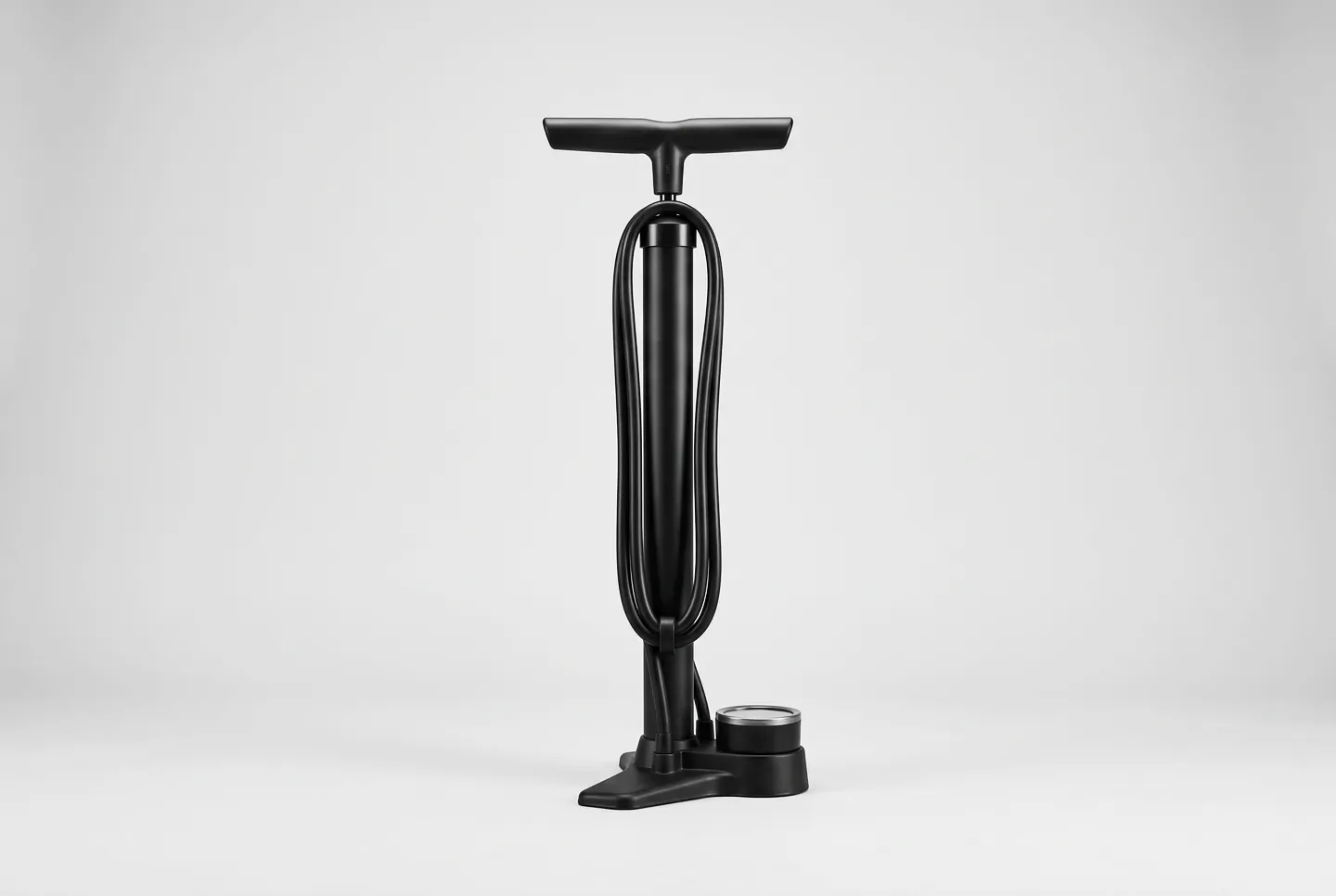
- Gauges aren’t accurate. Josh Poertner of SILCA says a regular floor pump gauge can be off by 5% either way, and over the years it tends to read lower than the real pressure5. In a BikeRadar test, two pumps read about 3% and 6% higher than a digital gauge5.
- Heat raises the pressure. Continental says that for every 10 °C (18 °F) of extra heat, pressure goes up by about 0.17 bar (2.5 psi)5. If you pump up in a cool basement and then ride out into the sun, the pressure in your tires will be higher.
- Check your pressure before every ride.
Berto doesn’t think the 15% rule works for mountain bike tires1, and this guide doesn’t give numbers for off-road. For how speed changes with tire width, see the guide on 28 vs 32 mm tires, and for rolling resistance, the guide on Crr.
Enter your ride in the calculator to see what faster-rolling tires are worth next to the other upgrades.
Sources
We read every source ourselves. They’re all public pages you can read for free. Rene Herse, Schwalbe and Continental make tires, and SILCA makes pumps and gauges.
- Frank Berto. “All About Tire Inflation”: 50 road tires at 7 pressures and 8 loads, the 15% rule, the 45/55 front/rear weight split and the example of a 170-pound rider on a 30-pound bike. The PDF is a reprint. Article (PDF)
- Rene Herse / Bicycle Quarterly. Jan Heine on tire pressure: where the 15% comes from, the tests on smooth and rough asphalt, the limits of low pressure. Article
- SILCA. The breakpoint pressure and the test on new asphalt: 10 psi below, about 1 W; 10 psi above, about 9 W. Article
- Schwalbe. Hookless rims: a maximum pressure of 5 bar (72.5 psi) under ETRTO and a table by tire width; if the rim’s maximum is lower, that one applies. Page
- BikeRadar. Hookless rim safety: ETRTO and ISO limits by width, the 110% test, the effect of temperature according to Continental, gauge accuracy and a test of two pumps. Article