GUIDES · DRIVETRAIN
Ideal cycling cadence: how fast to pedal.
Cadence is how many full turns your pedals make in a minute. There’s no single right cadence for everyone. On the flat, trained cyclists settle on around 90 rpm on their own. The cadence that uses the least oxygen is lower, around 60 at moderate power. At the same watts you go the same speed at any cadence. What changes is how hard you push on each pedal stroke, and what that costs you.
89 rpm
The average cadence of seven pros on flat Grand Tour stages. In time trials it was 92, and on long climbs 71.
90–100
The rpm that highly trained cyclists and runners chose on their own, from 75 to 250 W.
53–60
The rpm that used the least oxygen in the same study, in every group, between 75 and 200 W.
+50%
How much harder you push on each pedal stroke at 60 instead of 90, at the same watts. Your speed doesn’t change.
The cadence you choose on your own
Marsh and Martin let 12 cyclists, 10 runners and 10 less-trained men choose their own cadence. The cyclists and runners, all highly trained, stayed between 90 and 100 rpm at every power output, from 75 to 250 W. The less-trained men pedaled slower, and the higher the watts, the lower they went. They dropped from about 80 rpm at 75 W to about 65 at 175 W2.
Pros do the same in races. Lucía and colleagues measured seven riders at the Giro, the Tour and the Vuelta. They averaged 89 rpm on flat stages, 92 in time trials and 71 on long climbs of about 15 km (9 mi)1.
Brennan and colleagues tested 14 people who were comfortable on a bike but didn’t race. They rode at 2.5 W/kg and couldn’t see their cadence. On average they chose 81 rpm, with a lot of variation from one person to the next5.
SELF-CHOSEN CADENCE
| WHO | RPM |
|---|---|
| Pros, long climbs | 71 |
| Non-racing adults, 2.5 W/kg | 81 |
| Pros, flat stages | 89 |
| Pros, time trials | 92 |
| Trained cyclists and runners, 75 to 250 W | 90–100 |
| Less-trained men, 75 to 175 W | 80 to 65 |
The most economical cadence
In the lab you can measure how much oxygen it takes to put out the same watts at different cadences. In Marsh and Martin’s study, the cadence that used the least was between 53 and 60 rpm in all three groups. Between 75 and 200 W it changed little with the watts. Everyone chose a higher cadence on their own2.
Chavarren and Calbet found the same in seven road racers. At every intensity, they used less oxygen at 60 rpm than at 80, 100 and 120. But the harder they pushed, the less cadence mattered3.
At high watts the most economical cadence goes up. In six elite cyclists, of the four cadences tested (60, 80, 100 and 120), the most economical was 60 with no load and 80 at 350 W. In the incremental test to exhaustion, which lasted about 5 minutes, they held on longest at 80, the cadence that used the least oxygen at 350 W4.
Why riders spin faster
If 60 uses less oxygen, why do almost all riders choose a higher one? According to Marsh and Martin, saving oxygen isn’t what sets cadence in trained cyclists. The runners chose the same cadence as the cyclists, so cycling experience doesn’t matter either2.
Chavarren and Calbet found that the higher the power, the less a high cadence hurts efficiency. The authors say this may explain why racers pedal at 90 to 105 rpm in long, hard efforts3.
Brennan and colleagues looked at one of the thigh muscles with ultrasound. At the self-chosen cadence, that muscle was best placed to produce power without losing efficiency. But the whole body used more energy than at 60 rpm5.
There’s some simple math too. Watts are the force on the pedals times how fast they turn. At the same watts, if you turn them slower you have to push harder.
AT 200 W, AT ANY CADENCE
| CADENCE | TORQUE | FORCE VS. 90 |
|---|---|---|
| 50 rpm | 38.2 Nm | +80% |
| 60 rpm | 31.8 Nm | +50% |
| 70 rpm | 27.3 Nm | +29% |
| 80 rpm | 23.9 Nm | +13% |
| 90 rpm | 21.2 Nm | — |
| 100 rpm | 19.1 Nm | −10% |
Your speed doesn’t change, though. At the same watts you go the same speed at any cadence. Cadence changes what those watts cost you, and so how many watts you can hold. None of these studies says how many seconds that’s worth. That’s why our calculator doesn’t ask for your cadence.
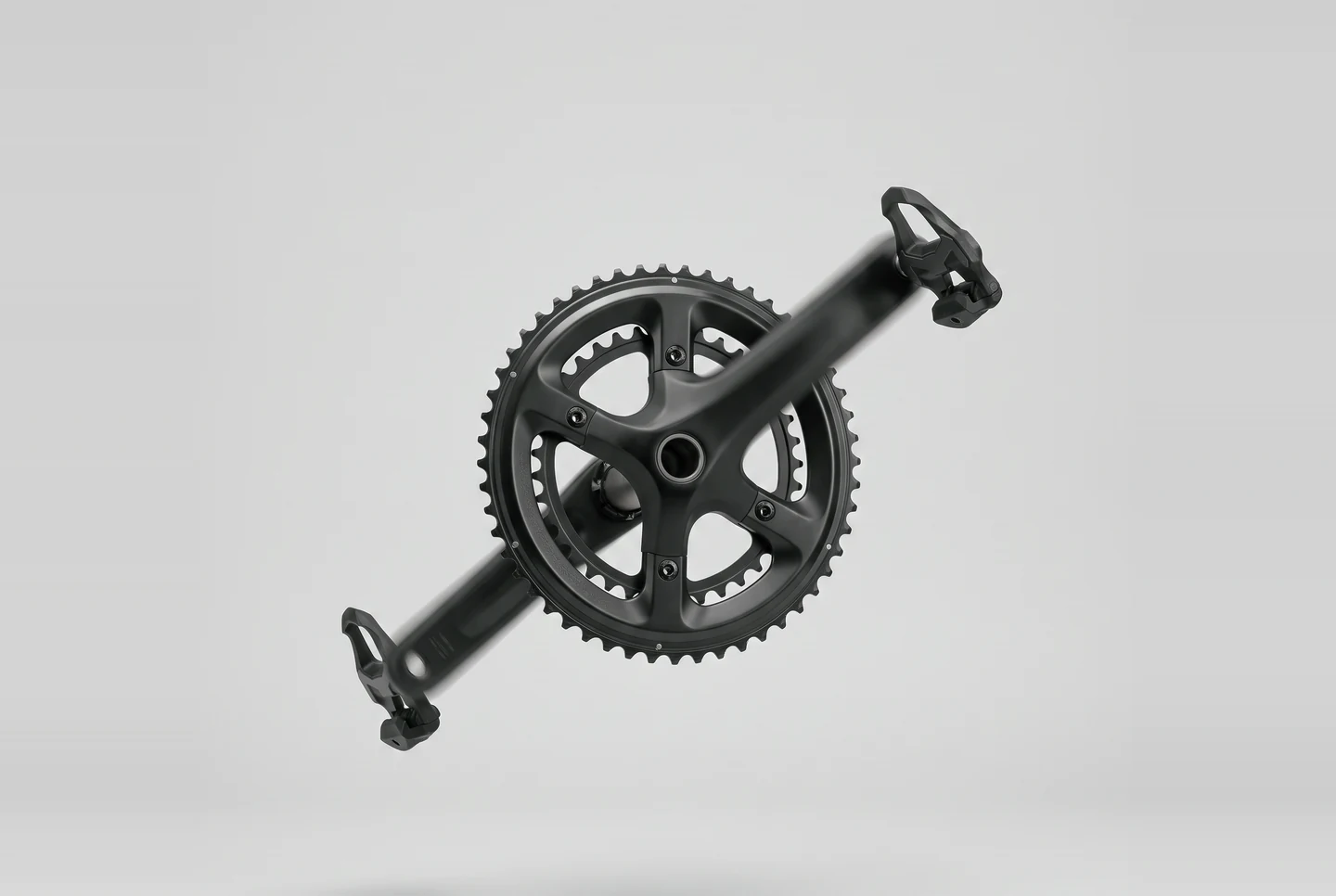
At the same cadence and watts, a shorter crank also takes a little more force. There’s a guide on 165, 170 or 172.5 mm cranks.
Climbing
On climbs the pros’ cadence dropped, from 89 rpm on the flat to 71 on long climbs1.
On climbs your gearing matters a lot. With the calculator’s model, a 74 kg (163 lb) rider at 200 W on an 8% grade pedals at about 76 rpm in 34×34 and about 55 in 39×28. At 150 W in 34×34, it’s about 58. An easier gear means you push less on each pedal stroke at the same speed. There’s a guide on road bike gearing, and to run the numbers for your own gears there’s the bike gear and speed calculator.
Low-cadence training
A lot of riders train at low cadence with big-gear hill repeats, climbing seated in a hard gear.
Low means lower than the cadence you’d choose on your own, so it depends on your watts. At low power you have to drop below 80, for example to somewhere between 40 and 70. At maximal effort, even 80 can be a low cadence6.
Hansen and Rønnestad pulled together seven studies on low-cadence training. They didn’t find strong evidence that it improves performance. In some studies, the riders who trained at their self-chosen cadence did better6.
The authors still say you can try adding a few low-cadence sessions to your training, at moderate to maximal intensity. They say it with caution, because there were few studies and they were very different from each other6. The review covers low-cadence training in general. It doesn’t look at big-gear hill repeats in particular.
Which cadence to use
On the flat, if you’re trained, let it settle on its own. In the studies, trained cyclists stayed around 90 rpm and non-racing adults around 801,2,5. Even on flat stages of about 190 km (118 mi), the pros stayed around 901. There’s no evidence that forcing it higher or lower makes you faster on the road.
If you put out a lot of watts, the most economical cadence goes up. In six elite cyclists it was 80 at 350 W, not 604.
If you’re less trained, it’s normal for your cadence to be lower, and to drop when you push harder2.
On climbs, if you’re often below 60 even in your easiest gear, you need an easier gear. The 60 rpm line is our own choice. No study points to it.
What the studies don’t tell us
The studies are small, from six to 32 people1,2,3,4,5. Apart from the pros, they’re all short lab tests. None of these studies measured times on a real ride at different cadences.
Sources
We read every source ourselves. They’re all public pages you can read for free.
- Lucía, Hoyos and Chicharro, 2001. Medicine & Science in Sports & Exercise. Cadence of seven pros at the Giro, the Tour and the Vuelta: 71.0 rpm on long climbs, 89.3 on flat stages, 92.4 in time trials. Abstract
- Marsh and Martin, 1997. Medicine & Science in Sports & Exercise. 12 cyclists, 10 runners and 10 less-trained men: self-chosen cadence at different powers and oxygen use at 50, 65, 80, 95 and 110 rpm. Abstract
- Chavarren and Calbet, 1999. European Journal of Applied Physiology. Seven road racers at six intensities and four cadences, from 60 to 120 rpm: oxygen use and efficiency. Abstract
- Foss and Hallén, 2004. European Journal of Applied Physiology. Six elite cyclists at 60, 80, 100 and 120 rpm: the most economical cadence rises from 60 rpm with no load to 80 rpm at 350 W. Abstract
- Brennan and colleagues, 2019. Medicine & Science in Sports & Exercise. 14 non-racing adults at 2.5 W/kg, from 40 to 100 rpm and at their self-chosen cadence: energy use and how one of the thigh muscles works. Article
- Hansen and Rønnestad, 2017. International Journal of Sports Physiology and Performance. Review of seven studies on low-cadence training. Abstract