GUIDES · AERODYNAMICS
Bikepacking bags: how much they slow you down.
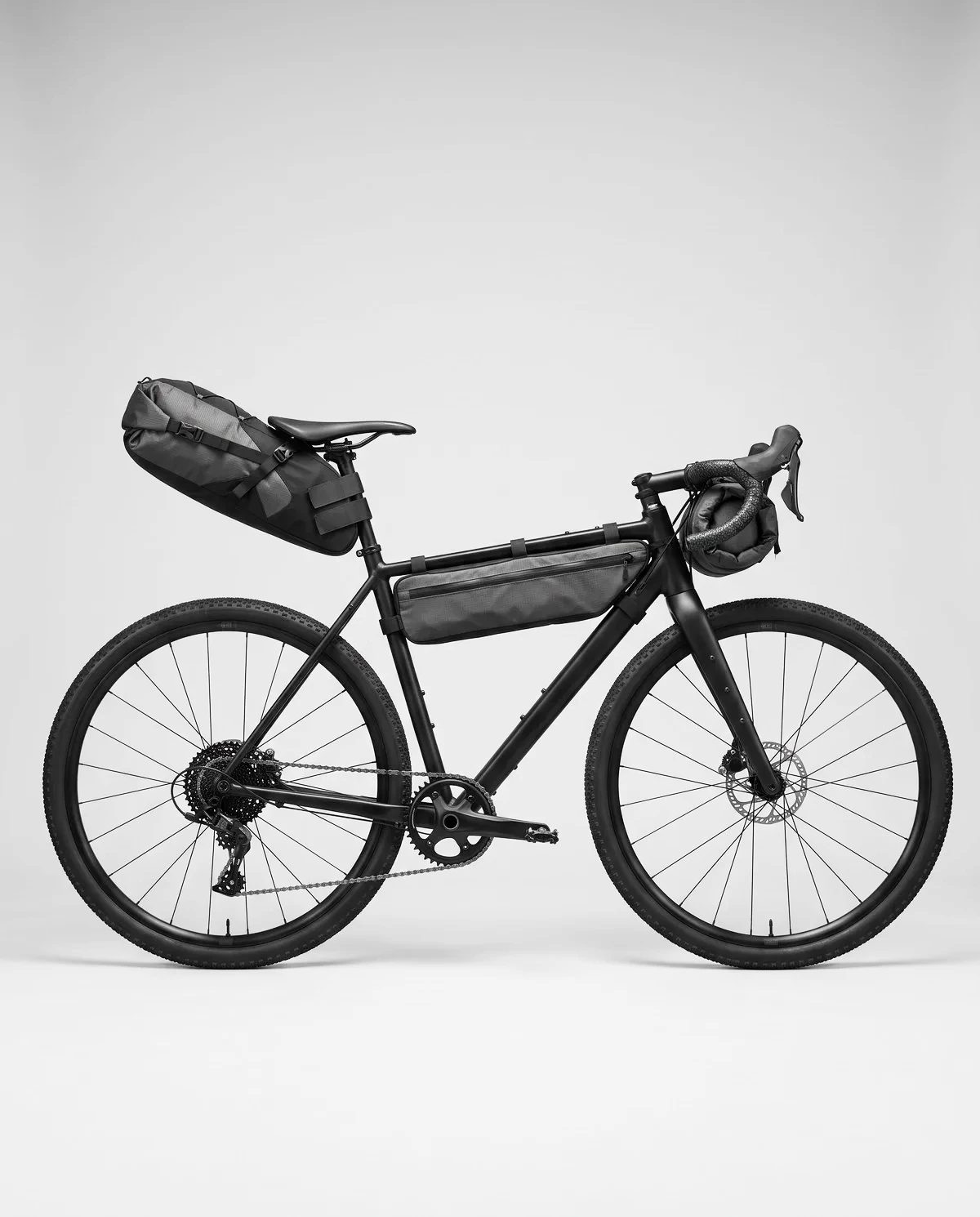
Bags cost you little when they sit behind you, and more when they stick out in front or to the sides. Most of the tests we found say the same, whether in a wind tunnel, a velodrome or on the road. In the calculator’s model, the full load from one wind tunnel test costs almost 9 minutes over a hilly 100 km (62 mi) at 150 W. Leaving 5 kg (11 lb) of gear at home saves almost 7.
+8'38"
The cost of the full load from a wind tunnel test over a hilly 100 km (62 mi) at 150 W. On the flat it’s 11'47".
+0.031 m²
The extra CdA from a wide handlebar roll compared with a narrow bag, in a road test. That’s about 5 minutes over 100 km (62 mi) on the flat.
about 0
The cost of a seat pack tucked in behind you, in the same road test.
−6'52"
What you save by leaving 5 kg (11 lb) of gear at home over the same hilly 100 km. On the flat it’s 2'11".
Behind you is cheap
Most of the air you push is pushed by your body. A bag that sits in your wake, behind your legs or under the saddle, doesn’t add much. A bag that sticks out in front of the bars or out to the sides of the wheels hits the air first, and it usually costs more.
Most of the tests we found point the same way134. On the road, the seat pack made no difference, and a rack bag behind the saddle was a touch faster than the bike with no bags at all4. Panniers always cost something, front or rear134.
On the handlebar, shape matters. The wide roll was the worst item in the road test, while a narrow aero bag used with aero bars did a touch better than no bag4. A wind tunnel test by an American magazine found a handlebar bag more aero than a seat pack2. It doesn’t give numbers, so we leave it out of our calculations.
What the tests say
THE TESTS, ONE BY ONE
| WHAT | HOW MUCH |
|---|---|
| VELODROME, 200 W, COMPARED WITH BIKEPACKING BAGS | |
| Two large panniers, front or rear | −6.5% in speed |
| Four large panniers | −7.9% in speed |
| WIND TUNNEL, 25 KM/H (16 MPH), ITEMS ADDED ONE AT A TIME | |
| Two bottles on the fork | +3 W |
| Plus a 2.5-liter handlebar bag | +8.5 W |
| Plus a rack bag behind the saddle | about +6.5 W |
| Plus panniers and a frame bag | +15.8 W |
| ROAD, EXTRA CdA | |
| Handlebar roll, compared with a narrow bag | +0.031 m² |
| Two 22-liter panniers, compared with the rack bag alone | +0.009 m² |
| Rack bag, compared with the bike with no bags | −0.005 m² |
| Seat pack, compared with the bike with no bags | about 0 |
In the velodrome, on a touring bike at about 200 W, the rider did 30.2 km/h (19 mph) with bikepacking bags. With two large panniers front and two rear, that dropped to 27.8 km/h (17 mph), 7.9% slower, or about 17 minutes over 100 km (62 mi). With only two panniers the loss was 6.5%, about 13 minutes, and front or rear made little difference1. The weight was the same, but the panniers had almost twice the volume, and there was no run without bags.
In the wind tunnel at 25 km/h (16 mph), items were added one after another. Two bottles on the fork cost 3 W. Adding the 2.5-liter handlebar bag brought it to 8.5 W, so the bag alone cost about 5.5 W. The rack bag behind the saddle took off about 2 W. With panniers and a frame bag it reached 15.8 W23.
On the road, on a gravel bike with aero bars and the same frame bag for every run, the handlebar roll was the worst item, adding 0.031 m² of CdA over a narrow bag. The author’s own simulation put that at seven and a half minutes over 180 km (112 mi) at 200 W and 35 km/h (22 mph). The two 22-liter panniers added 0.009 m² over the rack bag alone4.
Panniers vary more between tests than anything else. It depends on how big they are, where they’re mounted and how far they stick out past your legs.
In another wind tunnel, in Belgium, the brands that ran the test say an unoptimized bikepacking setup could cost up to 17.5 W at 40 km/h (25 mph). They don’t say what it was compared with5. At 25 km/h (16 mph) that would be about 4 W.
In a wind tunnel the air is steady and the rider doesn’t move. On the road, crosswinds change the numbers, and panniers catch them the most12.
What it’s worth on a ride
100 KM (62 MI) OF BIKEPACKING AT 150 W
| EXTRA | HILLY | FLAT |
|---|---|---|
| Two bottles on the fork | +1'31" | +2'21" |
| 2.5-liter handlebar bag | +2'45" | +4'16" |
| Handlebar roll instead of a narrow bag | +3'06" | +4'49" |
| Two large panniers | from +55" to +3'29" | from +1'25" to +5'25" |
| The full load from the wind tunnel test | +8'38" | +11'47" |
| 5 kg (11 lb) less luggage | −6'52" | −2'11" |
Bags cost more on the flat, because you’re going faster and air matters more. Uphill, at 15–20 km/h (9–12 mph), they matter less. In the hills, weight matters more. Carrying 5 kg (11 lb) less saves almost 7 minutes, more than any single bag.
These are model calculations, based on tests that each used one rider and one bike. Your numbers may differ, but in most tests the order holds. Bags in front and at the sides cost you, and bags behind you cost much less.
Bags aren’t the only thing that matters. In a test cited in the same roundup, at 32 km/h (20 mph), a loose jacket added 8% more drag and raising the handlebar by 20 mm (0.8 in) added 5%2. We have a guide on riding position.
How to pack your bike
- Carry less. In the hills, 5 kg (11 lb) less is worth more than any single bag. In the calculator’s model that’s 6'52" over 100 km (62 mi) with 1,000 m (3,280 ft) of climbing. We have a guide on weight.
- Put the load behind you. The seat pack sits in your wake, and on the road it made no difference4. The frame bag sits between your legs, but no test measured it on its own.
- Keep the handlebar bag small and narrow. The wide roll was the worst item on the road4. A narrow bag cost much less, or nothing at all.
- Only use panniers if you need them. They always cost something, anywhere from a little to a lot depending on the test134.
- Keep bottles in the frame if you can. Two bottles on the fork cost 3 W at 25 km/h (16 mph)3.
The calculator doesn’t have an item for bags, but you can enter your CdA and the weight of the loaded bike to see what the other upgrades are worth on your trip.
Sources
We read every source ourselves. They’re all public pages you can read for free. Three of the five sources are published by a bag maker or report numbers from the brands involved, and we note that next to each one. Ride times come from the calculator’s model.
- Denham, CyclingAbout, 2016. Velodrome test in Melbourne, at about 200 W with a power meter: bikepacking bags against front panniers, rear panniers, and front and rear panniers, 20 laps per setup, in a single day. Article
- Denham, CyclingAbout, 2020. Roundup of tests on the aerodynamics of bikepacking and bike touring: the wind tunnel test in source 3 with the setups added one after another, an American magazine’s test of the handlebar bag, the limits of the wind tunnel, jacket and handlebar height. Article
- Wind tunnel test, 2020. An English cyclist and YouTuber with an English aerodynamics lab, at 25 km/h (16 mph). Published on the blog of a bag maker, which makes the rack bag and the panniers tested. The table on the page doesn’t say what each item is measured against. Article
- Road test, 2021. 107 runs on a 1 km (0.6 mi) loop with power and speed (Chung method), on a gravel bike with aero bars. The test is by a rider from outside the company, but it’s published on the same bag maker’s blog, and almost all the setups use its rack. Article
- Rook, Cycling Weekly, 2022. Test in the Bike Valley wind tunnel, in Belgium: numbers stated by the brands involved, including a bag maker, with no method given. Article