GUIDES · TRAINING
FTP and W/kg: what they are and what counts as good.
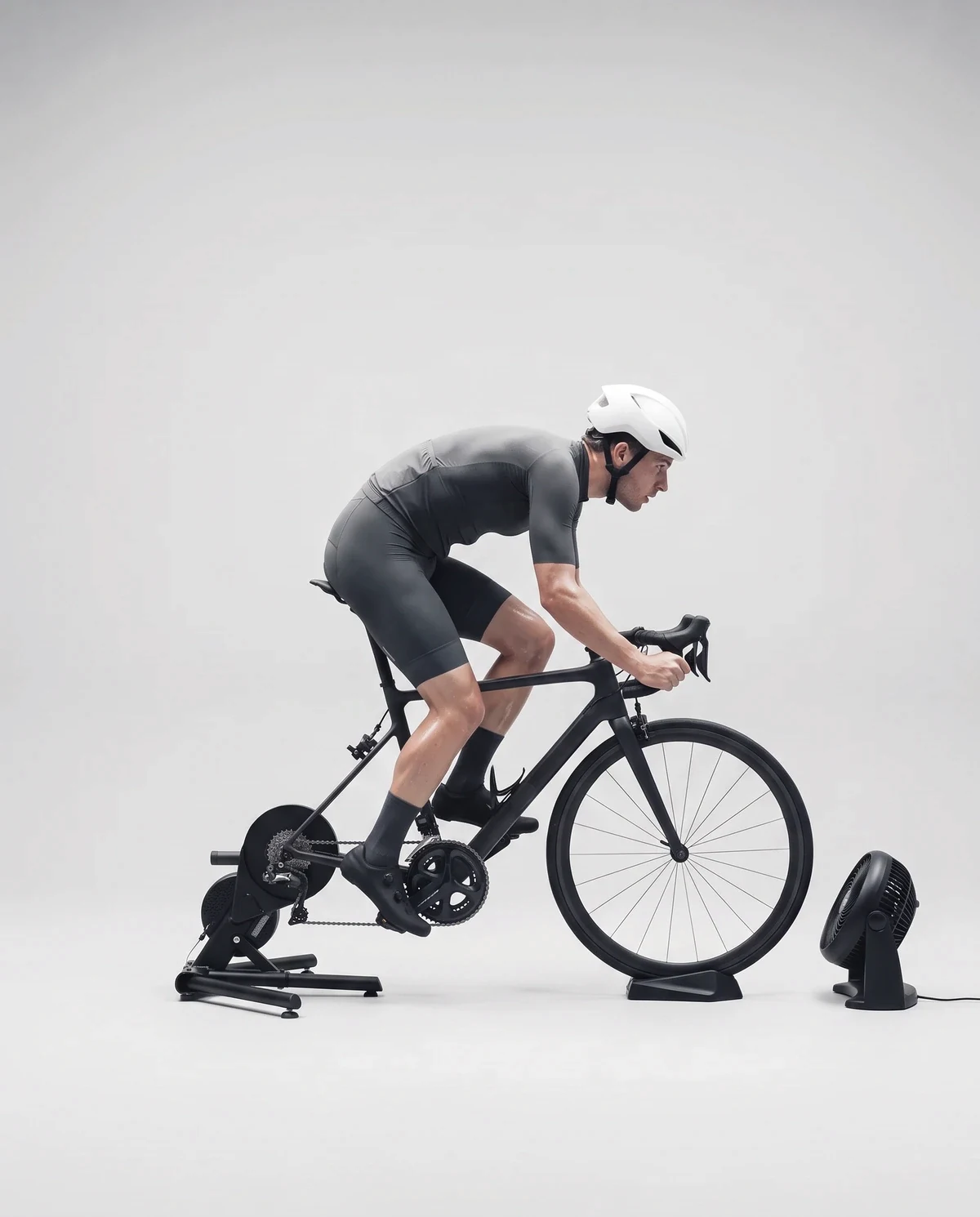
FTP is the highest power you can hold for about an hour. Divide it by your weight and you get W/kg, the number that matters on climbs. There’s no single “good” FTP, because it depends on age, sex and training. This guide has two reference tables, what they actually tell you, and how to do the test.
4.00 W/kg
The median for men aged 40 to 49, in a sample of riders who train with a power meter.
95%
To get your FTP from a 20-minute test, take 5% off your average power.
51 min
In one study, riders held the power estimated from a 20-minute test for this long on average, well short of an hour.
2.9%
The average change in competitive cyclists’ 20-minute test results when they repeated it several times, in one study.
What FTP and W/kg are
FTP stands for “functional threshold power”, the highest average power in watts you can hold for about an hour27. It’s mostly a training tool, since training zones are set as percentages of FTP27.
For the zones and how many watts they work out to with your FTP, there’s a guide on cycling power zones.
W/kg is your FTP divided by your weight. A 75 kg (165 lb) rider with 250 W is at 3.33 W/kg. On climbs this is the number that matters most. A 90 kg (198 lb) rider with 300 W and a 60 kg (132 lb) rider with 200 W both have 3.33 W/kg and climb at about the same pace, but on the flat the heavier one drops the lighter one3. We have a guide on how much weight matters and one on the watts you need to climb.
What’s a good FTP
The standard table comes from Hunter Allen and Andrew Coggan, who came up with the FTP test2. Here are the categories the Garmin manual takes from it, in W/kg, for men and women1:
FTP IN W/KG, GARMIN MANUAL CATEGORIES
| LEVEL | MEN | WOMEN |
|---|---|---|
| Superior | from 5.05 | from 4.30 |
| Excellent | 3.93–5.04 | 3.33–4.29 |
| Good | 2.79–3.92 | 2.36–3.32 |
| Fair | 2.23–2.78 | 1.90–2.35 |
| Untrained | under 2.23 | under 1.90 |
The book’s table is more detailed, with nine levels from “Novice” to “World Class”2. But Coggan designed FTP for building and tracking your own training, not for comparing riders2. Comparing yourself with others is interesting but not very useful. How your own FTP changes over time matters more2.
To see which category your FTP or a test result puts you in, try the FTP and W/kg calculator.
By age
A Faster You, an online coaching company, has published its athletes’ W/kg by age and sex, covering 1,710 riders with one value each3.
MEN, BY AGE
| AGE | MEDIAN | TOP 10% | RIDERS |
|---|---|---|---|
| under 30 | 4.95 | 5.77 | 404 |
| 30–39 | 4.30 | 5.59 | 526 |
| 40–49 | 4.00 | 4.88 | 352 |
| 50–59 | 3.63 | 4.38 | 173 |
| 60 and up | 3.23 | 4.18 | 62 |
WOMEN, BY AGE
| AGE | MEDIAN | TOP 10% | RIDERS |
|---|---|---|---|
| under 30 | 4.07 | 4.79 | 64 |
| 30–39 | 3.57 | 4.68 | 79 |
| 40 and up | 3.48 | 4.21 | 50 |
These numbers come from people who own a power meter, do structured tests and use a training platform. They’re well above the average for people who ride bikes, so the median isn’t a “normal” value3. FTP here isn’t measured over a real hour. It’s calculated from one of the platform’s tests using a model3, so it may not line up with your 20-minute test. It’s also a snapshot of different people over the same period, not the same people followed over the years. Some of the differences between age groups may come down to generation, when people started riding and how they train3.
In older age groups, watts go down and weight goes up. From men under 30 to men 60 and over, the median drops from 340 to 256 W and weight rises from 69 to 77.5 kg (152 to 171 lb)3.
How it’s measured
Riding all-out for an hour is hard and wipes you out. That’s why most people use shorter tests and estimate FTP from them6:
THREE TESTS TO ESTIMATE FTP
| TEST | FTP |
|---|---|
| 20 minutes all-out | 95% of average |
| 2 × 8 minutes all-out | 90% of average |
| Ramp: +20 W every minute | 75% of last step |
The 20-minute test. After a good warm-up that includes one or two hard 4–5 minute efforts, ride 20 minutes at the highest power you can hold, then take 95% of the average7. For very punchy riders, who are much stronger over 2 to 5 minutes than over 20, one coach uses 90%, and 93% for riders in between7.
How much you can trust it. In one study, 23 trained male cyclists did both the 20-minute test and a real 60-minute time trial. On average the two FTPs were almost the same, only a few watts apart, but for individual riders the gap could be big, almost always within about 40 W one way and 30 W the other4. At the power estimated from the 20-minute test, they lasted 51 minutes on average, give or take 16, with big differences between riders4. The authors conclude that for any one rider, the two values shouldn’t be treated as the same thing4.
The 20-minute test is repeatable, though. In another study by the same lead author, competitive cyclists did it several times with the same warm-up, and their results changed by 2.9% on average5. That makes it good for tracking whether you’re improving, as long as you always do the same test the same way. It’s less useful for knowing exactly what you can hold for an hour.
How to retest properly
- Stick to the same test. To compare results, repeat the same protocol6. Indoor and outdoor results can differ by 5–10%, so if you mostly train on a trainer, test on the trainer6.
- Show up rested. It’s a hard effort, so you need rest before and recovery after6.
- Don’t go out too hard. On their first test almost everyone starts too fast and then slowly fades. A steady pace from the start works better7.
- Don’t test too often. One coach recommends every 4–6 weeks during the season7. CTS says to wait at least 6 weeks, and usually 2–4 months6.
- Sanity-check the number. If you can’t hold your FTP for even 30 minutes, it’s probably too high7.
To see what your watts mean in speed, check the guide on average speed. Enter your ride in the calculator to see which upgrades are worth the most.
Sources
We read every source ourselves. They’re public pages, except the second study, where the abstract is free to read. A Faster You, ROUVY and CTS sell coaching or training. The manual is from a company that makes bike computers, power meters and trainers. BikeRadar is a cycling magazine.
- Allen and Coggan, 2010, in the Garmin manual. FTP categories in W/kg for men and women, based on the book “Training and Racing with a Power Meter”. Page
- ROUVY. What FTP is, Coggan’s nine levels and why they’re not meant for comparing yourself with others. Article
- A Faster You, 2026. FTP in W/kg by age and sex: 1,710 athletes, tests from 2020 to August 2026, threshold calculated with a model from their test. Article
- Borszcz and colleagues, 2018, International Journal of Sports Medicine. 20-minute test vs. a 60-minute time trial in 23 trained male cyclists. Study
- Borszcz and colleagues, 2020, International Journal of Sports Medicine. How repeatable the 20-minute test is in competitive cyclists. Abstract
- CTS, Chris Carmichael. The 20-minute, 8-minute and ramp tests: how to do them, the multipliers, how to repeat them. Article
- BikeRadar. What FTP is, the 20-minute test, when to use 90% or 93% instead of 95%. Article